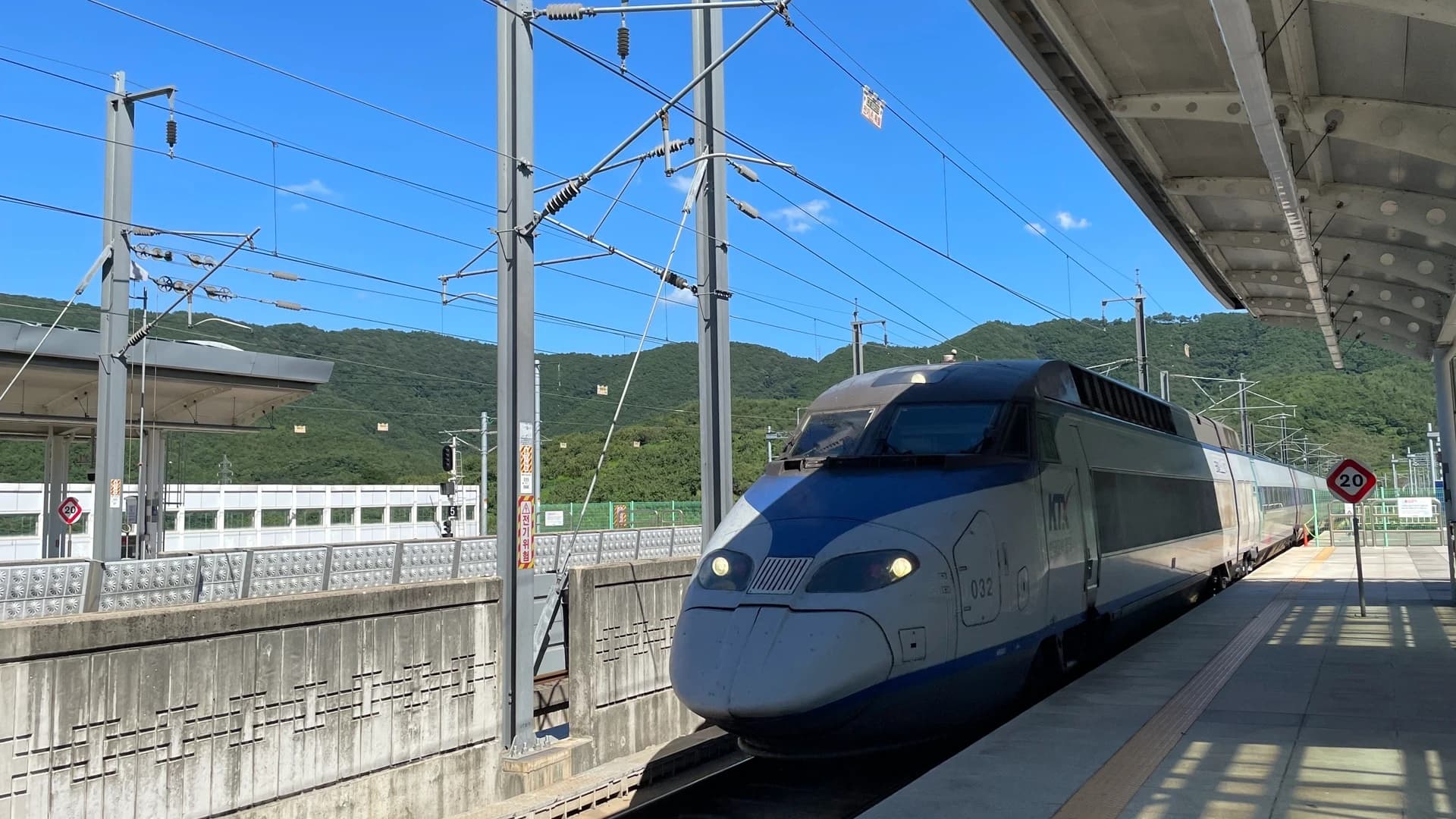
South Korea boasts a world-class long-distance transportation network. High-speed trains quickly connect major cities nationwide, while express and intercity buses reach every corner of the country, helping foreign travelers move around with ease. In this chapter, we will look at train, express bus, and intercity bus routes and features—all requiring assigned seats—as well as detailed fare systems and booking methods.
Complete Guide to Trains in KoreaProvides information on major train routes in South Korea.
1. Key Routes
Here are the essential train routes most useful for foreign travelers visiting Korea. Checking the destinations and typical travel purposes for each route will help you plan your itinerary easily.
- Gyeongbu Line (Southeastern Direction):
- Major Hubs: Seoul Station, Daejeon Station, Dongdaegu Station, Singyeongju Station, Ulsan Station, Busan Station
- Travel Purpose: The main transport axis connecting Seoul, Korea's largest city, and Busan, the second-largest city famous for its beautiful beaches. Use this line to visit Gyeongju, an ancient historic capital.
- Honam Line (Southwestern Direction):
- Major Hubs: Yongsan Station, Gwangju-Songjeong Station, Mokpo Station
- Travel Purpose: The route heading toward the Jeolla region, renowned for beautiful scenery and rich culinary culture. Use this line to reach Mokpo, the starting point for exploring the southern coast islands.
- Jeolla Line (Southern Direction):
- Major Hubs: Yongsan Station, Jeonju Station, Suncheon Station, Yeosu Expo Station
- Travel Purpose: One of the most popular tourist routes for foreign visitors, passing through Jeonju (famous for its traditional Hanok Village), Suncheon (known for its beautiful ecological park), and Yeosu (famous for its night sea view).
- Gangneung Line (Eastern Direction):
- Major Hubs: Seoul Station, Cheongnyangni Station, Pyeongchang Station, Gangneung Station
- Travel Purpose: The fastest line to reach Gangneung, a beautiful coastal city on the East Sea and a surfing hotspot, passing through the mountains of Pyeongchang, host of the Winter Olympics.
- Jungang Line (Inland Direction):
- Major Hubs: Cheongnyangni Station, Wonju Station, Jecheon Station, Andong Station, Gyeongju Station
- Travel Purpose: A scenic route offering views of deep mountain landscapes and quiet countryside in inland Korea. Convenient for visiting Andong, a historic city famous for Confucian heritage and traditional mask dance festivals.
2. Types of Trains
Trains in South Korea are systematically classified into high-speed trains, conventional trains, and metropolitan subways based on speed, purpose, and operating range.
1) High-Speed Trains
- KTX & KTX-Sancheon:
- Representative bullet trains operated by Korea Railroad Corporation (KORAIL). They connect major cities nationwide in the shortest time, linking Seoul and Busan in about 2 hours and 30 minutes. Trains are divided into spacious, comfortable First Class and Standard Class. Due to high demand, booking in advance for weekends or public holidays is strongly recommended.
- Forward vs. Backward Seating: The original KTX train model features non-swivel fixed seats, meaning there are forward-facing seats and backward-facing seats. Check seat directions carefully when booking. (Note: KTX-Eum, KTX-Cheongryong, and SRT models feature 180-degree rotating seats, so there are no backward-facing seats.)
- Family Seats (Companion Seats): Located in the center of passenger cars, these feature 4 seats arranged to face each other.
- SRT:
- High-speed trains operated by SR Co., Ltd., departing from Suseo Station in southeastern Seoul. Fares are about 10% cheaper than KTX, mainly connecting routes toward Busan (southeastern metropolis) and Gwangju/Mokpo (southwestern Jeolla region). Convenient for travelers starting near Suseo Station or the Gangnam area.
- KTX-Eum:
- An EMU (Electric Multiple Unit) high-speed train developed with Korean technology. Operating mainly toward Gangneung (east coast) and Andong (central inland), each seat is equipped with a wireless smartphone charger and power outlets for convenience.
- KTX-Cheongryong:
- Next-generation high-speed train operating at the highest speed in Korea (up to 320 km/h). Operating as an express service with minimal stops, it connects Seoul and Busan in about 2 hours and 10 minutes. It offers cutting-edge amenities like individual window frames and wireless charging facilities.
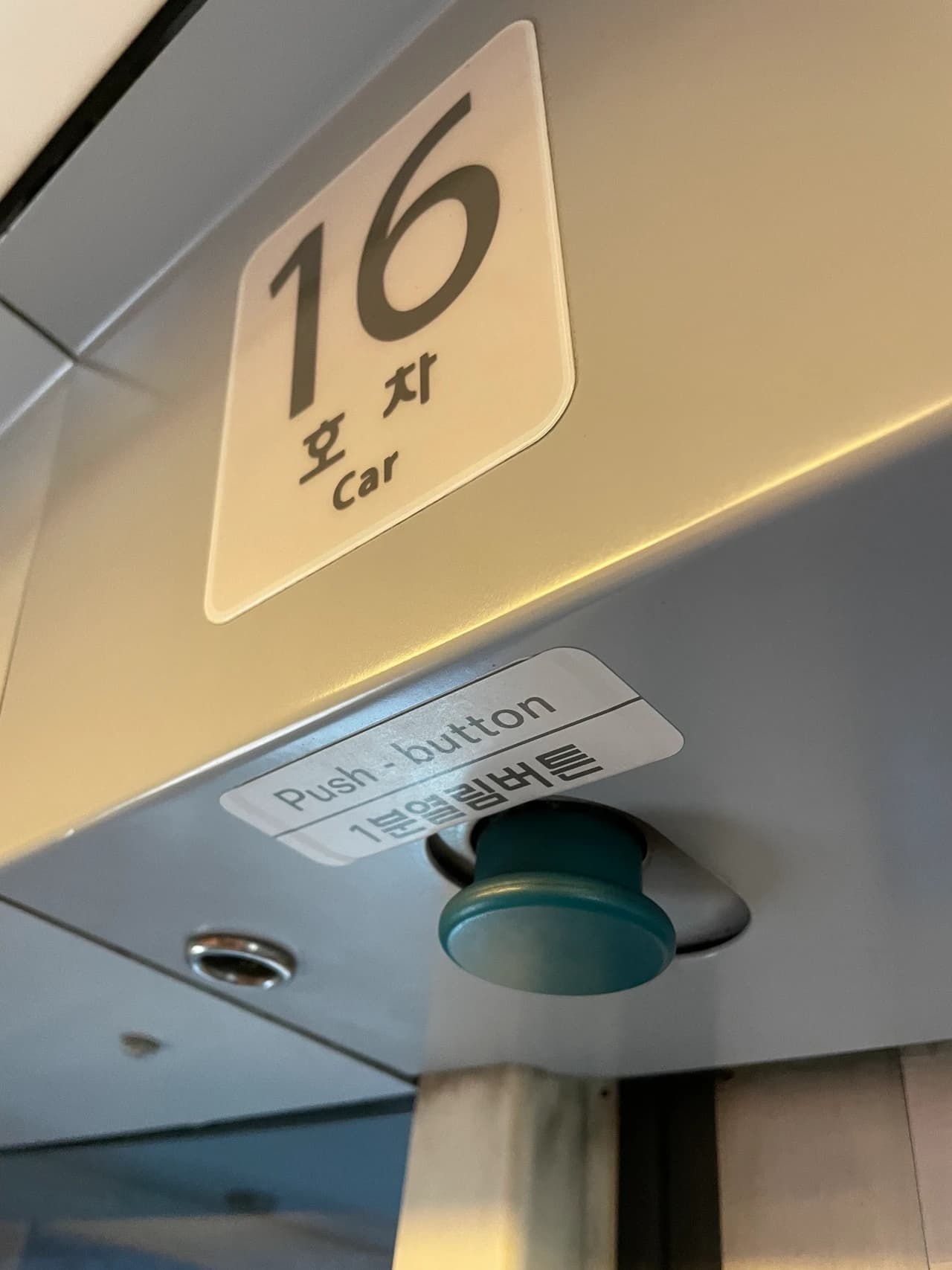
💡 Practical Tips for Operating KTX Passenger Car Automatic Doors:
- Automatic Closing When Pulling Handles: Pulling the handle on KTX aisle doors opens the door, but it automatically closes after just a few seconds.
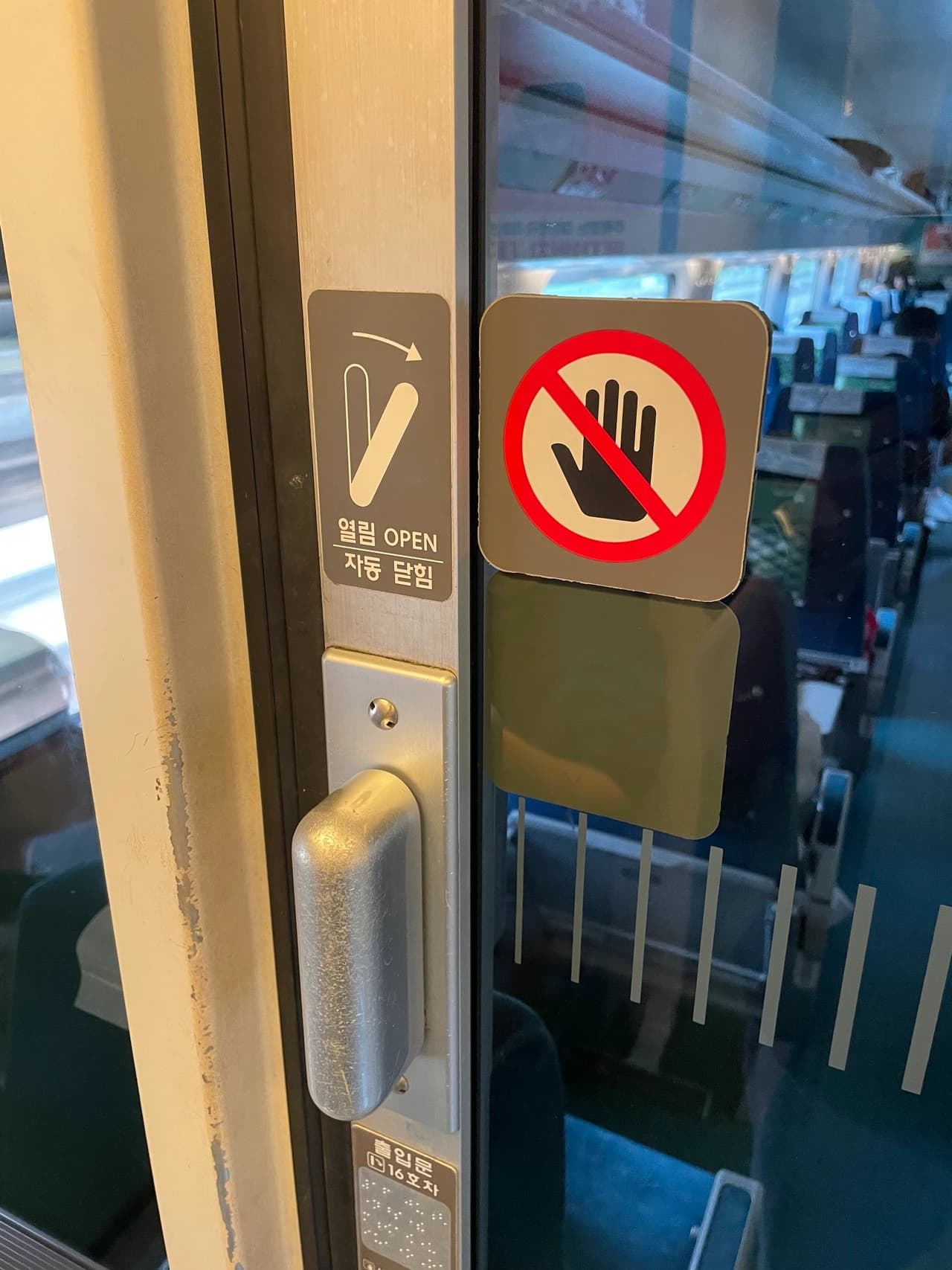
- Using the '1-Minute Open' Button: When carrying heavy luggage or at major stations with heavy passenger foot traffic, press the '1-Minute Open' button located at the top of the door frame. Pressing it holds the door open for 1 full minute without closing.
2) Conventional Trains
- ITX-Saemaeul & ITX-Maum:
- Modern, eco-friendly, high-grade conventional trains replacing older Saemaeul models. Stopping only at major hub cities, they offer relatively fast travel speeds with power outlets under seats for long journeys.
- Mugunghwa & Nuriro:
- Familiar traditional trains that have served the public for a long time. They stop at almost every railway station nationwide. Although slower, fares are very affordable, making them great for scenic, unhurried travel.
Essential Information for Train Travel:
- Booking Window: High-speed train (KTX, SRT) tickets can be booked starting at 7:00 AM, 1 month prior to the travel date via the Korailtalk app. Tickets sell out quickly for weekends and national holidays, so advance booking is essential.
- Standing Tickets & Non-Reserved Seats: If seat tickets are sold out, standing tickets or unreserved seat tickets (available on select trains) can be purchased at station ticket windows or vending machines.
3. Fare System
Unlike city subways, trains operate with designated seat reservations, applying separate fare criteria.
- Adult: Ages 13 and older. Standard passenger fare applies.
- Child: Ages 6 to 12. A 50% discount off adult fares applies.
- Infant: Under age 6. 1 infant per accompanying adult can travel for free without a separate assigned seat (held on lap).
- If an Individual Seat is Desired: If a separate seat is needed for an infant, purchase a child ticket (50% discount) to reserve a seat.
- Additional Infants: If an adult travels with more than 1 infant, child tickets (50% discount) must be purchased for each additional infant.
4. Seat Classes
Train seats in South Korea are divided into 4 class types based on fare and seating style.
- First Class & Premium Class:
- Refers to First Class on KTX or SRT, and Premium Class on KTX-Eum.
- Fares are about 30–40% higher than Standard Class, but seating arrangements are wider (3 seats per row), providing far superior legroom and seat width. First Class passengers receive complimentary bottled water and packaged snacks (cookies and nuts).
- Standard Class:
- The most common and standard seat class.
- Arranged in 4 seats per row (2+2 layout). Power outlets are located beneath seats or between windows for convenient mobile device charging.
- Unreserved Seats:
- Available only on select train lines during weekday commuting hours.
- Entire designated cars act as unreserved seating. There are no assigned seat numbers; seats are taken on a first-come, first-served basis. Fares are about 5% cheaper than Standard Class.
- Standing Tickets:
- Limited tickets sold only when all reserved seats are completely sold out.
- No seat is assigned, so passengers must stand. However, you can sit on foldable jump seats installed in the vestibules between cars if available. Fares are about 15% cheaper than Standard Class.
Exclusive TourCast Tips!
KTX Best Seat Selection & Seat Avoidance Guide
Paying a little attention to car and seat numbers when booking train tickets allows for a much more comfortable and quiet journey. Here is a guide to recommended and non-recommended seats for standard KTX trains:
- Best Value Choice (Car No. 5):
- This car was originally a First Class car converted into Standard Class, offering extra-wide legroom at regular Standard Class prices.
- All seats face forward, avoiding backward-facing seat discomfort.
- Recommended Seat: Seat 1A in Car 5 is a single standalone seat with no adjacent seat, making it the most popular choice for solo travelers.
- Seats to Avoid When Booking:
- Cars No. 1 & No. 8 (Infant Accompanied Cars): Designated cars for passengers traveling with infants, where noise and crying are more frequent. Avoid these if you prefer a quiet ride.
Note that families with infants are not restricted solely to these cars; they can book any standard car. However, Car 1 and Car 8 operate under a mutual understanding among passengers regarding child noise, making them ideal for parents wanting peace of mind. - Seats Near Restrooms (Front & Rear Rows of Each Car): High foot traffic causes noise from automatic doors opening and closing frequently; avoiding these end seats is recommended.
- Cars No. 1 & No. 8 (Infant Accompanied Cars): Designated cars for passengers traveling with infants, where noise and crying are more frequent. Avoid these if you prefer a quiet ride.
5. How to Book Train Tickets
Train tickets in South Korea can be booked or purchased via the Korailtalk mobile app or directly at train stations.
1) Official Online Booking
- KORAIL Operated Trains:
- KTX, KTX-Sancheon, KTX-Eum, KTX-Cheongryong, and conventional trains (ITX-Saemaeul, Mugunghwa, etc.) can be booked via the official KORAIL mobile app, Korailtalk.
- Multilingual services (English, Chinese, Japanese, etc.) are available for foreign travelers.
Integrated Booking Announcement (Scheduled for August 2026): Starting August 2026, KORAIL and SR booking systems will be integrated, allowing both KTX and SRT tickets to be booked together via the Korailtalk app.
2) Booking Windows & Tips
- Booking Window: Tickets can be booked online or at ticket counters starting at 7:00 AM, 1 month prior to the travel date.
- Weekends & Holidays: Tickets sell out very quickly for Friday afternoons through Sunday evenings, as well as Korean national holiday periods (Seollal, Chuseok). Book as soon as your schedule is fixed.
- Standing-by Reservation: If your desired train is sold out, you can apply for 'Standing-by' on the Korailtalk app to automatically receive assigned tickets when cancellations occur.
3) On-Site Purchases
- Ticket Counters: Tickets can be purchased directly from staff at ticket counters in major train stations nationwide using cash or credit card.
- Automatic Vending Machines: Automated ticket machines inside stations allow you to select routes and seats to print physical tickets. Multilingual screens are supported.
- On-Site Standing/Unreserved Tickets: If online seats are fully booked, limited standing or unreserved seat tickets can be purchased at station ticket counters or vending machines on the day of travel.
6. Rail Pass for Foreign Travelers (Korail Pass)
The Korail Pass is an exclusive rail pass for foreign tourists visiting South Korea, offering unlimited travel on KTX and conventional trains for a specified duration at a cost-effective price.
- Eligibility: Exclusive to foreign travelers; South Korean nationals cannot purchase or use this pass.
- Excluded Trains: SRT, urban subways, metropolitan commuter trains, and temporary tourist trains cannot be used with Korail Pass.
1) Pass Types and Prices (Select Pass)
The rates for the Select Pass, which allows you to choose valid travel days within 10 days from the start date, are as follows:
| Category | Adult (Ages 13+) | Child (Ages 6–12) |
|---|---|---|
| 2-Day Select Pass | 131,000 KRW | 66,000 KRW |
| 3-Day Select Pass | 186,000 KRW | 93,000 KRW |
| 4-Day Select Pass | 234,000 KRW | 117,000 KRW |
| 5-Day Select Pass | 275,000 KRW | 138,000 KRW |
- Infants under age 6 can travel for free up to 1 child per adult pass holder.
2) How to Use
- Purchase Pass: Install the Korailtalk app and purchase a pass in advance using passport details and a credit card.
- Seat Reservation:
- Booking Window: Seat reservations open 1 month prior to the train departure date.
- Reservation Limits: You can reserve up to 2 seats per person per day.
- Seat Class Selection: Standard Class (Economy Class) reservations are free of charge. Using First Class requires paying the price difference between Standard and First Class (50% of the First Class fee).
- Using Standing/Unreserved Seats: If seat reservations are sold out for a desired time slot, board unreserved seats or stand by carrying your valid pass and passport.
- Changing Reservations: Overlapping itineraries on the same date cannot be booked simultaneously. To change times, cancel your existing reservation before booking a new one.
- Boarding Trains:
- When boarding, you must carry your valid Korail Pass on the Korailtalk app (or printed copy), passport, and seat reservation ticket (Korailtalk screen).
- Live screens logged directly into the Korailtalk app are required; screenshot image files are not accepted as valid tickets.
3) Important Guidelines
- Refund Rules: Full refunds are available prior to the pass start date. Once the start date has passed, no refunds are given, even if unused.
- Transfer Prohibited: Passes are strictly non-transferable and can only be used by the registered passport holder. Illegal transfer or resale will incur penalty surcharges up to 10 to 30 times the fare.
- Delay Compensation Exclusion: Trains taken using a Korail Pass are excluded from delay compensation or service interruption claims.
Cost Comparison & Booking Tip: Considering a one-way Standard KTX fare between Seoul and Busan is about 60,000 KRW, a Korail Pass may not be cost-effective for short trips or single one-way journeys. Compare Korail Pass prices with standard point-to-point ticket prices based on your itinerary, especially if traveling long-distance twice or more in a day or visiting multiple cities.
7. Boarding Precautions
- Proof-of-Payment System: Train stations in South Korea operate on an open proof-of-payment system without ticket gates. Simply proceed directly to the platform and board your train with your ticket.
- Unauthorized Riding Prohibited: Conductors check seat occupancy using handheld devices onboard. Passengers without valid tickets or presenting only screenshot images will be treated as unauthorized passengers subject to heavy penalty fares. Always carry valid paper tickets or live app tickets.
- Ticket Inspection for Korail Pass & Unreserved Passengers: When traveling with a Korail Pass or unreserved tickets, your seat may show as vacant on the conductor's handheld device, making you subject to routine ticket checks. Have your Korailtalk app screen (or printed pass) and passport ready to present calmly upon request.
Express Buses and Intercity Buses
1. Express Buses
- Long-distance buses connecting major cities via expressways using the shortest routes. They make few or no intermediate stops. For long routes taking over 2 hours, buses stop once at an expressway rest area for about 15 minutes for passenger comfort. In addition to standard seats, spacious Superior and Premium buses are widely available. Tickets should be booked in advance via terminal ticket counters or mobile apps.
2. Intercity Buses
- Buses connecting neighboring cities, towns, and rural areas. Routes include local lines stopping at major intermediate terminals and direct lines running fast to destinations. Like express buses, tickets must be purchased in advance.
Essential Guidelines for Long-Distance Buses: No Onboard Restrooms & Rest Stop Tips:
- No Restrooms on Long-Distance Buses: Unlike long-distance buses in some countries, express and intercity buses in Korea do not have onboard restrooms. Be sure to use terminal restrooms before boarding.
- Remember Bus Location & License Plate at Rest Stops: Dozens of similar buses park at rest areas. Take a photo or remember your bus license plate number, parking spot, and rest stop duration (approx. 15 minutes) so you do not get left behind.
- Non-Stop Intercity Buses: Express buses stop at rest stops after traveling a certain distance, but many intercity buses run non-stop directly to their final destination without rest stops, even on long routes.
3. Fare System
Long-distance intercity buses require purchasing tickets classified by age at the time of booking, rather than using transit card taps.
- Adult: Ages 13 and older (middle school students and above).
- Notice for Youth Discounts: Youth discounts do not apply when booking online; present your passport at terminal ticket windows to receive discounts on-site. (Discount rules may vary by terminal and route.)
- Child (Elementary School): Ages 6 to 12. A 50% discount applies.
- Infant: Under age 6. Up to 1 infant per accompanying adult can travel for free when held on a lap without a separate seat. To assign a separate seat or for additional infants, child tickets (50% discount) must be purchased.
4. Baggage Regulations
Carry-on baggage allowed inside buses and checked luggage placed in lower cargo compartments follow these standards:
- Carry-On Baggage Inside Bus:
- Allowed only if the sum of 3 dimensions (length + width + height) is 115 cm or less (standard cabin size) or weighs under 10 kg.
- Checked Baggage in Lower Compartment:
- Cargo compartments accept luggage with 3 dimensions sum under 160 cm (approx. 28-inch large travel suitcase size) or weighing under 30 kg.
- Keep Valuables & Fragile Items with You:
- Fragile items, electronic devices, and valuables must always be carried with you inside the bus. Compensation for damaged or lost luggage in cargo holds can be difficult to receive under transport regulations.
5. Express Bus Booking Methods & Tips for Foreign Visitors
Korea's official integrated express bus booking service (Kobus) requires Korean phone verification or Alien Registration Cards, which can limit direct online bookings for short-term foreign travelers.
- New Official Foreigner Booking System Scheduled:
- Starting late 2026, a dedicated booking system for foreign travelers will allow overseas visitors to reserve official tickets directly on the website. (Updates will be reflected in this guide upon launch.)
- Currently Available Booking Platforms for Foreigners:
- Klook: The most convenient platform for foreign travelers to search and book express bus tickets without complex verification procedures.
- Hanpass: Allows booking via mobile app after membership registration. Note that passport-based identity verification is required, so complete registration before your trip.
- On-Site Purchases at Terminals:
- If advance booking is difficult, visit ticket counters or automated vending machines at express bus terminals on your departure day to purchase remaining tickets on-site. (Bringing a passport is recommended.)
💡 Express Bus vs. Intercity Bus Boarding Tips:
- Check Terminal Names in Advance (Most Important): In large cities (especially Seoul), Express Bus Terminals and Intercity Bus Terminals (e.g., Nambu Terminal, Dong-Seoul Terminal) are located in completely different places. Always check the exact terminal name and location on map apps as printed on your ticket.
- Check Platform Numbers: At combined terminals handling both express and intercity buses, boarding platforms are separate. Verify the platform/gate number printed on your ticket and wait at the corresponding gate.
- Route Differences (Direct vs. Intermediate Stops): Express buses run directly to destinations without intermediate stops (except 1 rest stop), whereas intercity buses often make multiple stops at smaller towns along the way. Check estimated travel times in advance.
Recommended Guides
Korea Accommodation Types and Booking Guide
Korea Public Transportation Guide

Must-Have Korea Travel Apps