This guide covers everything you need to know before flying to South Korea, from flight preparations and carry-on/checked baggage restrictions to step-by-step entry procedures upon arrival—including quarantine, immigration, baggage claim, animal and plant quarantine, customs declaration—and useful tips for a smooth departure.
Flight Preparation & Carry-On RegulationsExplains airport arrival recommendations and prohibited items for carry-on and checked baggage.
Essential safety rules to check before boarding your flight for a safe and seamless journey.
- Recommended Airport Arrival Time:
- To allow enough time for security checks and boarding procedures, it is generally recommended to arrive at the airport 2 to 3 hours before international flight departures. During peak holiday seasons, airports can be very crowded, so plan to arrive with extra time to spare.
- Prohibited Items on Board:
- Items that pose a threat to the safety of the aircraft and passengers—such as explosives, flammable materials, gases, radioactive substances, and toxic materials—are strictly prohibited in both carry-on and checked baggage.
- Liquid Regulations for Carry-On Baggage:
- Carry-On Baggage: Liquids must be in individual containers of 100ml or less and placed together in one transparent, sealable plastic bag of 1 liter or less (limit of 1 plastic bag per person).
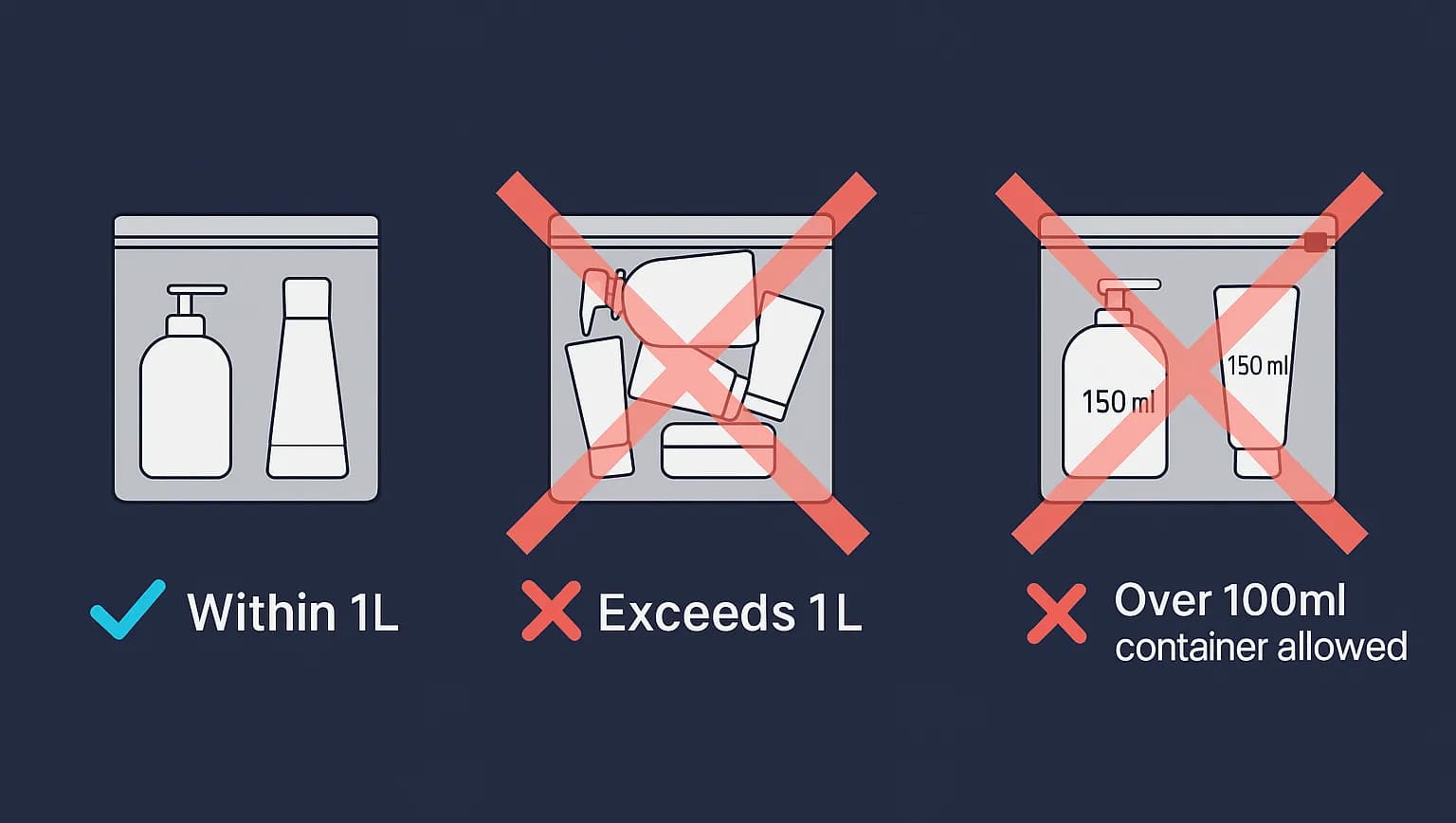
Only containers under 100ml in a 1-liter plastic bag are allowed on board - Checked Baggage: Standard liquids (beverages, alcohol, liquid cosmetics, etc.) have no quantity limits when placed in checked baggage, as long as they stay within the airline weight limits. However, toiletry items or cosmetic sprays (aerosols) are limited to 500ml per individual container and a total of 2kg (2L) per person. As specific policies may vary slightly by airline, travelers are advised to check the latest regulations directly on the airline website before boarding.
- Carry-On Baggage: Liquids must be in individual containers of 100ml or less and placed together in one transparent, sealable plastic bag of 1 liter or less (limit of 1 plastic bag per person).
- Battery Regulations:
- Power banks for smartphones or laptops and spare lithium-ion batteries pose a fire risk and must never be placed in checked baggage. They must be carried with you on board as carry-on baggage.
- Rules by Capacity and Quantity:
| Lithium Battery Capacity | Carry-On Standard (Per Person) | Airline Prior Approval Required |
|---|---|---|
| 100Wh or less | Up to 2 items allowed | Not required (Allowed by default) |
| Over 100Wh to 160Wh | Required (Prior approval needed) | |
| Over 160Wh | Not allowed | Prohibited in carry-on and checked baggage |
- Short-Circuit Prevention Required: To prevent short circuits caused by exposed terminals, short-circuit protection must be applied, such as attaching insulating tape to terminals or storing items in individual plastic bags.
- Onboard Regulations: For aircraft safety, using or charging devices with power banks is strictly prohibited inside the cabin. Storing power banks in overhead bins is also restricted, so keep them in seat pocket containers or carry them on your person.
South Korea Entry ProceduresOutlines the flow of arrival processes from entering the airport to exiting the gates: quarantine, immigration, baggage claim, animal/plant inspection, and customs.
Essential steps to go through upon arriving at a South Korean airport before exiting the arrival hall.
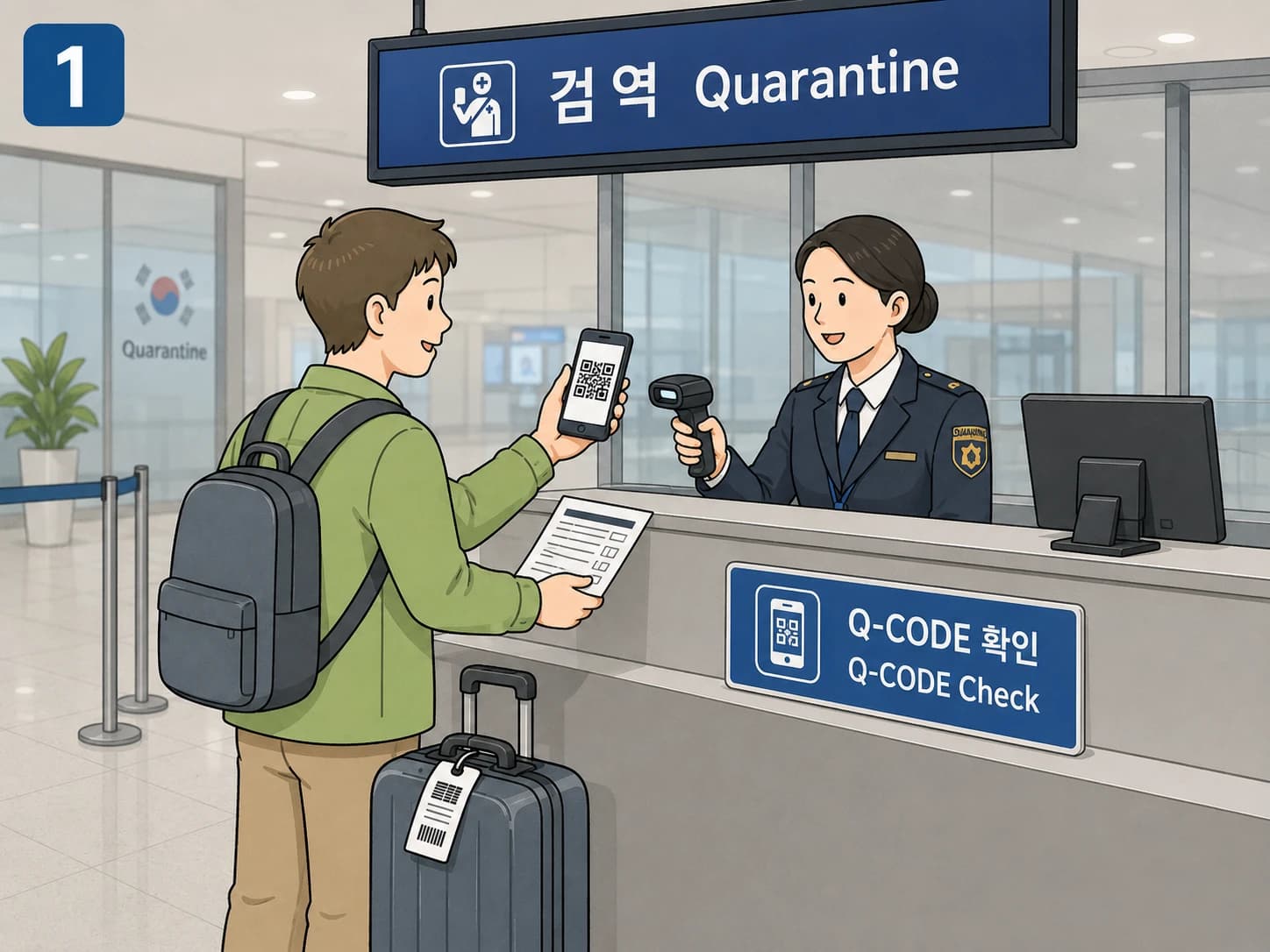
1. Quarantine (Q-CODE Check)
A quarantine step conducted for travelers entering South Korea to prevent the inflow of infectious diseases.
- Quarantine Process: Present the QR code from the Q-CODE (Quarantine Information Pre-entry System) issued online before departure, or submit the paper Health Declaration Form filled out on the plane.
- If you have not stayed in or transited through a quarantine inspection area and have no related symptoms, you do not need to register a Q-CODE separately.
- For details on online registration and target region criteria, please refer to the South Korea Pre-departure Guide: Q-CODE section.
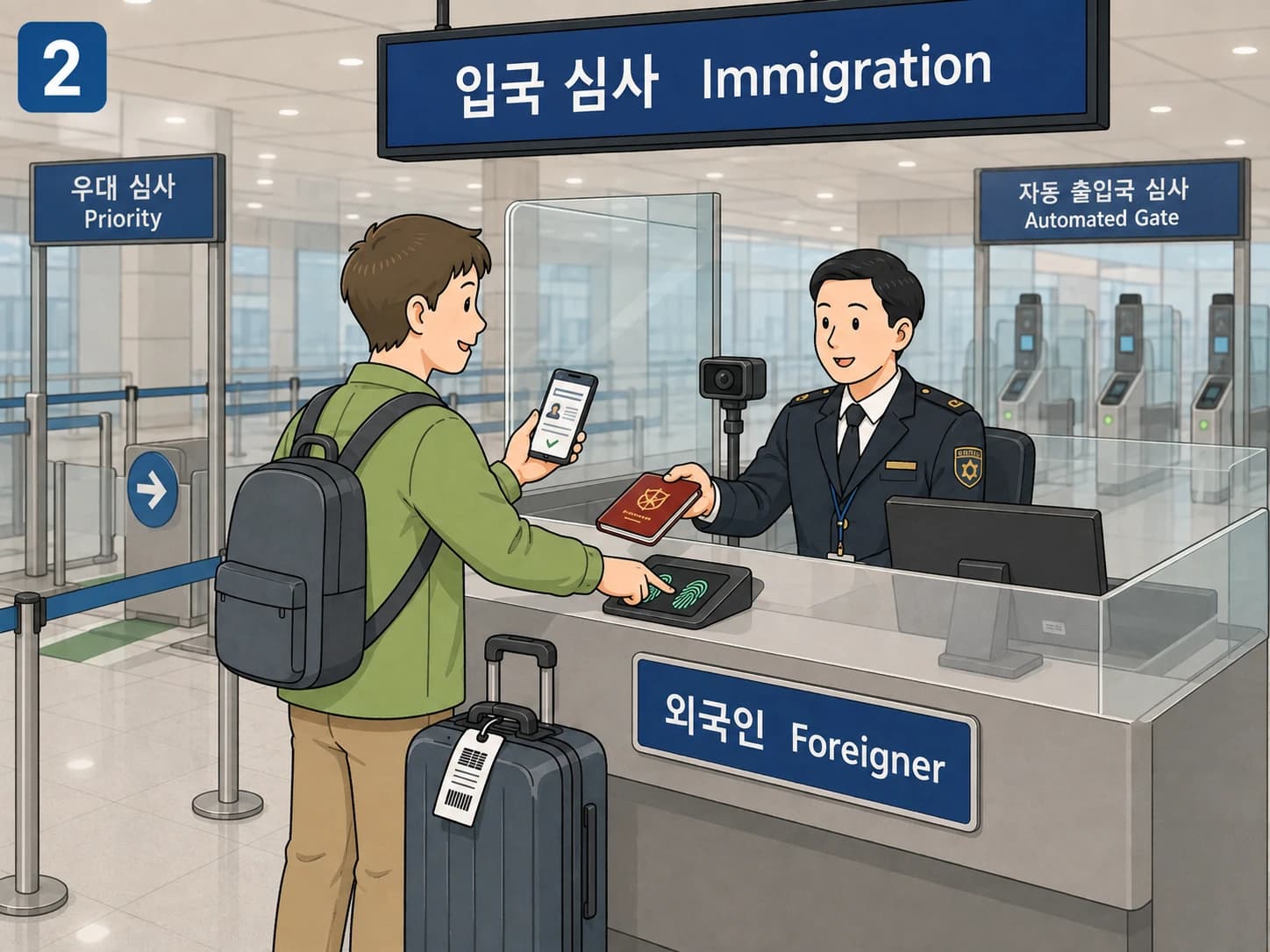
2. Immigration Check
After passing through the quarantine checkpoint, proceed to the immigration area.
- Waiting Area: Foreign tourists visiting South Korea for short-term travel for the first time cannot use the Automated Immigration Gates upon initial entry. Therefore, you must queue at the general face-to-face immigration line for 'Foreigners'. (However, you can use the Automated Immigration Gates when departing Korea at the end of your trip).
- Documents Required: Present your passport and pre-arranged e-Arrival Card screen (or printout) to the immigration officer.
- Passengers with approved K-ETA do not need to submit a paper arrival card and only need to present their passport.
- Fingerprint and Facial Information Registration: Under South Korean Immigration Law, foreign visitors aged 17 or older must register index fingerprints from both hands and facial photo information.
- Priority Line Eligibility: Children under 7 years old, pregnant women, persons with disabilities, and seniors aged 70 or older can pass through the priority immigration lane quickly along with up to 4 companions.
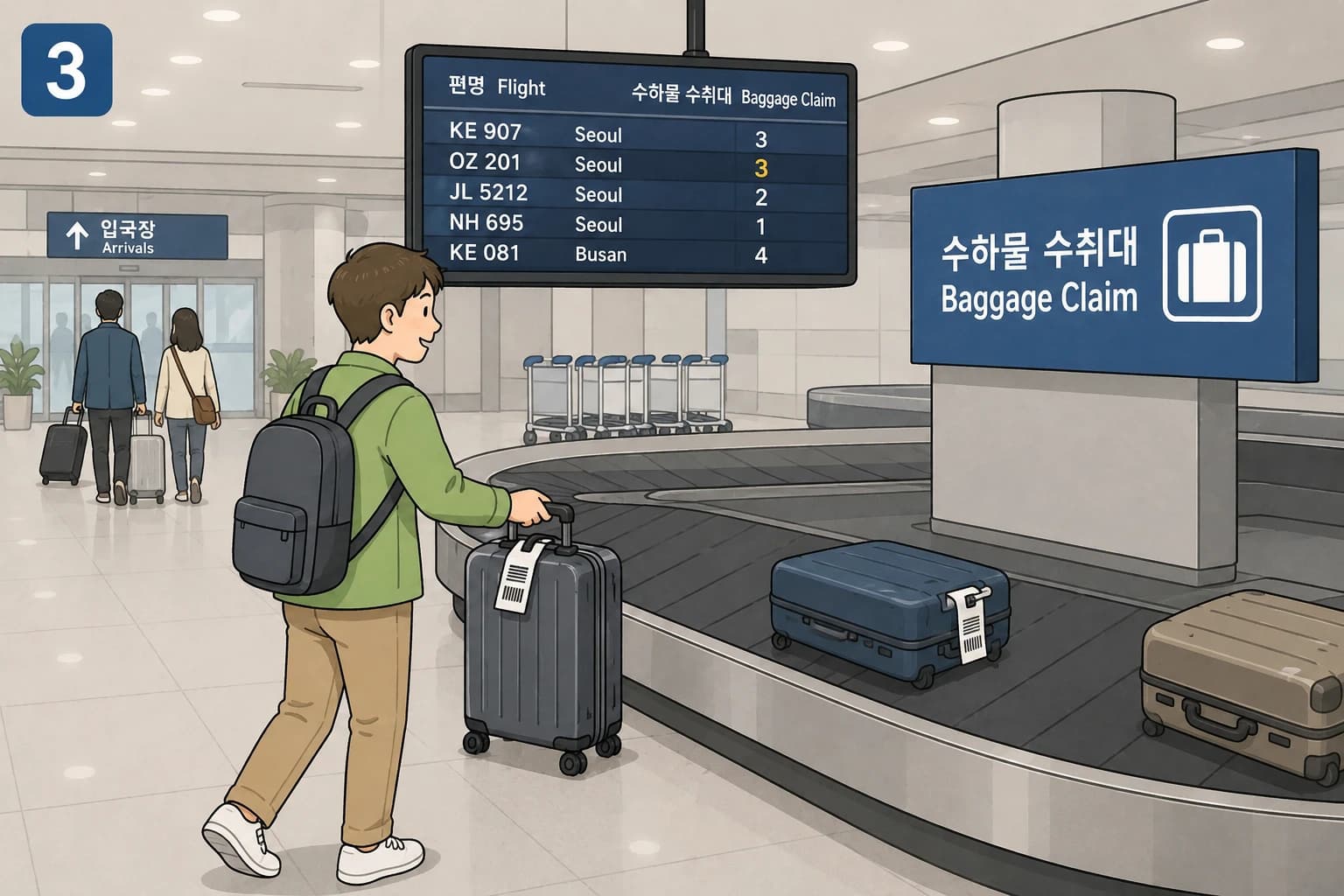
3. Baggage Claim
After completing immigration inspection, check the information display boards for your flight number and proceed to the designated Baggage Claim carousel to collect your luggage.
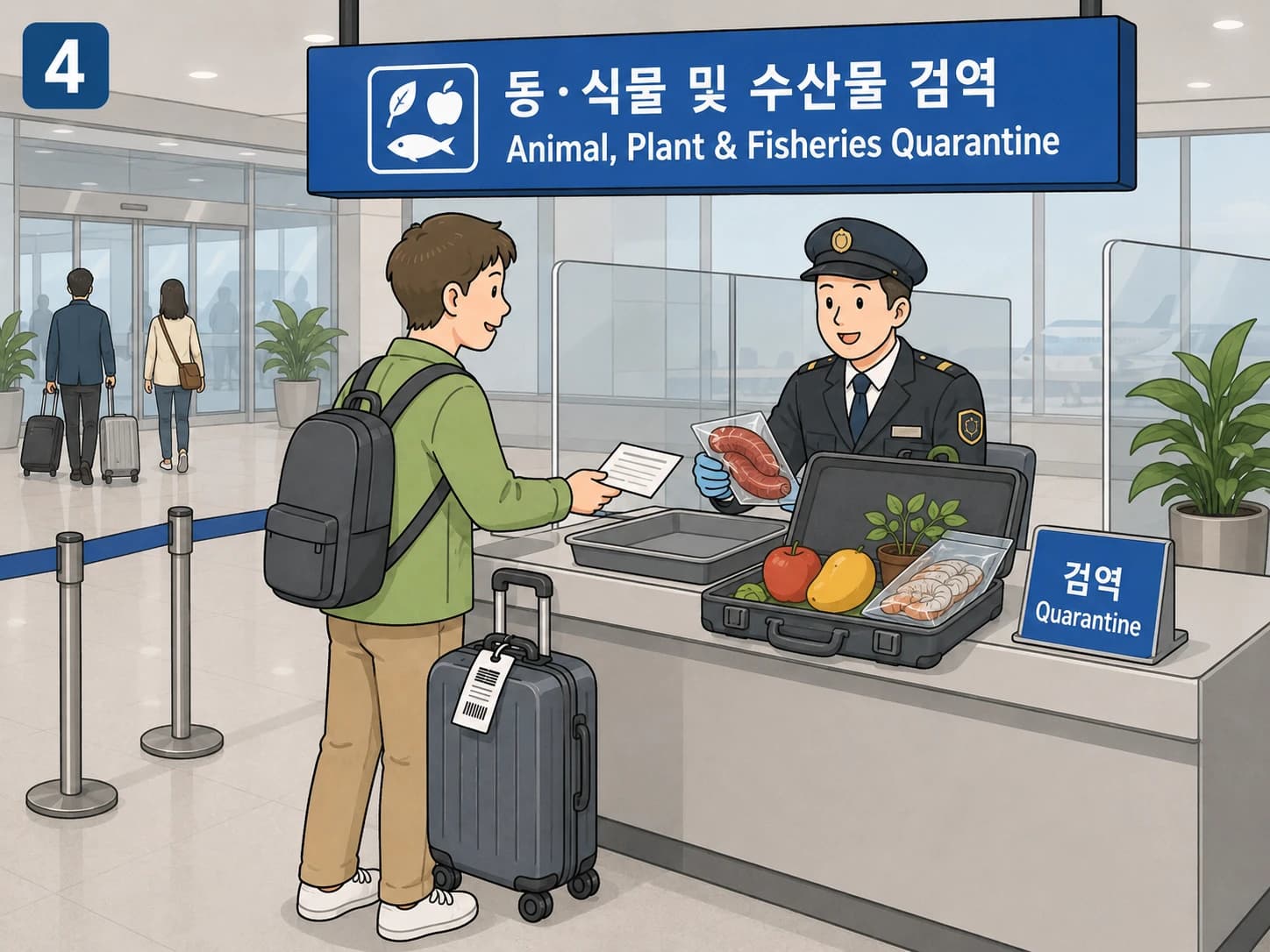
4. Animal, Plant, and Aquatic Product Quarantine
If carrying agricultural products, processed foods, or aquatic products into the country, you must undergo inspection to prevent the entry of domestic livestock diseases and exotic pests.
- Animal and Livestock Quarantine:
- Items to Declare: Raw meat (beef, pork, chicken, etc.), processed meat products (sausages, ham, jerky, dumplings, canned meat, etc.), dairy products (milk, cheese, butter, etc.), live pets (dogs, cats, etc.).
- Required Documents: An Animal Quarantine Certificate issued by the government of the departing country must be attached.
- Restrictions: Animals and livestock products produced in import-prohibited countries are strictly banned from entry. Anyone who has visited livestock farms must avoid contact with livestock for at least 5 days after entry.
- Plant and Agricultural Quarantine:
- Items to Declare: Live plants, fresh fruits, vegetables, seeds, seedlings, bulbs, mushrooms, timber, traditional herbal medicines, etc.
- Restrictions: All fresh fruits and fruit vegetables (apples, mangoes, peppers, etc.) are banned in principle due to concerns over infectious crop pests.
- Exemptions: Processed plant products that have been cooked at high temperatures or hygienically packaged are exempt from plant inspection.
- Wild Animals Such as Reptiles: When bringing in live reptiles (snakes, lizards, turtles, etc.) or related leather products, you must make a verbal declaration to the officer or system to obtain a 'Wild Animal Import Quarantine Certificate'. (Animals listed under CITES international protection require a separate permit from the Ministry of Environment.)
- Aquatic Product Quarantine:
- Items to Declare: All live aquatic products (ornamental fish, general fish, shellfish, crustaceans, amphibians, etc.) and chilled or frozen abalone, oysters, and shrimp. Check the item on your customs declaration form, make a verbal report to an aquatic product quarantine officer, and submit a separate declaration form.
- Restrictions: Live aquatic organisms such as fry, seed shellfish, or eggs that could be used for aquaculture or release are banned from entry. Fully cooked or fully dried processed aquatic products are exempt from quarantine.
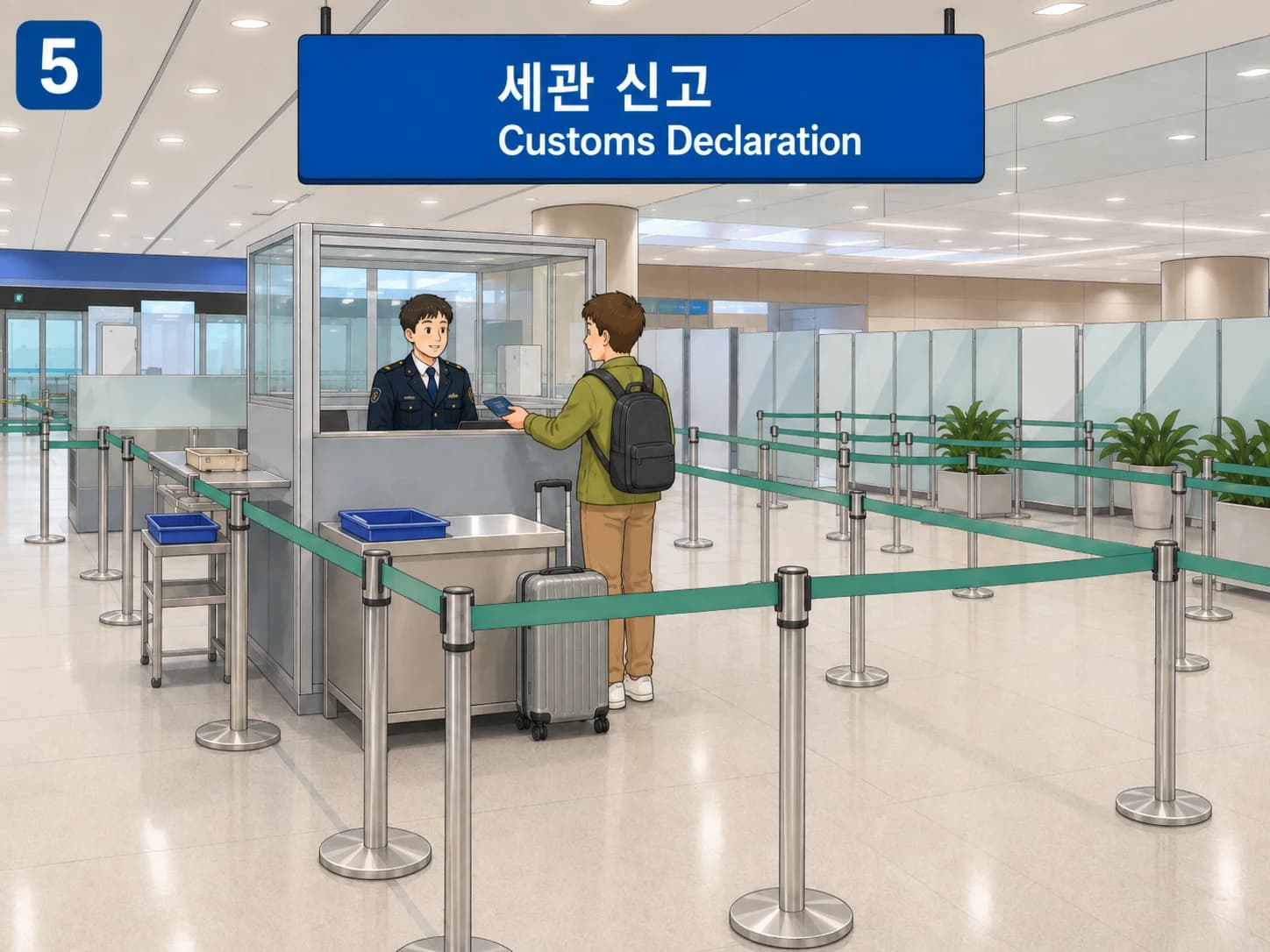
5. Customs Declaration
After clearing quarantine, you will undergo final customs screening. South Korea operates a voluntary declaration system for travelers carrying items that exceed the standard duty-free allowance.
- Basic Duty-Free Allowance:
- Total up to USD $800 per person (based on the total value of items purchased overseas or at domestic/international duty-free shops, or received as gifts).
- Separate Duty-Free Limits (Applied in addition to the basic $800 allowance):
| Item | Duty-Free Limit Standard | Notes & Restrictions |
|---|---|---|
| Alcoholic Beverages | Up to 2 liters in total, and total value under USD $400 | Minors under 19 are excluded from duty-free allowances |
| Tobacco | Choose 1 option: 200 cigarettes (10 packs), 50 cigars, or 30ml liquid e-cigarettes | Minors under 19 are excluded from duty-free allowances |
| Perfume | Total volume of 100ml or less | No limits on quantity or type; only volume limit applies |
- Voluntary Declaration and Mobile Declaration:
- Travelers with no goods exceeding the duty-free allowance can walk straight through the customs exit without writing or submitting a paper declaration form.
- Family members belonging to the same household can submit a single combined declaration through one representative family member.
- Taxation Regulations on Minors for Alcohol and Tobacco: As of 2026, duty-free benefits for alcohol and tobacco apply only to persons born in or before 2007. If a minor born in or after 2008 brings in alcohol or tobacco, customs duty will be charged in full regardless of the quantity.
- Online Voluntary Declaration: Using the Korea Customs Service mobile app or web portal allows you to complete voluntary declaration forms conveniently before arriving at the airport.
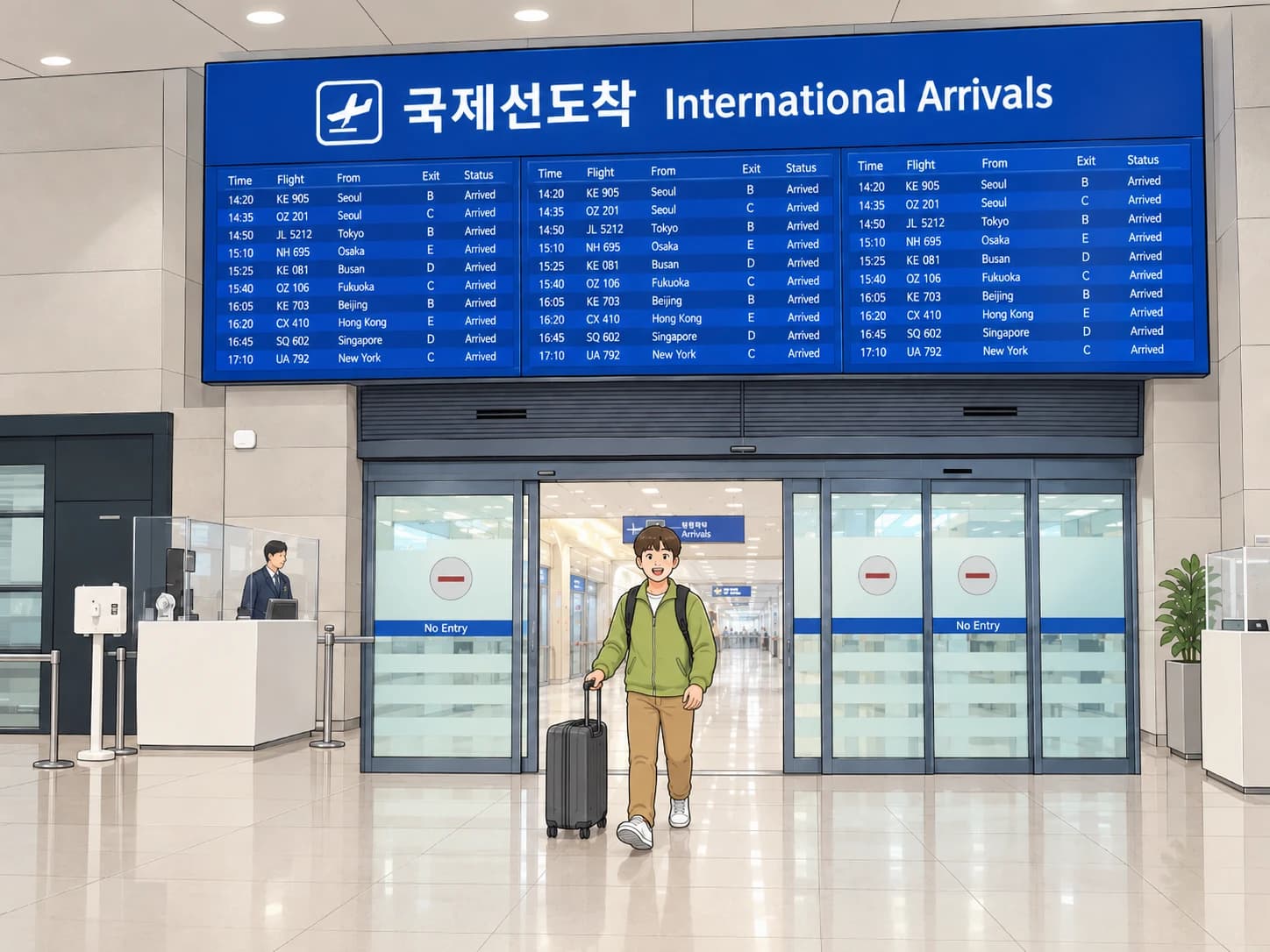
6. Exit to Arrival Hall
Once you clear the customs desk and enter the arrival hall (exit gates), all arrival procedures for South Korea are complete.
Departure TipsProvides information on the Smart Entry Service (SES) useful when departing South Korea.
Useful information to keep in mind when exiting South Korea at the end of your trip.
- Smart Entry Service (SES) Usage Guide:
- Foreign short-term visitors aged 17 and older register their biometric information (fingerprints and facial photo) at the immigration desk upon arrival in South Korea.
- If this registration is completed successfully upon entry, you can immediately use the Automated Smart Entry Service (SES) gates at the airport upon departure without any separate prior application.
Recommended Guides

South Korea Entry Preparation Guide (Passport, Visa, K-ETA, Q-CODE)
Korea Gateway Airports and Entry Guide
Korea Travel Essentials and Checklist