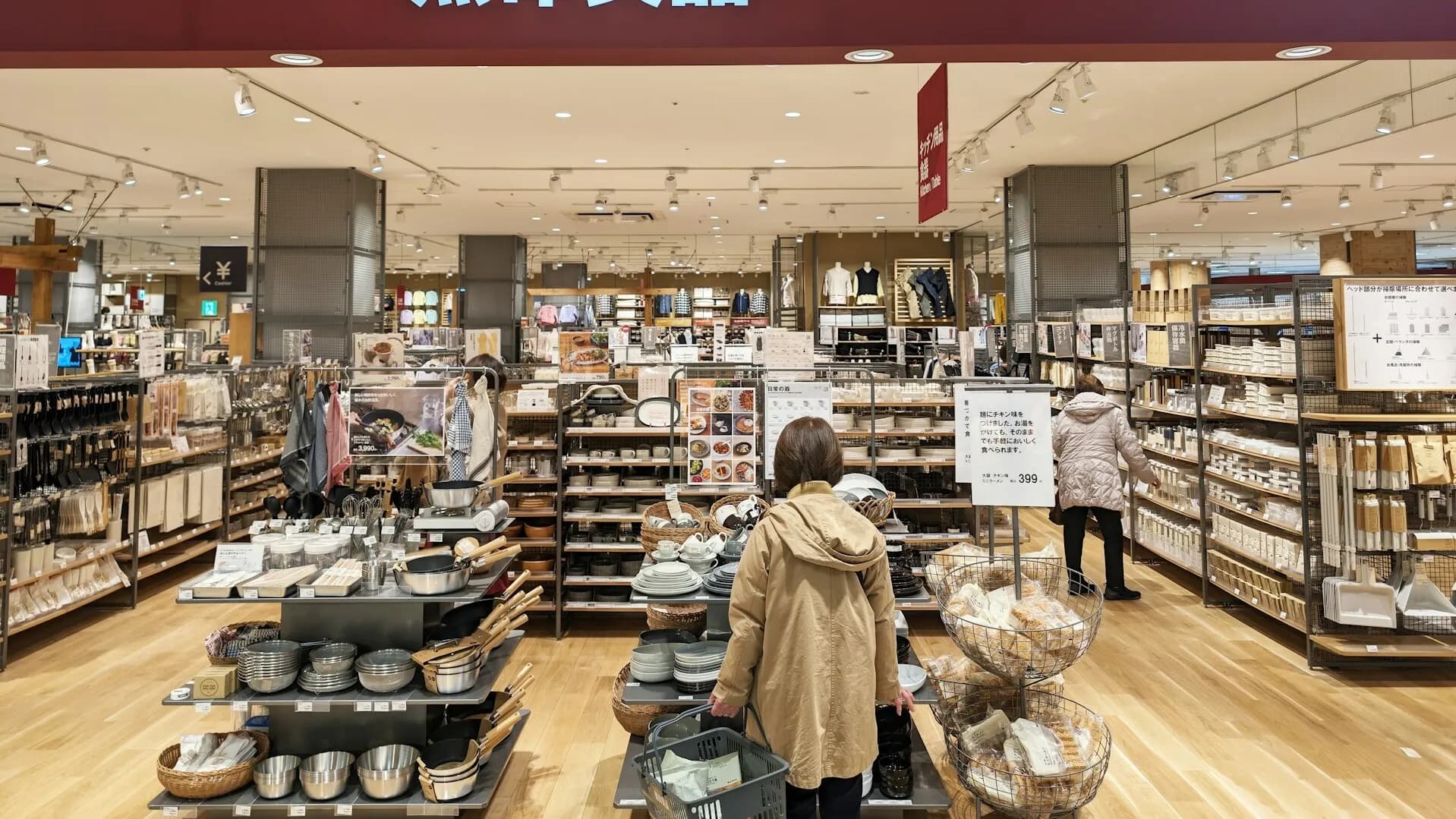
Consumption TaxWhy is convenience store bread 108 yen? The secret of Japan tax system
In countries with tax-included pricing, you pay only the displayed price.
In Japan, however, prices are usually shown without tax, and the product price and consumption tax are displayed separately.
- 税抜き (zei-nuki): price without tax — usually shown in large text
- 税込 (zei-komi): price with tax included — usually shown in smaller text
Japan’s standard consumption tax rate is 10%, and this tax is added at checkout.
1) Consumption tax on food
For example, if you buy bread for 100 yen at a convenience store, is the final price 110 yen? 🤔
Japan has a reduced tax rate system. For daily necessities (food and drinks, excluding alcohol and dine-in meals), the tax rate is reduced to 8%.
So the final price is 108 yen.
However, if you eat the bread inside the store, the tax changes.
Eating inside is considered dining-in, and the 10% tax rate applies. Staff may stop you if you try to eat inside with takeout tax.
Because the reduced rate applies only to takeout, most convenience stores do not allow eating inside.
2) Cafés and fast food
Eat-in: 10% tax
Takeout: 8% tax
When ordering, it is important to clearly tell staff where you will eat.
Exclusive TourCast Tips!
Alcohol purchase age, beer types, and expiry date labels
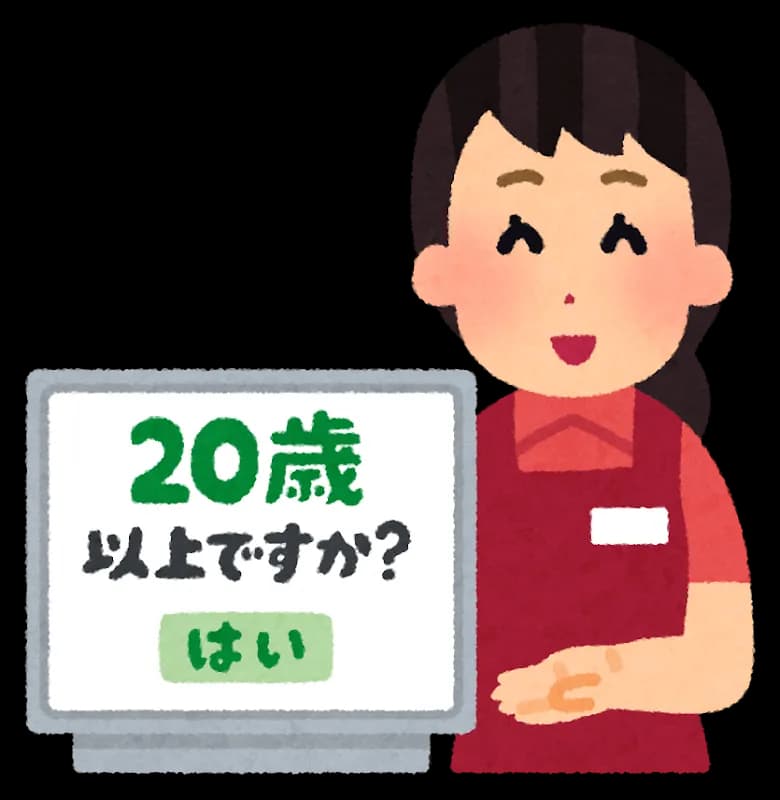
- Buying alcohol and cigarettes in Japan
- Allowed from age 20. At convenience stores, you must press 'Yes' on the age confirmation screen.
- How to identify Japanese canned beer types
- ビール (Beer): 67% or more malt, regular beer
- 発泡酒 (Happoshu): less than 67% malt, made with other grains
- リキュール / 新ジャンル: beer-flavored drinks without malt
- Liqueur and Happoshu are cheaper and easy to confuse. Always check the can label.
- Difference between expiry dates
- 消費期限 (Use-by date): safe consumption limit — cannot be sold or eaten after this date
- 賞味期限 (Best-before date): recommended for best taste — can be eaten after the date
- It is important to check the Japanese labels
Tax-Free ShoppingFrom convenience stores to department stores, a complete Japan tax-free guide
In Japan, Tax Free means you do not pay the 10% consumption tax.
However, not all stores offer tax-free service. Only stores with a Tax Free or Tax Refund sign can provide it.
If your single purchase is 5,000 yen or more (before tax), you can get tax-free service by showing your passport.
If you are not sure, ask: “Tax-free desu ka?” (Is it tax-free?)
Are convenience stores tax-free?
Some convenience stores offer tax-free service under the same conditions.
- Not all convenience stores offer tax-free, so check in advance
- You pay the full price first, then receive a refund
- Tax-free packaging may take 10–15 minutes
- Consumables (cosmetics, snacks, etc.) must not be opened
- In Japan, tax-free is valid only on the same day at the store where you purchased (From November 2026, airport refund system is planned)
- Tax-free items cannot be exchanged or refunded
- Some medicines such as 'Pabron Gold A' and 'EVE' contain small amounts of controlled ingredients. Check import rules of your country.
Exclusive TourCast Tips!
Tax-Free Shopping Checklist
- Tax Free vs. Tax Refund
- Some stores deduct a handling fee (about 1.55%)
- Minimum purchase amount at one store
- General goods vs. consumables
- Department store discount coupons
- Keep all receipts
Tax Free: Pay without consumption tax at checkout
Tax Refund: Pay full price first, then get a refund at a separate counter
At department stores, Tax Refund is common. Card refunds may take up to 2 weeks.
You must spend at least 5,000 yen at the same store on the same day.
Plan shopping and buy everything at once.
General goods: watches, clothes — can be used in Japan
Consumables: cosmetics, snacks, medicine — must remain sealed until departure
Example: General goods 3,000 yen + consumables 2,500 yen → total is valid, but all items must remain sealed
Department stores listed in the TourCast app offer discounts without extra coupons
Other stores require a guest coupon from the information counter
When declaring at customs in your home country, without receipts, you must declare at full price.
Customs DutyJapan duty-free limits at a glance
Japan duty-free allowance on entry is as follows.
If you exceed these limits, you must declare at customs and pay duty.
1) Entering Japan
- Other goods: up to 200,000 yen
- If total per item type exceeds 200,000 yen: only the excess is taxed
- If one item exceeds 200,000 yen: the full value is taxed
- Alcohol: 3 bottles (760 ml per bottle)
- Total allowance is up to 2,280 ml
- Example: two 1,000 ml bottles are within allowance
- Perfume: 2 oz (about 56 ml) for parfum
- Eau de toilette and eau de cologne are counted as other goods
- Tobacco:
- Cigarettes: 200 sticks
- Heated tobacco: 10 packs
- Cigars: 50
- Other tobacco: 250 g
Customs duty when entering Japan
- Alcohol per liter
- Whisky, brandy: 800 yen
- Rum, gin, vodka: 500 yen
- Liqueur: 400 yen
- Shochu: 300 yen
- Wine, beer: 200 yen
- Tobacco
- 15 yen per cigarette
- Other goods vary by item
2) Entering your home country
Duty-free limits for entering Japan and for returning to your home country are different.
Check your country’s rules before shopping.
Exclusive TourCast Tips!
Perfume duty-free rules
In Japan, only Parfum is duty-free up to 2 oz (56 ml). Eau de parfum and eau de toilette are counted as other goods.
Example: Two bottles of 100 ml eau de toilette → duty-free when entering Japan
Customs DeclarationComplete guide to customs declaration before entering Japan
1) Entering Japan
- Fill in the “Declaration of Personal Effects and Unaccompanied Articles” form by hand, or register immigration and customs declaration on the Visit Japan Web site.
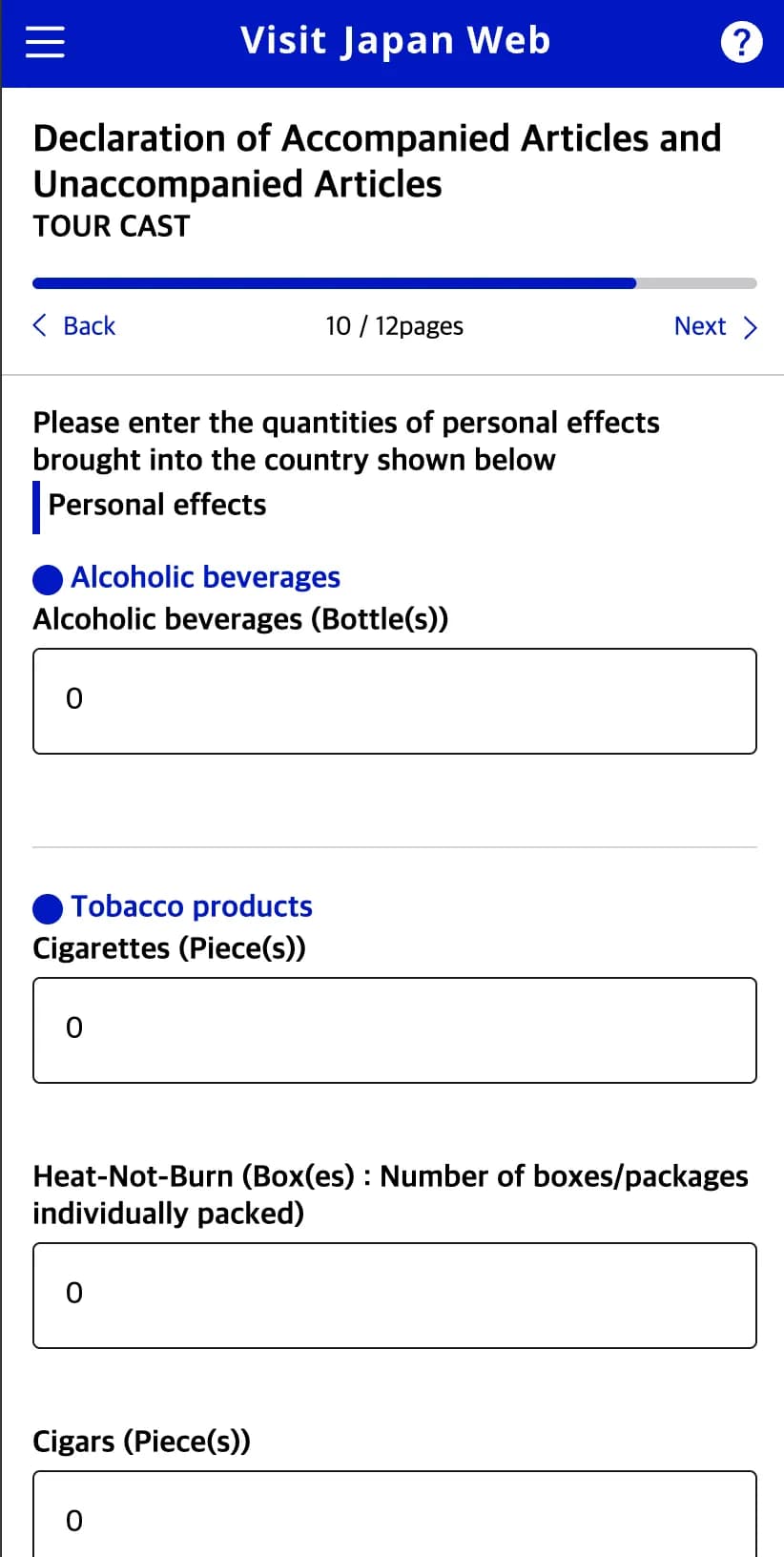
Example exceeding duty-free allowance
- Example: Whisky (760 ml) ×3, brandy (700 ml) ×1, 600 cigarettes, perfume 1 oz, clothes 50,000 yen, watch 150,000 yen, handbag 80,000 yen, ring 120,000 yen → taxable
- Items exceeding the duty-free limit are taxed when entering Japan. If there are multiple items of the same type, only the lowest-taxed item is taxed.
- Alcohol tax calculation
- One bottle exceeding the allowance is taxed.
- Only the lowest-taxed bottle (here, brandy) is taxed.
- 800 yen / L × 0.7 L = 560 yen
- Amounts under 100 yen are rounded down → tax payable is 500 yen
- Alcohol tax: 500 yen
- Tobacco tax calculation
- Cigarettes exceeding allowance are taxed by quantity.
- Excess quantity: 400 cigarettes
- 15 yen × 400 = 6,000 yen
- Tobacco tax: 6,000 yen
- Perfume duty-free rule
- If not parfum, perfume is counted within duty-free goods.
- In this example, perfume is not taxed.
- Other goods tax calculation
- Tax is based on overseas purchase price and duty rate.
- Items with higher tax are counted first for duty-free allowance.
- Here: handbag 80,000 yen (15%) + ring 120,000 yen (15%)
→ total 200,000 yen is duty-free - So only clothes (50,000 yen) and watch (150,000 yen) are taxable.
- Only 60% of overseas price is used as taxable value.
- Clothes duty calculation (50,000 yen)
- 50,000 × 0.6 = 30,000 yen
- 30,000 × 15% = 4,500 yen
- Watch tax calculation (150,000 yen)
- 150,000 × 0.6 = 90,000 yen
- 90,000 × 7.8% = 7,000 yen (consumption tax)
- 7,000 × (22 / 78) = 1,900 yen (local consumption tax)
- 7,000 + 1,900 = 8,900 yen
Watches are not subject to customs duty,
but 10% consumption tax and local consumption tax. - Total tax summary
- Alcohol tax: 500 yen
- Tobacco tax: 6,000 yen
- Customs duty (clothes): 4,500 yen
- Consumption tax (watch): 8,900 yen
- Total: 19,900 yen
- Taxes are charged by item type. The total amount is paid at airport customs.
- If you fill out the paper declaration form, list all purchased items as shown below.
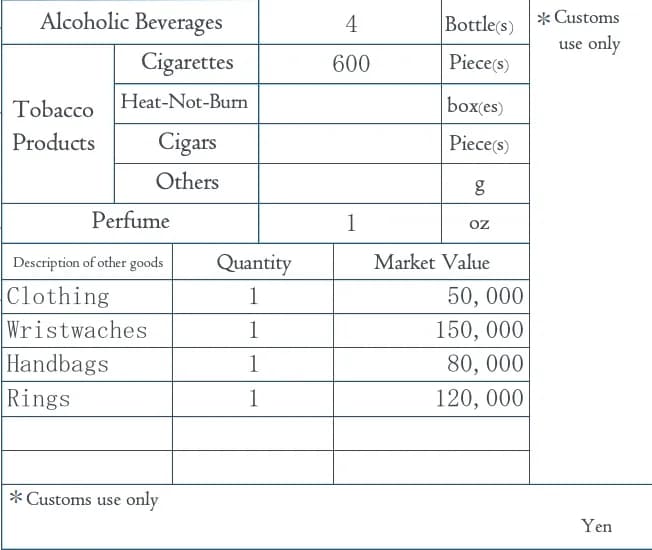
2) Entering your home country after travel
- If your shopping exceeds your country’s duty-free limit, declare at customs and pay the required duty.
Exclusive TourCast Tips!
What if a minor brings alcohol or tobacco to Japan?
In Japan, alcohol and tobacco can be purchased only from age 20. If a person under 20 enters Japan with alcohol or tobacco, all items are taxable regardless of quantity.
Tobacco is taxed at 15 yen per cigarette. For 200 cigarettes, you must pay 200 × 15 yen = 3,000 yen.