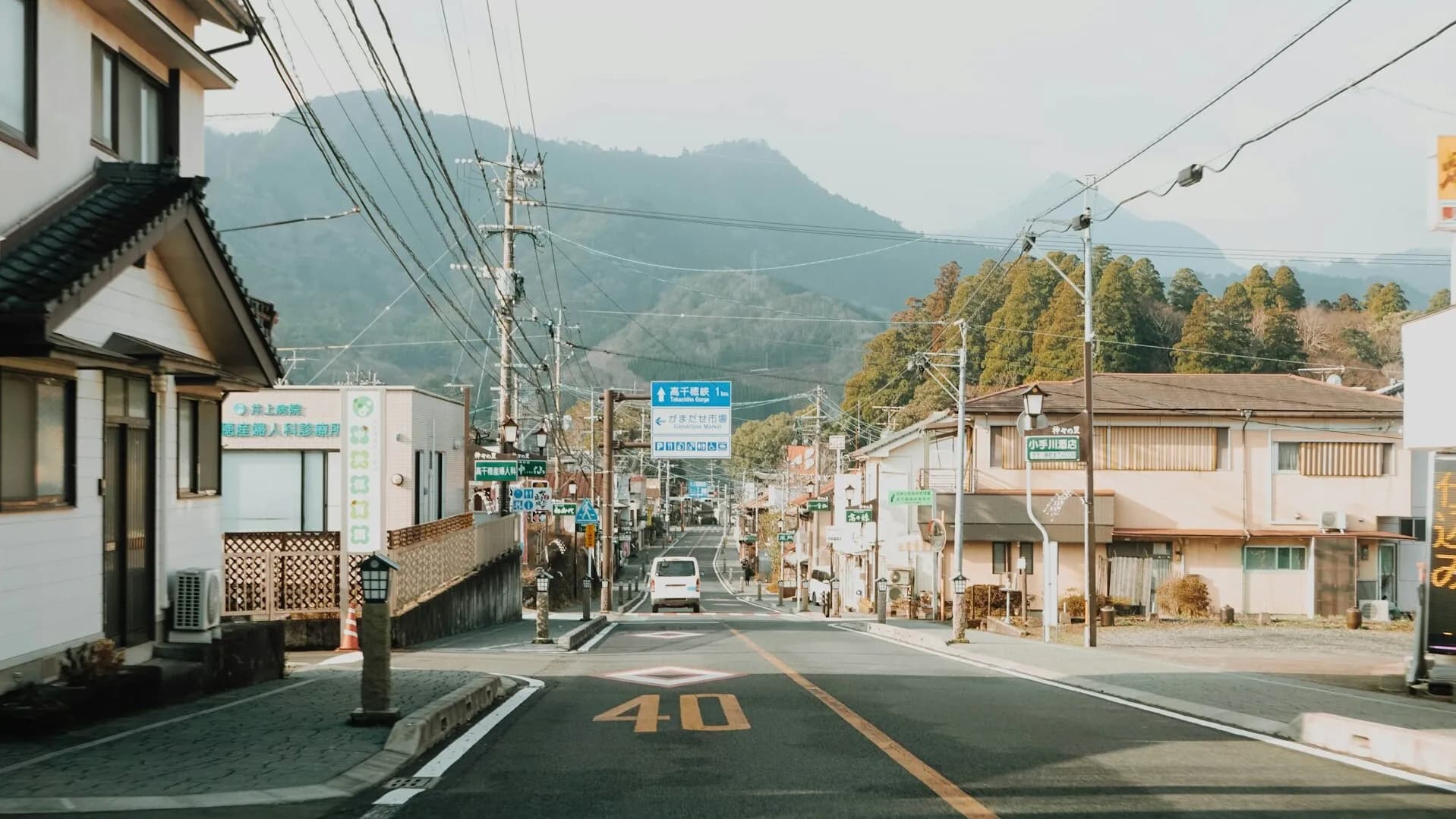
Japan Rental Car Travel Guide: From Booking to Safe Driving RulesExpand your journey with a rental car to reach places difficult for public transport
In many cases, suburban tourist attractions in each region are difficult to reach via public transport due to distance. Furthermore, if you are traveling with elderly family members like parents or grandparents, moving according to strict train or bus schedules can be challenging. In these situations, using a rental car is an excellent alternative.
- Cost Efficiency: Rental car costs are highly competitive compared to purchasing transport passes for several people, making it especially advantageous for group travel.
- Flexible Itinerary: You can manage your schedule flexibly by adjusting travel times and routes yourself.
- Keep Left Warning: In Japan, the driver's seat is on the right, and vehicles drive on the left. After an initial adjustment period of about an hour, you will be able to drive safely.
💡 Why is the driver's seat on the right (driving on the left) in Japan?
- Samurai Culture: Most samurai in the Edo period were right-handed and carried their swords on their left waist. Walking on the left became a fixed habit to prevent scabbards from clashing when passing others on the road.
- Introduction of British Technology: When Japan's first railway was constructed in 1872, British technology and systems were introduced, naturally solidifying the left-hand traffic system. This standard then carried over to road traffic when automobiles became widespread.
Essential Requirements for Renting a Car in JapanCheck international license, passport, and credit card
In Japan, renting a vehicle with only your domestic license is not possible; an International Driving Permit (IDP) is mandatory. If even one of the following documents is missing, you will not be able to rent a car on-site, so be sure to check before your departure.
1. Mandatory Document List
- Passport (Original): Required for identity verification.
- International Driving Permit (IDP, Booklet type): Must be valid for one year from the date of issuance. It must be issued in advance by your home country's license issuing authority (DMV, automobile registration office, etc.) before departure.
- Original Domestic Driver's License: Even if you have an IDP, you must bring your original domestic license as well.
- Credit Card in Driver's Name: Required for the security deposit; use of check or debit cards may be restricted. The name on the card must match the English name on the passport.
💡 International Driving Permit (IDP) Issuance Guide
- You can obtain this at your local driving license center, automobile registration office, or authorized agency.
- In Japan, only IDPs based on the 1949 Geneva Convention are valid. Please verify validity before departure.
- Check the expiration date (1 year from issue) and ensure it does not expire during your trip.
⚠️ Precautions for Motorcycle Rentals
To rent a motorcycle in Japan, your IDP must have an authorization stamp in Category A (Motorcycle License). A standard car license does not grant Category A authorization; you must hold a separate motorcycle license.
Booking a Rental Car: Fail-proof CheckpointsCheck vehicles, insurance, and return conditions thoroughly
When booking a rental car, insurance and options are as important as the price. Choose the safest conditions possible, considering Japan's unfamiliar road environment.
- Insurance Choice (Highly Recommended): We recommend choosing Full Cover Insurance that waives not only the deductible (CDW) but also the NOC (Non-Operation Charge), which is the compensation for lost business while the car is being repaired.
- ETC Card Rental: This is Japan's electronic toll collection system. If you plan to use highways, be sure to add the ETC card rental option when booking. Tolls are settled at the rental office upon return.
- Vehicle Size: Japanese compact cars are generally quite narrow. It is more comfortable to choose one class higher than you think you need, considering the 'number of adults + number of suitcases.'
- 9-Seater Warning: To drive a vehicle with 9 or more seats (such as a Toyota Hiace), you need a Large Vehicle License from your home country. A standard passenger car license is not sufficient, so verify with the rental company before booking.

💡 Detailed Comparison of Rental Car Insurance Items
| Insurance Item | Coverage |
|---|---|
| Liability / Personal / Property | Coverage for third-party injury/property damage and driver's own bodily injury (usually included). |
| CDW (Collision Damage Waiver) | Reduces the deductible (out-of-pocket cost) to 0 yen in the event of an accident. |
| NOC (Non-Operation Charge) | Waives the business loss fee paid to the rental company when the vehicle needs repair due to an accident. |
| JAF (Emergency Assistance) | Towing and roadside assistance for emergencies like flat tires, dead batteries, or lost keys. |
Warning Against Violating Japanese Traffic LawsImmediate punishment for violations of phone use, signals, speed, and stop lines
Japan is extremely strict regarding traffic violations, and fines and penalties are high. The following items are the most common mistakes made by foreign drivers, so be sure to memorize them.
1. Zero Tolerance & Immediate Enforcement Items
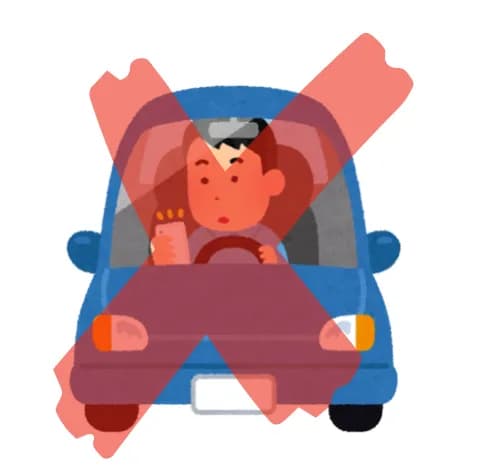
- Using a Phone While Driving: Both holding a phone in your hand or staring at the screen are strictly prohibited. Navigation must be used with a mount. Touching a phone while driving is grounds for immediate enforcement.
- Drunk Driving: Penalties are severe. Criminal liability extends not only to the driver but also to the person who provided the alcohol and the passengers.
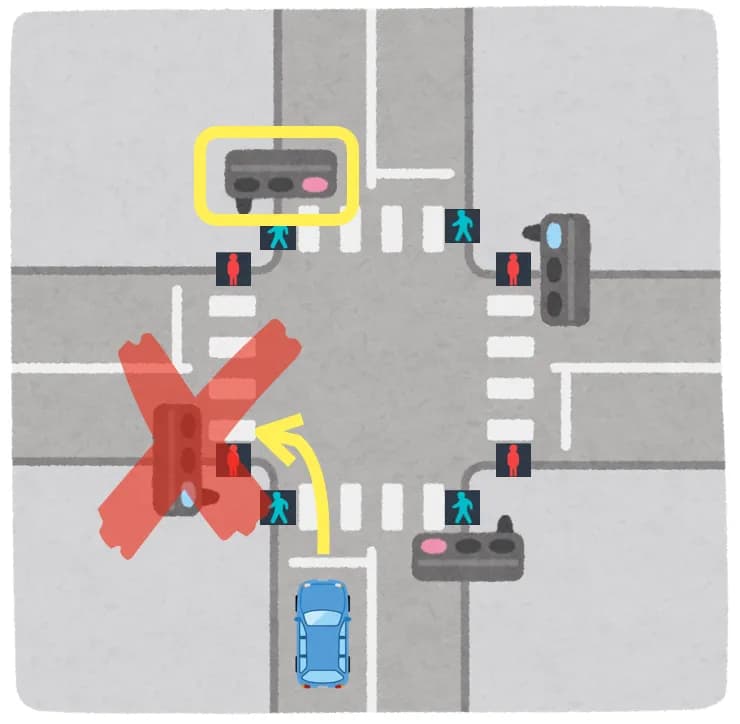
- Traffic Signal Violations: In addition to running red lights, turning left on a red light is strictly prohibited in Japan. You must only move on a green light.
2. Common Mistakes by Foreigners
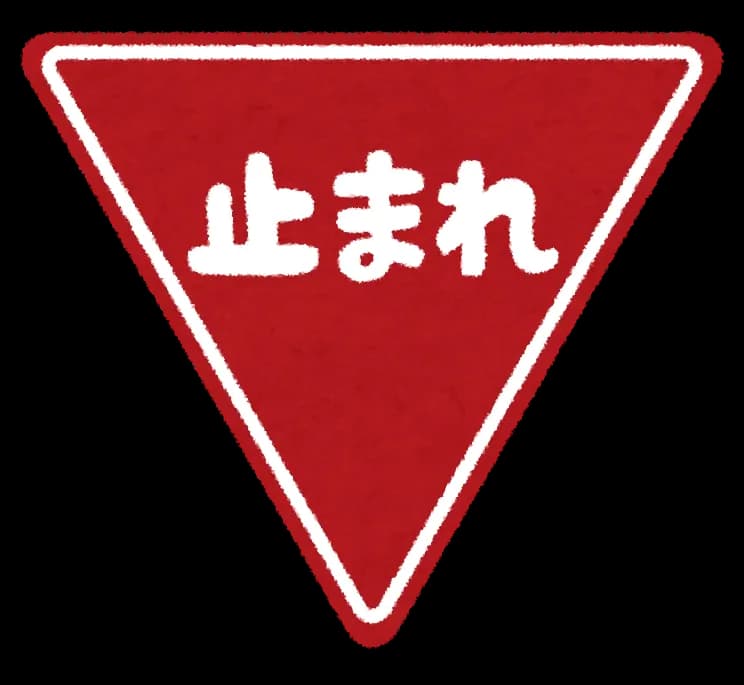
- Tomare (止まれ, Stop): At a red inverted triangle sign, you must come to a complete stop for at least 3 seconds and check both ways. Crawling (moving slowly) is not considered a stop.
- Railway Crossings: Even if the barrier is not down, you must stop momentarily immediately before the tracks to verify safety.
- Seat Belts for All: Wearing seat belts in all seats, including the back, is mandatory. Children under age 6 must use a car seat.
3. Driving Etiquette and Other Precautions
- No Honking: In Japan, horns are rarely used unless the car in front doesn't move after a signal change. Unnecessary honking can be viewed as road rage or a violation.
- Bus Lanes: Be careful of bus-only lanes marked with solid yellow lines in urban areas, as standard vehicles are prohibited during specific times.
- Pedestrian Priority: If a pedestrian is standing at a crosswalk without a signal, the basic rule is to stop and yield.
4. Speed Limit Guide by Section
| Road Type | General Speed Limit | Notes |
|---|---|---|
| Urban Residential/Commercial | 30 – 50 km/h | Watch for pedestrians and bikes |
| Suburban National Roads | Up to 60 km/h | Always check local signs |
| Expressways (Highways) | 80 – 100 km/h | 80 km limit is common in Okinawa |
⚠️ Warning on Criminal Penalties: Exceeding the speed limit by 30 km/h or more (40 km/h on expressways) can lead to imprisonment or heavy fines rather than a simple ticket, and your international permit may be suspended.
❄️ Driving in Snowy Regions: In areas with heavy snow like Hokkaido or Tohoku, ensure your car is equipped with studless tires (winter tires). If you are poorly prepared during an icy road accident, the driver's negligence will be considered significantly higher.
Key Rules for Safe Driving in JapanComplete understanding of the signal system and lane rules in a left-hand traffic environment
The most confusing parts for drivers in Japan are the 'unprotected turns' and the 'signal system.' We've summarized the key rules you must learn to prevent accidents in a left-hand traffic environment.
1. Crossing Traffic (Right Turns Across the Center Line)
Japanese roads are relatively lenient regarding right turns that cross the center line.
- Crossing Allowed: On straight roads without signals, making a right turn across a solid or dotted center line to enter a building or alley on the opposite side is generally permitted.
- Precaution: Always maintain a sufficient following distance, as the car in front may suddenly stop in the middle of the road to wait for a right turn.
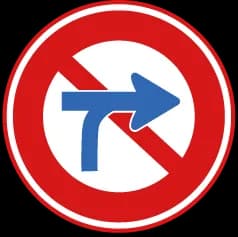
- Prohibited Crossing: It is strictly forbidden where 'No Road Crossing' signs like the one below are present.
2. Reading Traffic Lights (Red vs. Green)
The most frequent mistake by foreign drivers is 'turning left on a red light.'
- Red Light: Must stop completely. Unlike some countries, turning left on a red light is strictly prohibited in Japan. You must wait for the green light.
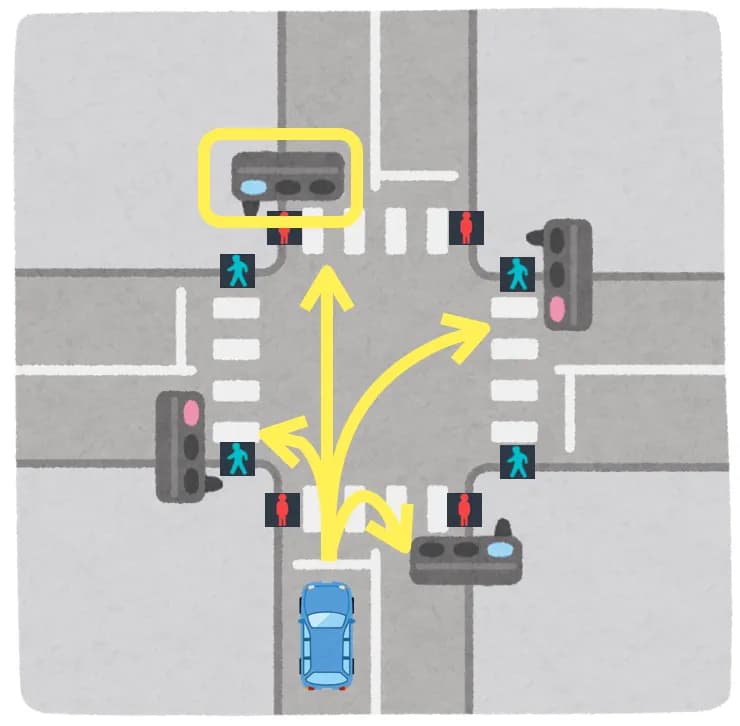
- Green Light: Basically allows straight, left turn, and right turn (unprotected). U-turns are allowed unless a 'No U-turn' sign is present.
3. Tips for Left and Right Turns
- Left Turn: A left turn in left-hand traffic is similar to a right turn in right-hand traffic countries. However, the pedestrian signal is often green, so you must stop before the crosswalk to check for pedestrians.
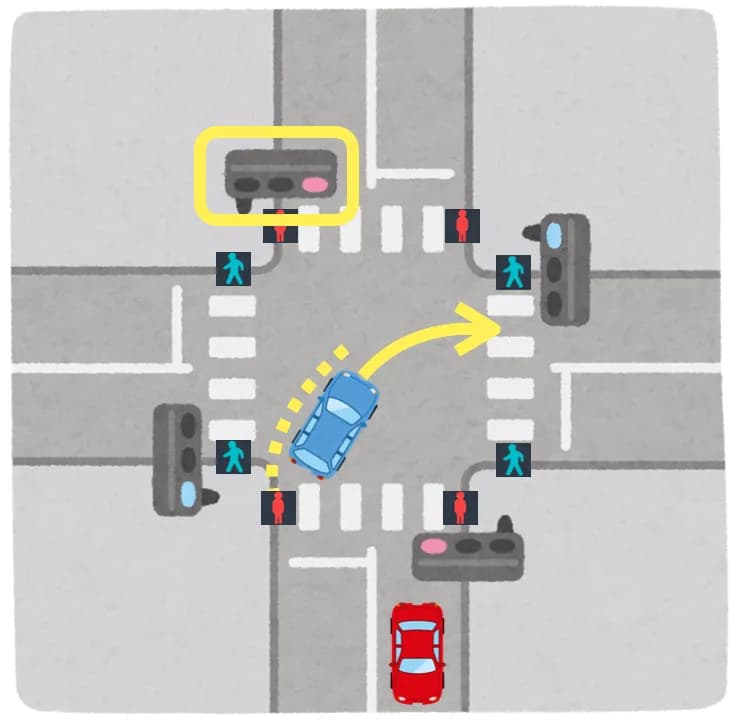
- Right Turn (Unprotected): On a green light, you may turn right if there is no oncoming traffic. The standard procedure is to enter the right-turn auxiliary line (waiting zone) in the center of the intersection. If the light turns red while you are already in the waiting zone, you can quickly complete your turn.
4. Auxiliary Arrow Signals
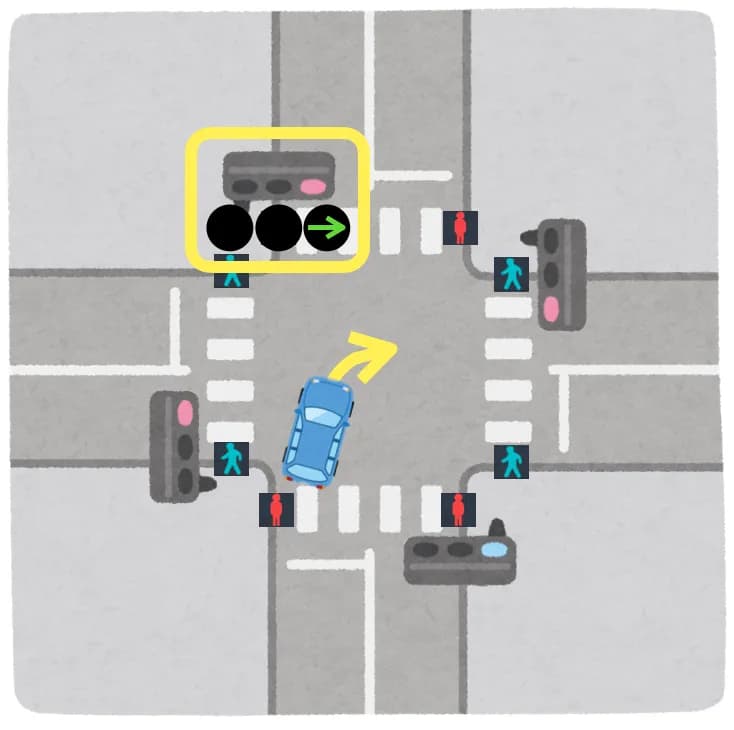
Even if the main signal is red, you may proceed in the direction indicated if a green arrow is lit below.
- Usually, straight or left/right arrows light up sequentially, guaranteeing priority in that direction.
5. Lane and Expressway Rules
- Solid Orange/White Lines: Overtaking is prohibited, but 'crossing' to enter a building is allowed.
- Dotted White Lines: Overtaking is permitted.
- Expressway Passing Lane: On Japanese expressways, Lane 1 (the furthest right lane) is for overtaking only. After passing, you must return to the left cruising lane; driving continuously in the passing lane is a punishable offense.
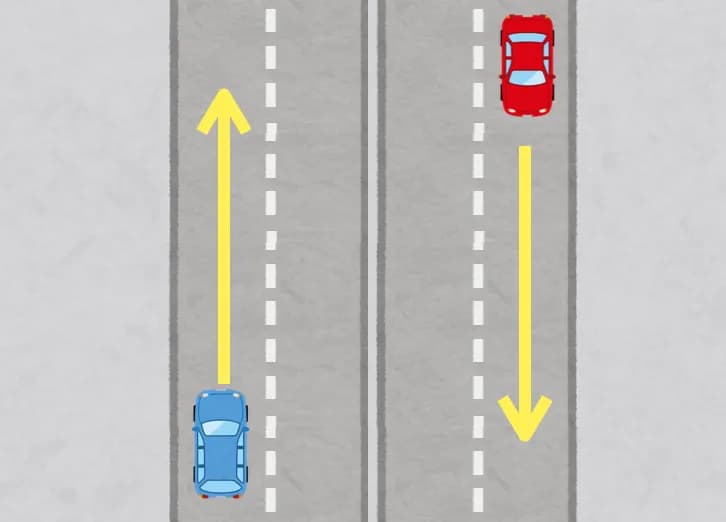
⚠️ U-Turn Warning: In Japan, you can U-turn on a green light at an intersection unless a 'No U-turn' sign is present. However, oncoming traffic and pedestrians have priority, so proceed with extreme caution.
Must-Check Items Before Picking Up Your Rental CarCheck for scratches, fuel type, and navigation language settings
A rental car trip starts with a thorough vehicle inspection. Since the driver's seat is on the right in Japan, you need to pay closer attention to everything from vehicle condition to control operations.
1. Vehicle Pickup and Handover Procedure
- Requirements: You must bring your Passport, International Driving Permit (IDP), original domestic license, and booking voucher.
- Pickup Service: Often, you check in at an airport counter and take a dedicated shuttle to the nearby rental office.
- Delay Notification: If you will be late due to flight delays, you must notify the office in advance. Unnotified delays may be treated as a No-Show, resulting in cancellation.
2. Vehicle Inspection Checklist
- Exterior and Interior Check: Verify existing scratches or damage with the staff and take photos or videos of the entire vehicle. Unidentified scratches could become your responsibility upon return.
- Confirm Fuel Type: You must confirm whether the car takes Gasoline (Regular) or Diesel. Misfuelling may not be covered by insurance.
- Navigation Settings: Request to change the language settings to English or your preferred language. In Japan, searching for destinations using Mapcodes or phone numbers is very convenient; it's helpful to learn how to use them.
- Learn the Controls: Because the seat is on the right, the turn signal (right hand) and wipers (left hand) are opposite to right-hand traffic countries. The accelerator and brake pedal positions remain the same.
3. Refueling and Return Rules
- Full to Full: You receive the car with a full tank and must return it with a full tank.
- Keep Your Receipt: After refueling at a station near the return location, you must keep the fuel receipt and present it to the staff upon return.
📛 Prevent Wrong-way Driving! Most Common Accident Situations
- Left Small, Right Large: It is a frequent mistake to turn right at a complex intersection and accidentally enter the far-right lane (wrong-way). Always remember to stay on the left.
- Always turn left tightly and turn right broadly.
- Center Line Reference: Since you are sitting on the right, driving with the feeling that your right shoulder is aligned with the center line will help prevent the car from drifting too far to the left.
🆘 What to do in Case of Accident or Breakdown
- Reporting is Mandatory: Even for minor scratches, you must report to the Police (110) and obtain an Accident Certificate to receive insurance benefits.
- In Case of Injury: Call 119 immediately for an ambulance.
- Language Barrier: Ask nearby locals for help or contact your national embassy/consulate emergency number for translation assistance. Save these numbers before you fly.
- Contact the Rental Office: After notifying the police, you must also inform the rental car office of the accident.
Japanese Parking Culture and Fine RegulationsReverse parking customs, how to use coin parking, and penalty precautions
Japan has some of the strictest parking regulations in the world. The environment is highly organized, and penalties for illegal parking are very high.
1. Basic Parking Etiquette and Knowledge
- Reverse Parking Standard: Due to limited space, reverse parking is the standard custom for safety when exiting.
- Illegal Parking Fines: Fines usually range from 15,000 yen to 18,000 yen.
- Rental Car Handling: If you do not pay the fine yourself and leave it to the rental company, they may charge handling fees totaling 25,000 yen to 30,000 yen or more. It is more economical to visit a police station and pay voluntarily immediately.
2. How to Use Coin Parking (Automated Lots)
This is the most common form of parking in Japanese urban areas. Many use a locking flap system on the floor.
- Entry: Reverse into an empty spot (indicated by '空' on the sign).
- Locking: After about 3–5 minutes, a locking flap (plate) will automatically rise under the car.
- Payment: Before exiting, enter your parking spot number into the payment machine (精算機) and pay the displayed amount.
- Exit: Ensure the locking flap has fully lowered before driving away. (Driving off while the flap is still partially up can damage the vehicle's undercarriage.)
3. Precautions for Reading Rate Signs
Misreading the kanji on signs can lead to a 'fee bomb.'
- 最大料金 (Maximum Rate): A system where you pay a fixed amount regardless of duration within a certain period.
- 1回限り (One-time only): Means the maximum rate applies only once upon entry. If you leave it until the next day, standard rates may be added on top, resulting in a large bill.
- 夜間最大 (Night Maximum): A maximum rate that applies only during specific night hours (e.g., 20:00–08:00). It does not apply during the day.
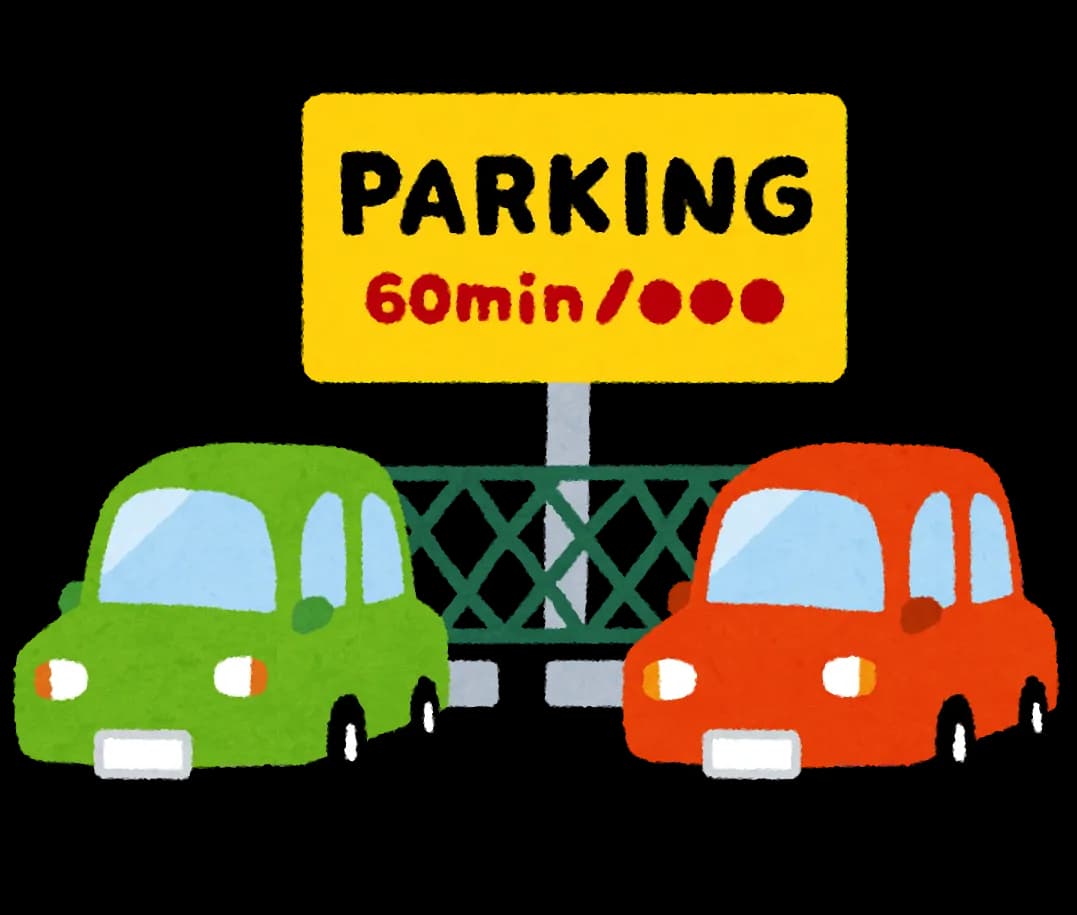
⚠️ Warning on Limited Hour Lots: Parking lots attached to department stores or large buildings often close their entrances completely after business hours. You will not be able to retrieve your car until the next day, so check for '24-hour operation.'
💡 Finding Parking: You can easily find paid parking nearby by searching for 'Coin Parking' or '駐車場' (Chushajo) in Google Maps.
Refueling in Japan is Easy with the BasicsFrom fuel types to getting change at self-service stations
Refueling is the most frequent situation you'll face on a road trip. Just remember the fuel names and colors.
1. Fuel Types and Fuel Door Location
Nozzle colors in Japan are standardized nationwide. Most rental cars use Regular (Red).
- Regular (レギュラー) Standard Gasoline 🔴
- High-Octane (ハイオク) Premium Gasoline 🟡
- Keiyu (軽油) Diesel 🟢
💡 How to find the fuel door: Look for the small arrow (◀ or ▶) next to the fuel gauge icon on your dashboard. The arrow points to the side where the fuel door is located.
2. Self-Service Station Procedure
- Select Payment: Choose Cash or Credit Card.
- Select Amount: Choose 'Full' (満タン, mantan) or a specific amount/volume.
- Remove Static: Touch the anti-static pad on the right of the machine first.
- Refuel: Remove the correct colored nozzle, insert it fully into the tank, and pull the lever.
- Settlement: Take your receipt. If you paid cash and didn't get change, take the receipt to a separate adjustment machine (精算機) nearby and scan the barcode to receive your change.
Mastering Japan's ExpresswaysDistinguishing ETC-only lanes and utilizing regional expressway passes
Expressway tolls in Japan are among the most expensive in the world. If you plan long-distance travel, renting an ETC (Electronic Toll Collection) card and using a fixed-rate pass is essential.
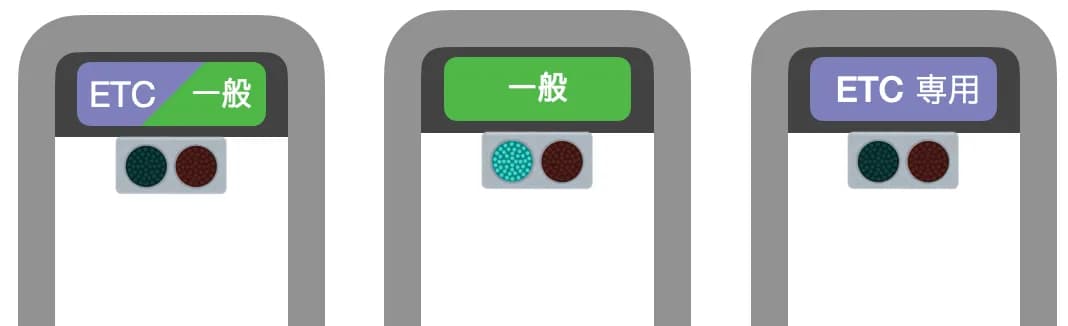
1. Toll Gate Lane Distinctions
- Purple ETC Only (専用): For vehicles equipped with an ETC device and card. (Slow down to below 20 km/h).
- Green General (一般): For vehicles paying with cash or credit card.
- Mixed (ETC/一般): Both methods are available.
2. Regional Fixed-Rate Expressway Passes
These are products exclusive to foreign rental car users, allowing unlimited expressway use for a set period.
| Pass Name | Target Region | Links |
|---|---|---|
| JEP | Nationwide Japan | Japan Expressway Pass |
| KEP | Kyushu | Details |
| HEP | Hokkaido | Details |
| CEP | Central (Nagoya, etc.) | Details |
| TEP | Tohoku | Details |
Exclusive TourCast Tips!
Tip for Checking Japan Highway Tolls
If searching for Japanese Interchange (IC) names in English is difficult, use the taxi route feature in the 'Japan Travel' app.
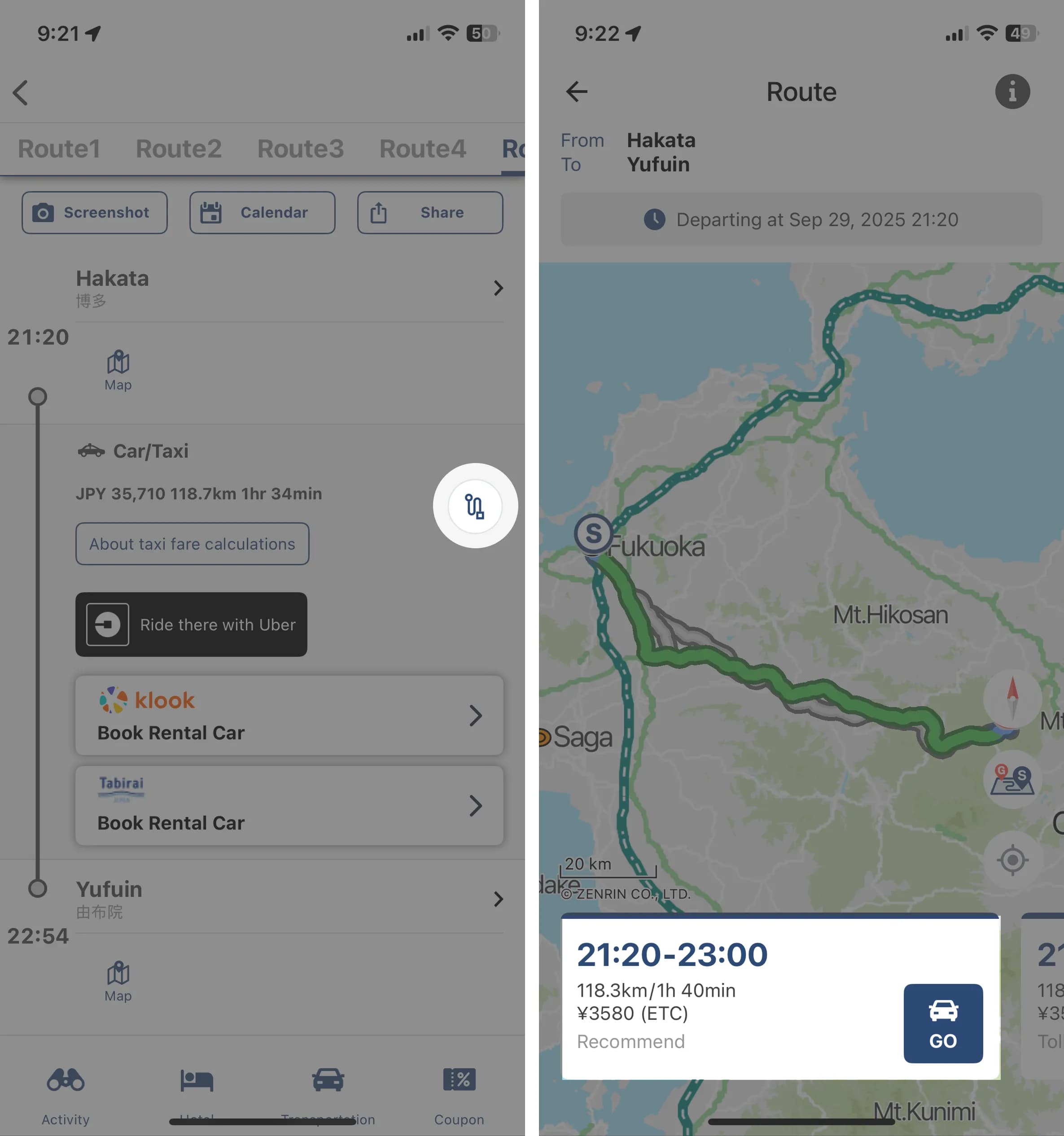
In the route details, tap the circular button on the right to see expressway tolls. Note that regional passes (like KEP) often do not include inner-city expressway tolls, so cross-reference the pass coverage.
- For example, when searching Hakata Station to Yufuin Station, the Fukuoka Urban Expressway is not included in KEP. Calculate only the Dazaifu IC – Yufuin section to decide if KEP is worth it.
⚠️ Expressway Driving Precaution: The furthest right lane (Lane 1) on Japanese expressways is the overtaking lane. Staying in this lane after passing is a violation; you must return to the left cruising lane.