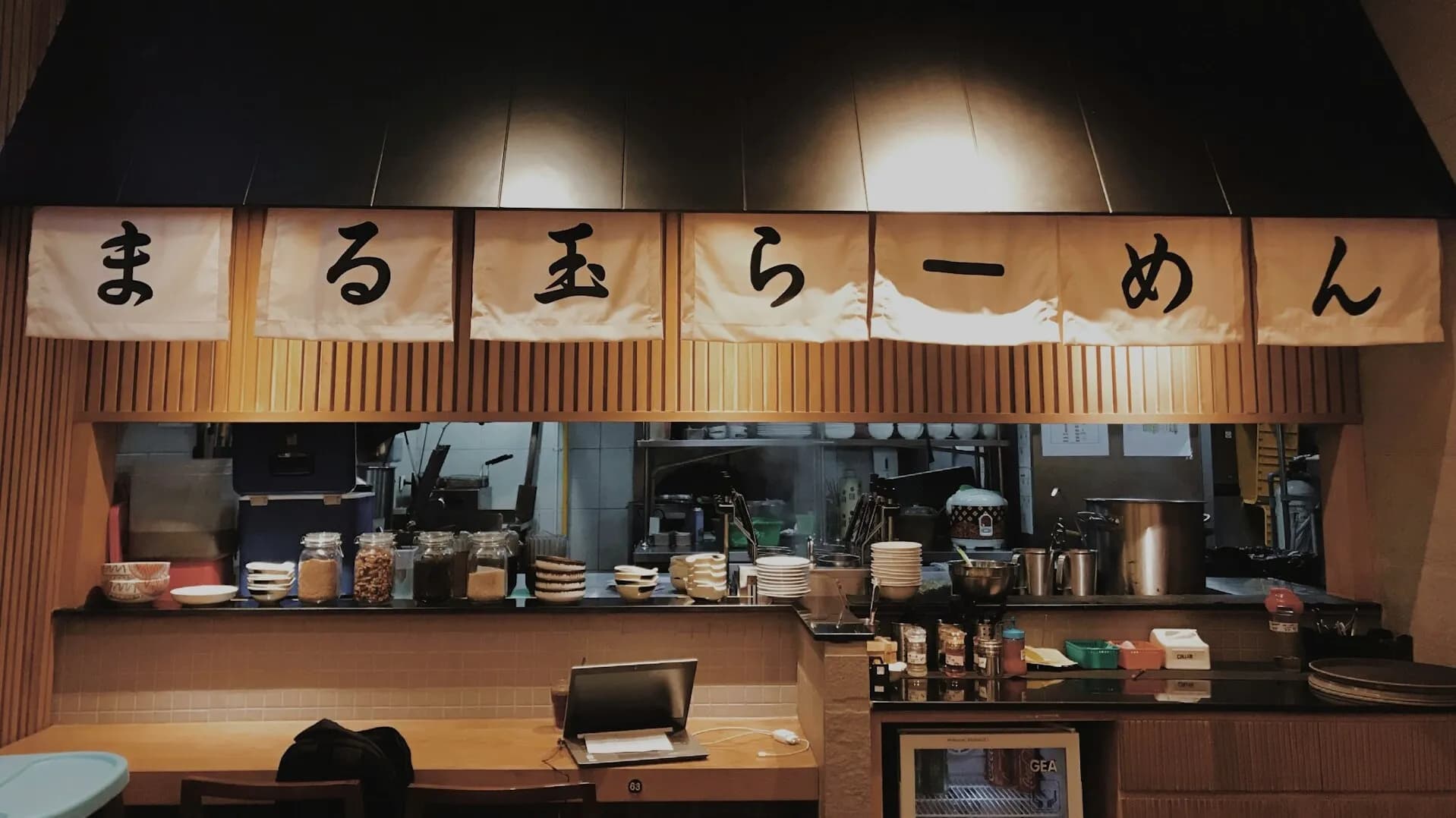
Finding Good Local Restaurants in JapanHow to Search for Places Locals Often Visit
One of the best parts of travel is food.
However, when you visit restaurants introduced on blogs or YouTube, you may find that they are crowded with tourists rather than locals.
For example, if it is a ramen chain found across Japan, and you wait over one hour just because it is “the original”—your valuable travel time becomes shorter. (Imagine tourists lining up for a common chain store in your own country.)
Of course, these places often match many travelers’ tastes, so the chance of failure is low. Also, Japanese food is not heavily spiced, so most people can enjoy it without strong dislike.
That is why TourCast introduces restaurant search methods and websites that locals commonly use. (Local signature dishes are introduced separately in each region guide.)
How to Search for Local RestaurantsFind Restaurants on Tabelog and Google Maps
1) Tabelog (Tabelog)
“Tabelog” combines the Japanese word for “eat” (食べる, taberu) with “blog,” and it is one of the most-used restaurant review sites in Japan.
When you look at the ratings, you might think, “Is it not that good?” But the score is a total rating that includes taste, service, price, and atmosphere.
- 3.0–3.5: Hidden local gems that are not widely known yet. Read reviews carefully before you visit.
- 3.6–4.0+: Top-rated places locals also recommend. Usually strong in both food and service.
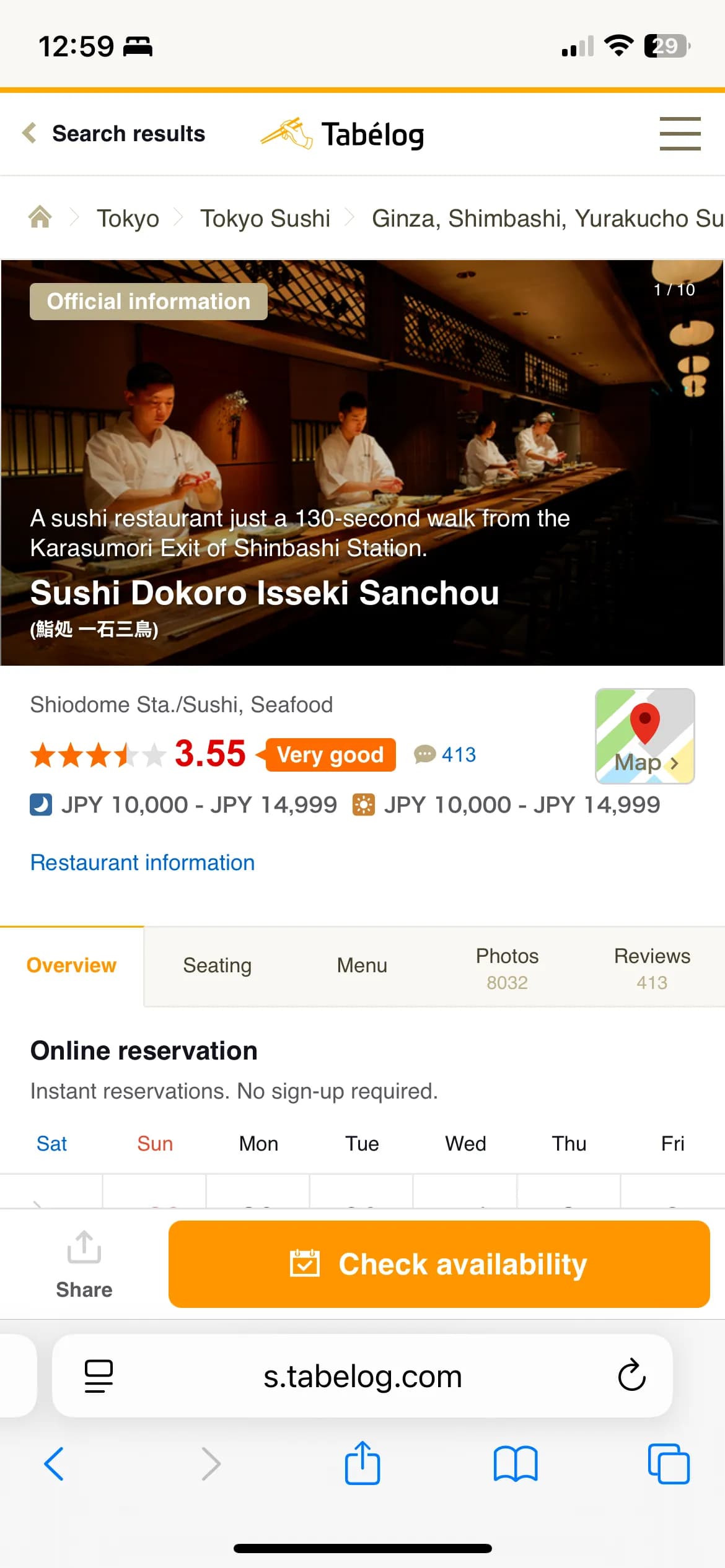
A key advantage of Tabelog is that it offers detailed filters such as area, cuisine type, price range, group type, and visit purpose.
In the past, reservations were only available on the Japanese pages, but recently the site has been updated in multiple languages, making reservations easier.
Set the date, number of people, and time, then verify your email and enter card details to complete the booking.
Tabelog English Website
2) Google Maps
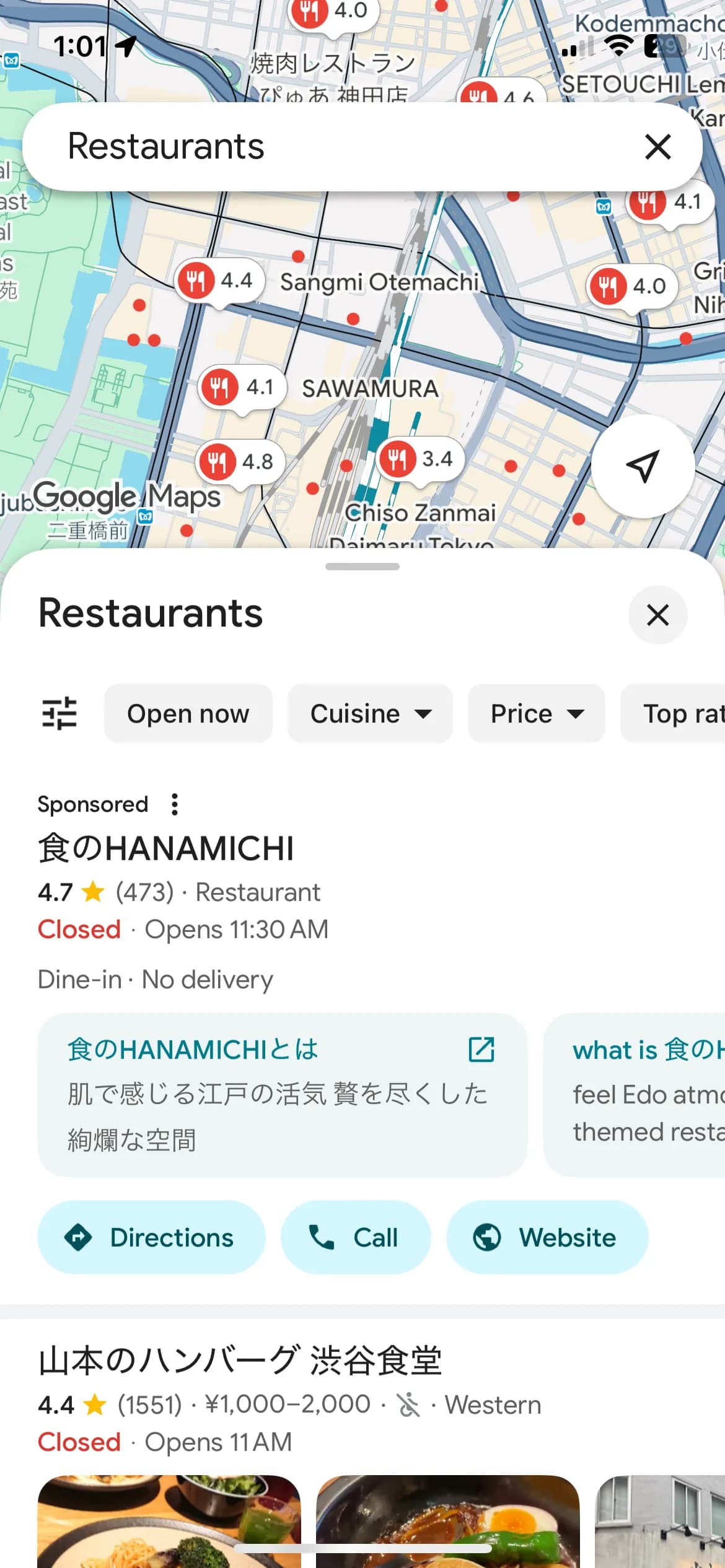
You can also search for restaurants using the Google Maps app.
Enter a place in the search bar, then tap the restaurant button below. You will see nearby restaurant information with a map.
- Rating 3.5–4.0: Check reviews carefully before choosing.
- Rating 4.0+: A higher chance of being a reliable local restaurant.
Izakaya Otoshi (お通し) GuideIs There a Seating Fee in Japan Too?
Some restaurants charge a seating fee or a table charge. In Japan, izakaya have a similar system called otoshi (お通し).
Otoshi is a small appetizer served as soon as you sit down, and it is automatically provided and charged, even if you did not ask for it.
If you do not know this, you may feel uncomfortable after a nice meal when you see an item you did not order on the receipt, so it is important to know in advance.
- It may appear on the receipt as お通し (otoshi) or 突き出し (tsukidashi).
- It is usually about ¥300–¥600 per person, but some higher-end izakaya may charge ¥1,000 or more.
- Common otoshi items: simple starters such as edamame, pickled cabbage, or a small salad.
- If choosing food takes time, it is often considered polite to order drinks first.
If you want to refuse otoshi, the response depends on the restaurant. Some may refuse entry, or they may only provide otoshi and not serve other small dishes.
The best option is to ask in Japanese: オトーシ、抜けますか? (Can I skip otoshi?) before you sit down. However, during travel, respecting local culture and enjoying it naturally can also be part of the experience.
Lastly, you should check whether menu prices include tax.
By rule, prices should be shown with tax included, but some places show tax-excluded prices only.
In that case, when you add the otoshi fee plus 10% consumption tax, the final bill may be higher than expected.
~Hodai (~放題) GuideAll-You-Can Enjoy Within a Set Time
At the entrance of izakaya or restaurants in Japan, you may see signs like 2時間 飲み放題 ¥1980.
This means all-you-can-drink for 2 hours, offered as nomihodai (飲み放題) for ¥1,980 per person.
- Hodai (放題) means “as much as you want.”
Nomihodai (飲み放題) is an all-you-can-drink option for a set time, often including beer, highballs, sours, shochu, soft drinks, and tea.
Tabehodai (食べ放題) means all-you-can-eat within a set time, usually in a buffet-style format.
In most cases, the price is listed per person, and each person is expected to order it.
It is polite not to leave food or drinks unfinished, and there may be rules such as needing to finish your current drink before ordering another. Check the instructions before you start.
Unmanned Vegetable Stands in JapanUnmanned Vegetable Stands in Japan
Recently, there are more unmanned convenience stores with machines for payment, and unmanned fruit shops as well.
However, Japan has had a true unmanned sales style—with no staff and no machines—for a long time.
A representative example is the unmanned vegetable stand (無人野菜直売所).
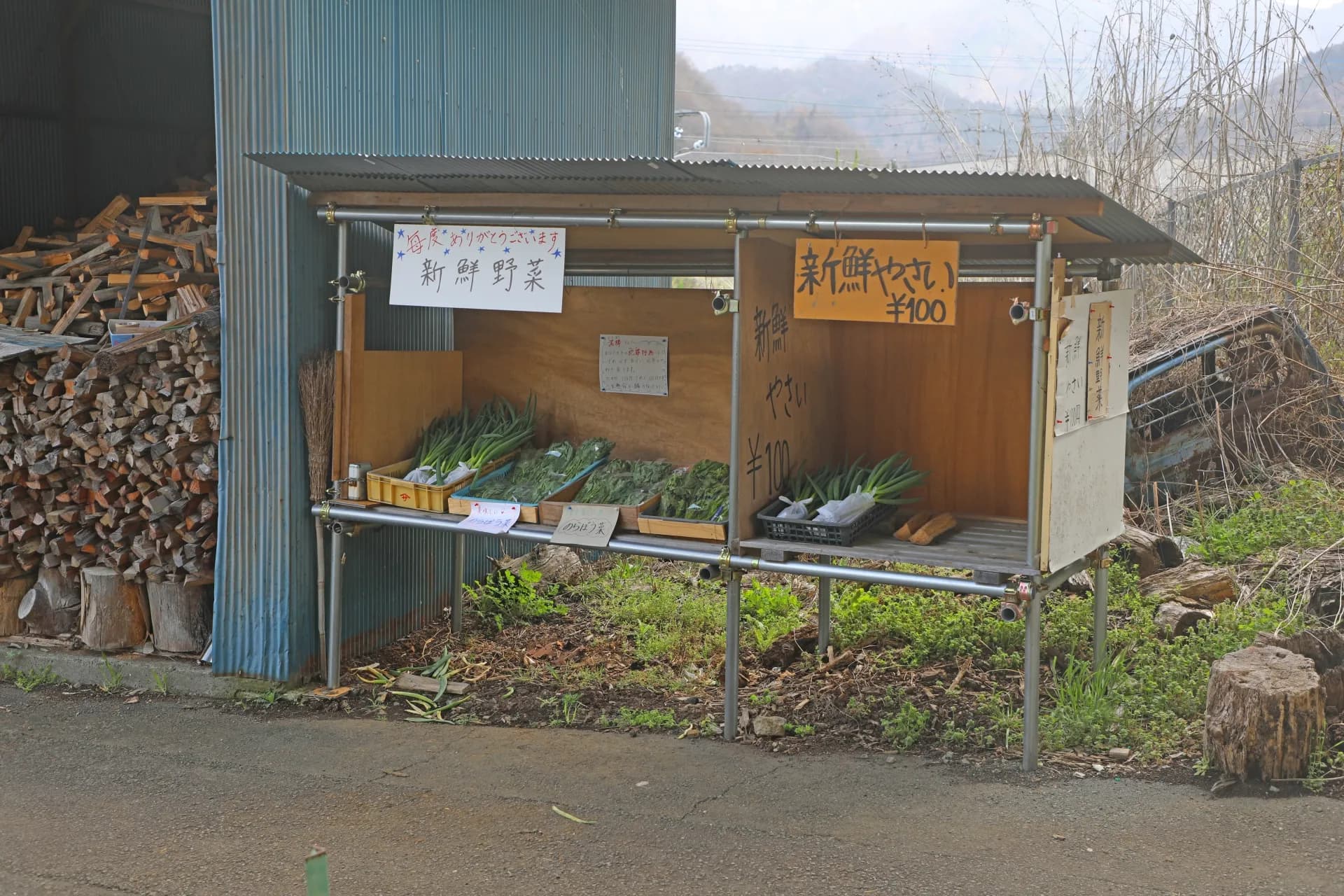
- Farmers grow vegetables themselves,
- display them simply by the roadside or in front of their home,
- and customers choose what they want and put about ¥100–¥150 into the box next to it.
There is no clerk and no kiosk. All transactions are based on honesty and trust.
Theft is rare even without surveillance, and it is often seen as a unique local distribution style that works because people follow the rules.
You can also find unmanned vegetable stands (無人野菜直売所) easily on Google Maps.
Type 無人野菜直売所 in the Google Maps search bar, and nearby stands will appear on the map.
Tap the button below to copy the keyword, then paste it into Google Maps to find locations easily.