
Yokohama: A Romantic Port City Where the History of Opening Borders Lives OnFirst impressions of Yokohama, breathing with history and romance.
Yokohama's development began with the signing of the Treaty of Peace and Amity with the United States in 1854, followed by the Treaty of Amity and Commerce in 1858, which led to the decision to open the Kanagawa port.
On July 1, 1859, the Port of Yokohama officially opened, marking the full-scale influx of Western culture and transforming Yokohama into an international city. Thanks to its exotic and relaxed atmosphere—distinct from Tokyo—it is highly beloved as a day-trip destination.
To fully enjoy the brilliant night views, it is effective to plan your Yokohama sightseeing for the afternoon or evening rather than the morning.
1) Major Transport Methods and Fares
You can choose from various lines depending on your starting point. Plan your schedule by considering travel time and fares.
- From Shibuya: Tokyu Toyoko Line (310 yen one-way) – The most common and affordable method.
- From Shinjuku: JR Shonan-Shinjuku Line Rapid (620 yen one-way).
- From Shinagawa: JR Tokaido Line / Yokosuka Line (350 yen one-way).
- From Tokyo Station: JR Tokaido Line (530 yen one-way).
2) Safety Precautions
While Yokohama is generally a very safe city, there are areas where travelers should exercise caution.
⚠️ Area Caution
Yokohama contains an area called 'Kotobukicho,' known as one of Japan's three major slums. Once a hub for day laborers, it currently faces issues with an aging population and poverty. The atmosphere can be quite unsettling at night, so it is safest to avoid visiting.
We recommend checking the location in advance to ensure you do not accidentally wander into the area.
3) Preview of Iconic Yokohama Sights
- Minato Mirai 21: A modern waterfront district featuring the Yokohama Landmark Tower and the giant Ferris wheel at Cosmo World.
- Akarenga (Red Brick) Warehouse: A shopping mall renovated from old storage warehouses, boasting an exquisite historic exterior.
- Chinatown: One of the largest in the world, where you can enjoy diverse street food and brilliant Chinese-style architecture.
- Yamashita Park: The best place to soak in the romance of Yokohama Port along its seaside promenade.
💡 Travel Tip
You can tour the city more comfortably and uniquely by using the 'Akai Kutsu' (Red Shoes) loop bus, which stops at major landmarks, or the 'Yokohama Air Cabin,' a recently introduced waterfront cable car.
Optimal Transport Pass Selection Guide for YokohamaChoosing an efficient pass that covers major routes.
Major tourist attractions in Yokohama are concentrated along the Minato Mirai Line (Yokohama Station – Motomachi-Chukagai Station). Choose the pass that is most advantageous based on your starting point and travel frequency.
1) Tokyu Minato Mirai Pass
東急みなとみらいパス
The most commonly used pass when starting from the Tokyu Line, including Shibuya.
- Benefits: One round-trip between any Tokyu Line station ↔ Yokohama Station + Unlimited rides on the Minato Mirai Line for one day.
- Price: 920 yen from Shibuya, Daikanyama, or Meguro stations.
- Features:
- The Tokyu Line section between your starting point and Yokohama is a simple round-trip ticket (no stopovers allowed).
- Unlimited travel is only permitted on the Minato Mirai Line section (Yokohama to Motomachi-Chukagai).
- Decision Criteria: It is profitable if you plan to ride the Minato Mirai Line 2 or more times in addition to the Shibuya-Yokohama round-trip (standard cost 640 yen).
2) Keikyu Minato Mirai Pass
京急みなとみらいパス
Advantageous if starting from Shinagawa or toward Haneda Airport.
- Benefits: One round-trip between starting station ↔ Yokohama Station + Unlimited rides on the Minato Mirai Line for one day.
- Price: 930 yen from Shinagawa Station.
- Precautions:
- Available only to holders of physical PASMO cards.
- Note that it cannot be purchased via Apple Pay (Wallet App) or Mobile PASMO.
3) Minato Mirai Line 1-Day Ticket
みなとみらい線一日乗車券
Suitable if you have already arrived at Yokohama Station or have traveled there individually via JR.
- Benefits: Unlimited rides on only the Minato Mirai Line (Yokohama to Motomachi-Chukagai) for one day.
- Price: Adult 460 yen / Child 230 yen.
- Decision Criteria: Since basic Minato Mirai Line fares are 200–230 yen, you break even if you use the line 3 or more times.
- Tip: For a route like "Yokohama Sta. → Chinatown (walk) → Minato Mirai Sta. → Yokohama Sta.," you only board twice, so a standard IC card may be cheaper.
💡 Pass Selection Pro-Tip If you only think about the round-trip between Tokyo and Yokohama, a standard IC card is easier. However, if you plan to travel busily between Chinatown, Akarenga Warehouse, and the Cup Noodle Museum via train, holding one of these passes is the best way to save your wallet.
Exclusive TourCast Tips!
Conquering Kamakura + Yokohama in One Day
If you skip visiting the interior of Enoshima Island during a Kamakura trip and focus on the 'Kamakura High School' crossing (Slam Dunk backdrop) and the 'Hasedera Great Buddha,' the morning is sufficient for touring.
Use the Tokyu or Keikyu Minato Mirai Pass to reach Yokohama Station, and then pay separately for the Yokohama Station ↔ Kamakura Station (JR 440 yen one-way) section. After finishing Kamakura in the morning, returning to Yokohama to end your day with the brilliant night views of Minato Mirai is the most efficient route.
- Kamakura Sta. → Kamakura-koko-mae Sta.: 260 yen
- Kamakura-koko-mae → Hase Sta.: 220 yen
- Hase Sta. → Kamakura Sta.: 200 yen
It is cheaper to buy individual one-way tickets than an Enoden 1-Day Pass (800 yen) for an itinerary that quickly visits core spots.
To add fun to your journey, consider taking the Shonan Monorail. Take the JR from Yokohama Station to Ofuna Station (350 yen), then ride the unique suspended monorail to Shonan-Enoshima Station.

Comparison of 3 Yokohama Sightseeing Buses: Finding Your Mode of TransportComplete guide to Akai Kutsu, Bayside Blue, and Burari buses.
Tourism-specialized buses operated by Yokohama City have the same fare as regular city buses but the advantage of stopping specifically at key tourist spots.
1) Akai Kutsu (Red Shoes)
"The nostalgic loop bus capturing the vibe of Yokohama"
- Features: A symbolic Yokohama bus with a classic red exterior and charming wooden-textured interior.
- Target: Travelers who want to get off right in front of major spots like Chinatown, Akarenga Warehouse, and Yamashita Park.
- Major Route: Loops from Sakuragicho Station around Minato Mirai and the port area. (M-Route)
2) BAYSIDE BLUE
"The blue bus connecting Yokohama Station to the end of the port"
- Features: A long articulated bus (looking like two buses connected), colored a vivid blue to symbolize Yokohama's sea.
- Target: Travelers starting from Yokohama Station who want to move quickly toward the Cup Noodle Museum or Yamashita Pier.
- Advantage: Faster travel between major hubs due to fewer stops than regular buses.
3) Burari Sightseeing Bus
"Unblocked to your destination! Themed direct buses"
These routes connect major hubs directly to specific tourist themes.
- Burari Akarenga Bus: The fastest connection between Yokohama Station ↔ Akarenga Warehouse.
- Burari Sankeien Bus: (Runs Sat/Sun/Holidays) Direct to the traditional Sankeien Garden, located slightly away from the city center.
- Burari Nogeyama Zoo Bus: Guides you to the free Nogeyama Zoo, great for families with children.
4) Fares and Efficient Passes
- Single Ride: 220 yen for adults / 110 yen for children (Standard IC cards accepted).
- Recommended Pass: Minato Burari Ticket (700 yen)
- Allows unlimited rides for one day on all three bus types above (Akai Kutsu, Bayside Blue, Burari) plus specific municipal subway sections (Yokohama to Yoshinocho Station).
- If you ride the bus 4 or more times, the pass is definitely worth it over individual IC card payments.
- Note: The Yokohama Municipal Bus 1-Day Pass (600 yen) does NOT cover these sightseeing buses; make sure to distinguish them.
- A Wide Pass that includes Shin-Yokohama Station via subway is 750 yen.
💡 Pro-Tip Subway stations on the Minato Mirai Line can be deep underground, making staircases a hassle. To save stamina, take the Akai Kutsu or Bayside Blue which drop you right at the entrance of attractions.
Yokohama Air Cabin: Enjoy a Panoramic View from the SkyJapan's first permanent urban ropeway.
YOKOHAMA AIR CABIN
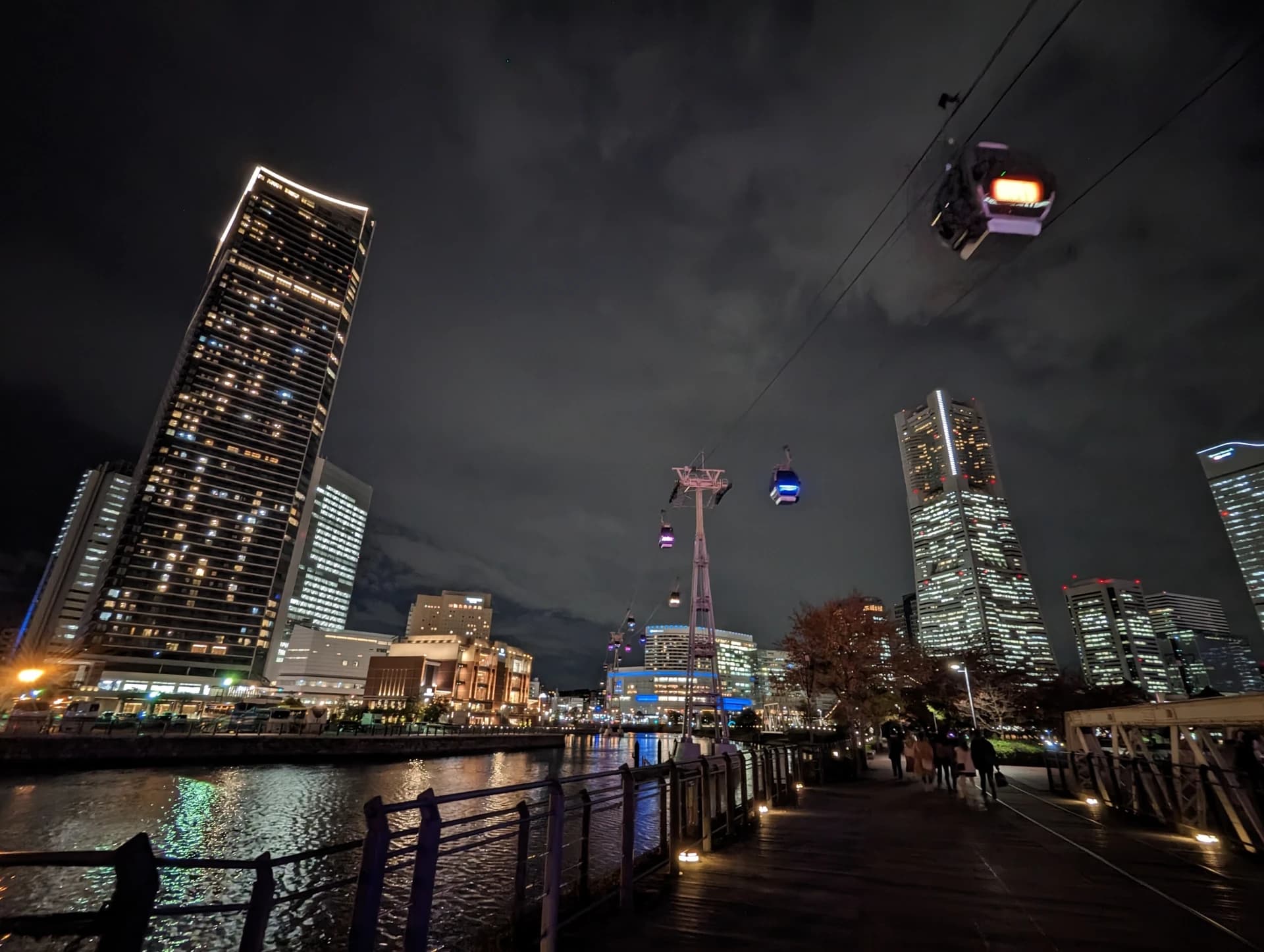
Opened in 2021, the Yokohama Air Cabin is Japan's first permanent urban ropeway, connecting JR Sakuragicho Station with the center of Minato Mirai at Canal Park (near Akarenga Warehouse). Beyond simple transport, it has become a new landmark for viewing Yokohama's modern skyline.
1) Key Features and Boarding Info
- Route: JR Sakuragicho Station ↔ Canal Park (In front of Yokohama World Porters).
- Duration: Approx. 5 minutes (approx. 630m one-way).
- Facilities: All cabins are air-conditioned and barrier-free, accommodating wheelchairs.
- Highlights: Enjoy an open view of Yokohama Port by day, and the brilliant night lights created by the Giant Ferris Wheel (Cosmo Clock 21) and Landmark Tower by night.
2) Fares and Operating Hours
- Hours: 10:00 – 21:00 (May be extended seasonally or on weekends).
- Fare (One-way): Adult (Middle school+) 1,000 yen / Child (Elementary-) 500 yen.
- Fare (Round-trip): Adult 1,800 yen / Child 900 yen.
- Set Ticket: Buying a bundle that includes the Cosmo World Ferris wheel is even more economical.
3) Travel Tip: When to Ride?
- Best Time: Ride during the Magic Hour (just before sunset) to watch the city lights gradually turn on.
- Route Logic: If you take the Air Cabin from Sakuragicho Station to 'Canal Park' immediately upon arrival, you are within a 5-minute walk of the Akarenga Warehouse and the Cup Noodle Museum, making it a great way to save energy.
💡 Please Note While 1,000 yen for a one-way trip is relatively high, the experience of facing Yokohama's landmarks directly from the sky is well worth it. It is highly recommended for dates or families.
Recommended Yokohama One-Day Itinerary: A Perfect Route for Flavor, Views, and HistoryA route to enjoy Yokohama's highlights in a single day.
Yokohama is a charming city where exotic streets unique to a port town coexist with a modern night skyline. To feel the essence of Yokohama in a single day, follow this route:
Recommended Route Yokohama Station → Motomachi-Chukagai Station → Motomachi Shopping Street → Chinatown → Yamashita Park → Osanbashi International Passenger Terminal → Yokohama Akarenga Warehouse → Cup Noodle Museum → Yokohama Cosmo World → Nippon Maru → Yokohama Landmark Tower → Minato Mirai Station → Yokohama Station
1) Motomachi Shopping Street
A historic European-style shopping street formed near the former foreign settlement of Yamate. It is lined with sophisticated boutiques and cafes, including Japan's first bakery, 'Uchiki Pan,' which has maintained its flavor for over 130 years.
2) Chinatown (Chukagai)
The largest Chinatown in Japan, catching the eye with its brilliant Pai-lou (gates) and numerous Chinese restaurants. The 'Kanteibyo' temple, enshrining Guan Yu as the god of business prosperity, is a symbol of this area.

3) Yamashita Park & Osanbashi Terminal
Yamashita Park, built along the sea, is a resting spot for locals. A short walk leads to the Osanbashi International Passenger Terminal. The rooftop plaza, nicknamed 'Kujira no Senaka' (The Whale's Back), is one of the best date courses with a panoramic view of Yokohama Port.

4) Yokohama Akarenga Warehouse
Red brick buildings used as storage in the early 20th century have been renovated into a sophisticated shopping and exhibition space. At night, soft lighting gives the buildings an even more vintage atmosphere.

5) Cup Noodle Museum (Ando Momofuku Invention Memorial Museum)
A unique experience space where you can learn the history of instant ramen and create your own one-of-a-kind cup noodles.
- Visitor Info: Adult entry 500 yen (Experience fee separate) / Closed on Tuesdays.
- Caution: Do not confuse this with the 'Ramen Museum' near Shin-Yokohama Station; verify the location.
6) Yokohama Cosmo World & Nippon Maru
- Cosmo World: An urban amusement park famous for the massive Ferris wheel 'Cosmo Clock 21.' Entry is free; pay per ride.
- Nippon Maru Memorial Park: Preserves and displays the sailing ship Nippon Maru, built in 1930. The sight of the ship with its white sails unfurled is magnificent.

7) Yokohama Landmark Tower
For the end of your trip, we recommend the 'Sky Garden' observatory on the 69th floor of the Landmark Tower. The fantastic night view of Minato Mirai through the 360-degree glass windows is the pinnacle of a Yokohama trip.

Yokohama Anpanman Children's Museum: A Journey into Childhood for the Whole FamilyEnter the world of Anpanman! A family destination for all ages.
Despite its name as a children's museum, it offers deep nostalgia and joy to adults who grew up watching Anpanman. This is a popular theme park found in major Japanese cities including Fukuoka, Kobe, Nagoya, and Sendai.
- Space for Everyone: Filled with cute Anpanman and Baikinman characters. The detailed sets serve as excellent photo spots for adults as much as the interactive facilities delight children.
- Fare Feature: Consistent with a child-centric facility, entry fees are the same for everyone aged 1 and up.
1) Visitor Information & Tips
- Visit Time: If you plan to visit, we recommend making it your first stop upon arriving in Yokohama. Last entry is relatively early at 4 PM.
- Hours: 10:00 – 17:00 (Last entry 16:00).
- Closing Days: Irregular (Check the website before visiting).
- Admission: 2,200 – 2,600 yen for ages 1+ (varies by date).
2) Unmissable Fun
- Jam's Kitchen: A very popular bakery where you can see bread being baked in the shape of Anpanman's face and taste them yourself.
- Shows: Brilliant stage shows featuring characters are held at specific times.
- Free Zone: Besides the paid museum area, the 1st-floor shop and food court area are accessible without an entrance fee, perfect for buying limited-edition goods.
💡 Itinerary Tip The Anpanman Museum is a 10–15 minute walk from Yokohama Station or close to 'Shin-Takashima Station' on the Minato Mirai Line. Following your visit, a walk toward the 'Yokohama Landmark Tower' or 'Cosmo World' right next door makes for a perfect route.