
Everything About Tokyo Transport: Basic Guide to Trains and Subways for BeginnersA core guide to transfers and fares that even beginners can quickly master.
When preparing for a trip to Japan, you've likely heard that you have to pay extra every time you transfer.
This is likely due to the psychological burden many travelers feel regarding Tokyo's complex transportation system. However, TourCast aims to explain these complexities as simply as possible, tailored to the perspective of those visiting Tokyo for the first time.
- The content below is based on Essentials Part 2 - Japan Transport System, so it is recommended to read that section first before referring to this guide.
Railway (JR/Private) vs. Subway (Metro/Toei): The Core Distinction of Tokyo TransportConfusion is reduced by knowing the characteristics and fare differences of each line.
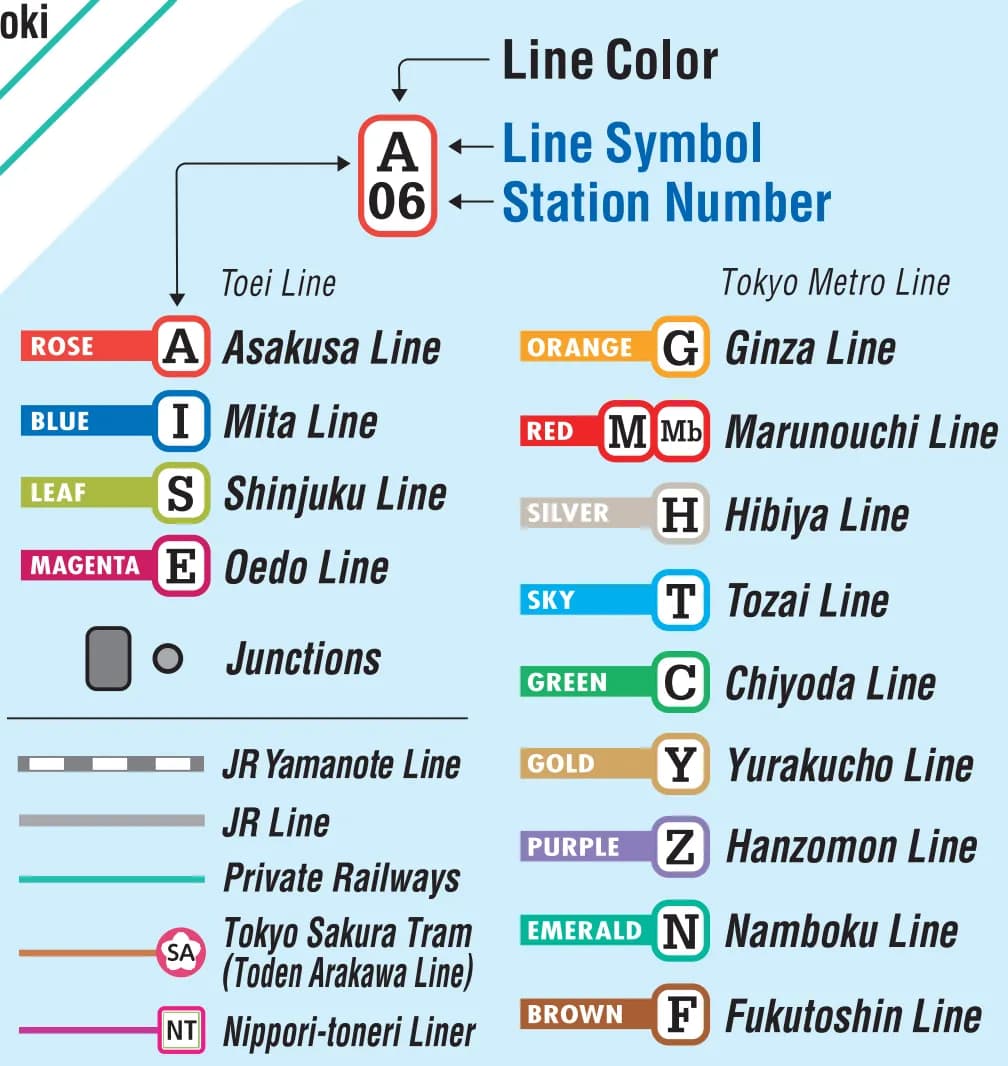
Tokyo's rail system is broadly divided into Above-ground Railways (JR/Private Rail) and Subways (Metro/Toei) depending on the operator. Since these are separate companies, identifying the line colors and logos is the first step in finding your way.
- Subway: Lines that densely connect the city center underground, with a total of 13 lines.
- Tokyo Metro (9 lines): Indicated by alphabetical symbols such as G (Ginza), M (Marunouchi), H (Hibiya), etc.
- Toei Subway (4 lines): Operated by the Tokyo Metropolitan Government, including the Asakusa and Oedo lines.
- Railway: Primarily above-ground, connecting Tokyo and surrounding areas over long distances.
- JR Lines: Serves as the backbone of Tokyo travel, including the Yamanote Line (green) and Chuo Line (orange).
- Private Rail: Lines operated by private corporations such as Odakyu, Keio, Seibu, and Yurikamome.
💡 Payment Trends and the Necessity of IC Cards
Tokyo Subways (Metro, Toei) are scheduled to introduce contactless payment (credit card tap) on all lines by Spring 2026, and some private lines already implement this.
However, the JR Lines (Yamanote Line, etc.), which travelers use most frequently, currently have no confirmed plans for contactless payment and are only expected to introduce QR code payment (teppay) from Autumn 2026.
Ultimately, because payment methods vary by line, preparing a physical or mobile IC card (Suica, PASMO, etc.) is the most reliable and convenient way to use JR, subways, and private rails without transfer restrictions.
Master Major JR Lines: Circular Yamanote Line and Chuo Line Rapid TipsDifferences between Tokyo's central loop line and direct lines, with travel time comparisons.
The core of Tokyo travel is the JR Yamanote Line (Loop Line). Major tourist attractions like Shinjuku, Shibuya, Tokyo, and Ueno are all connected by this one line. However, because it is a loop, reaching a station on the opposite side can take time. In such cases, direct lines that cut across the city center are very useful.
1) How to Use Direct Lines to Save Time
When moving from Shinjuku Station to Tokyo Station, taking the Yamanote Line (Green) takes about 33 minutes as it loops wide toward Shinagawa. However, using a line that cuts through the center can drastically reduce time.
- Chuo Line (Orange, Rapid): Reaches Tokyo Station from Shinjuku in just 13 minutes. This is thanks to the rapid system that stops only at major stations like Yotsuya and Ochanomizu.
- Chuo-Sobu Line (Yellow, Local): Stops at every station and connects toward Akihabara via Ochanomizu. This is the most efficient way to get from Shinjuku to Akihabara.
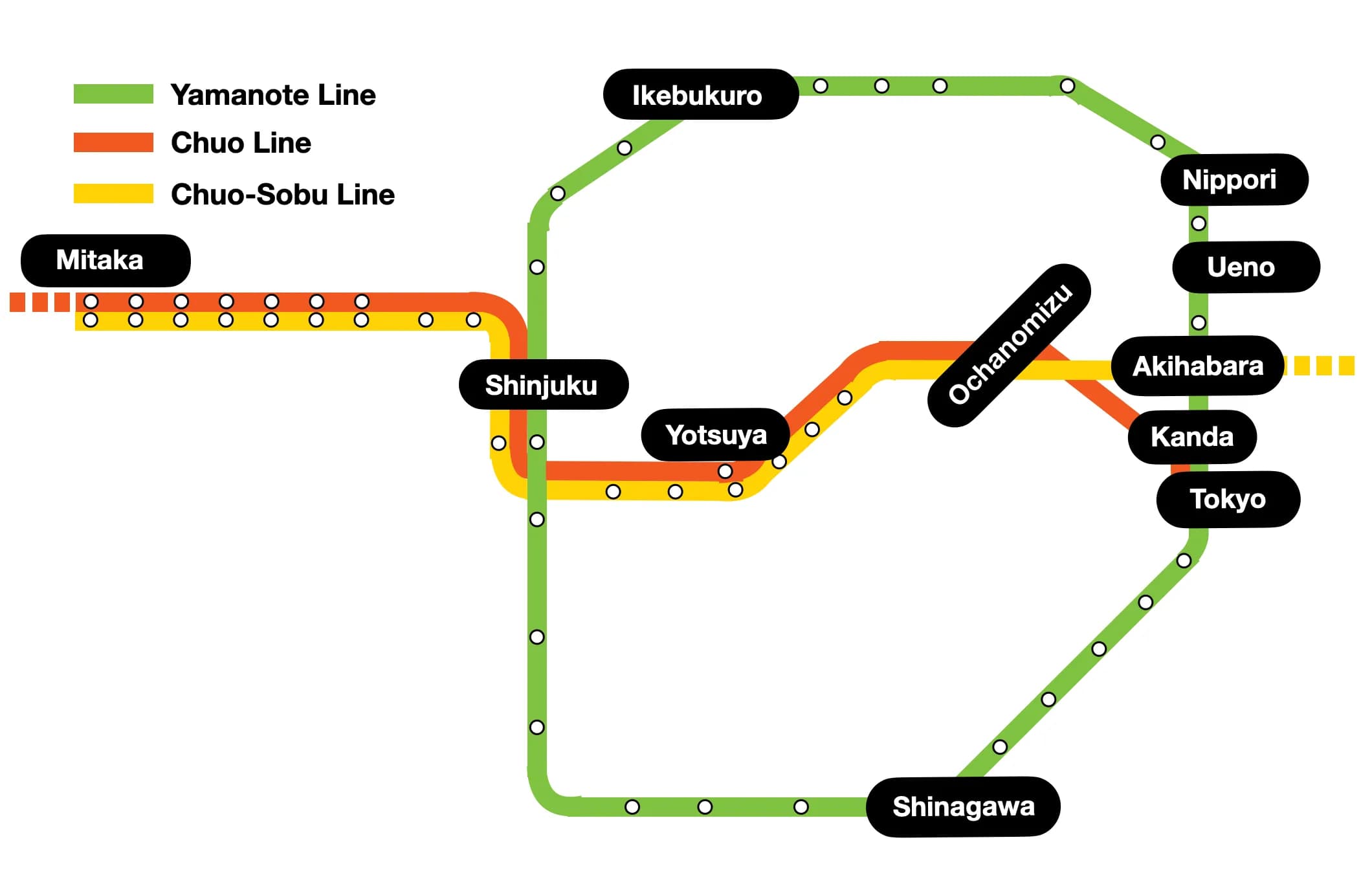
2) Travel Time Comparison by Destination (Starting from Shinjuku Station)
| To Destination | Line Used | Duration | Notes |
|---|---|---|---|
| Tokyo Station | Chuo Line (Orange) | Approx. 13 min | Shortest cross-city route |
| Yamanote Line (Green) | Approx. 33 min | Travels along the loop | |
| Akihabara Station | Chuo-Sobu Line (Yellow) | Approx. 18 min | Direct without transfers |
💡 Hidden Detail of the Yamanote Line
You can distinguish the direction of the Yamanote Line by the voice of the announcements. A male voice announces the clockwise direction (Outer Loop), and a female voice announces the counter-clockwise direction (Inner Loop). Knowing this can help you avoid boarding the wrong way.
Private Railways Connecting Outskirts: Yurikamome, Odakyu, and Monorail GuideCharacteristics and connections of major private lines like Yurikamome, Monorail, and Odakyu.
In addition to JR and subways, Tokyo has various Private Railway lines operated by private companies. These serve as key links to specific tourist spots or outlying areas like Odaiba, Hakone, and Haneda Airport.
Most of these private lines start from major hub stations on the JR Yamanote Line and extend outward. Due to historical policies intended to prevent city center congestion, private lines generally do not enter the interior of the Yamanote Line (central city center).
1) Representative Private Lines and Connection Points
| Line Name | Major Hub Station | Main Destinations & Features |
|---|---|---|
| Yurikamome | Shimbashi, Toyosu | Toward Odaiba. An automated tourist-focused line with excellent front-seat views. |
| Odakyu Line | Shinjuku | Toward Hakone, Enoshima, Kamakura. Famous for its 'Romancecar' limited express trains. |
| Tokyo Monorail | Hamamatsucho | Connects to Haneda Airport. Known for scenic views that feel like gliding over the sea. |
| Keisei Electric Railway | Ueno, Nippori | Connects to Narita Airport. Operates the high-speed 'Skyliner' trains. |
2) Usage Tips and Pass Applications
Private railways tend to have more expensive fare systems than the standard subway or JR, but using specialized tourist passes can save significant costs.
- Yurikamome 1-Day Pass: Definitely worth it if you plan to get on and off 3 or more times within Odaiba.
- Hakone Free Pass: An essential item that includes round-trip Odakyu travel and various transport modes within Hakone (ropeway, pirate ship, etc.).
- Enoshima-Kamakura Free Pass: Provides unlimited use of the local Enoden trains and round-trip Odakyu travel from Shinjuku.
💡 Transfer Precautions
Because private railways are operated by different companies, you must exit the ticket gate and re-enter when switching from JR or subways. Always carefully check the transfer passages and gate locations suggested by Google Maps.
Detailed Subway Analysis: How to Distinguish 9 Metro and 4 Toei LinesInformation on extra transfer fees and distinguishing between the 9 Metro and 4 Toei lines.
Tokyo's subways are divided into the 9 lines of 'Tokyo Metro,' operated by a private company, and the 4 lines of 'Toei Subway,' operated by the Tokyo Metropolitan Government. Because the operators differ, it is important to distinguish the logos and colors on the map.
The most important thing to note is the transfer fare. While there is no extra charge for transferring between lines of the same operator, fares are combined when switching to a line of a different operator.
- Transfer between Tokyo Metro lines: No extra charge.
- Transfer between Toei Subway lines: No extra charge.
- Transfer between Tokyo Metro ↔ Toei Subway: Extra charge applies (however, a 70 yen discount is applied when using an IC card).
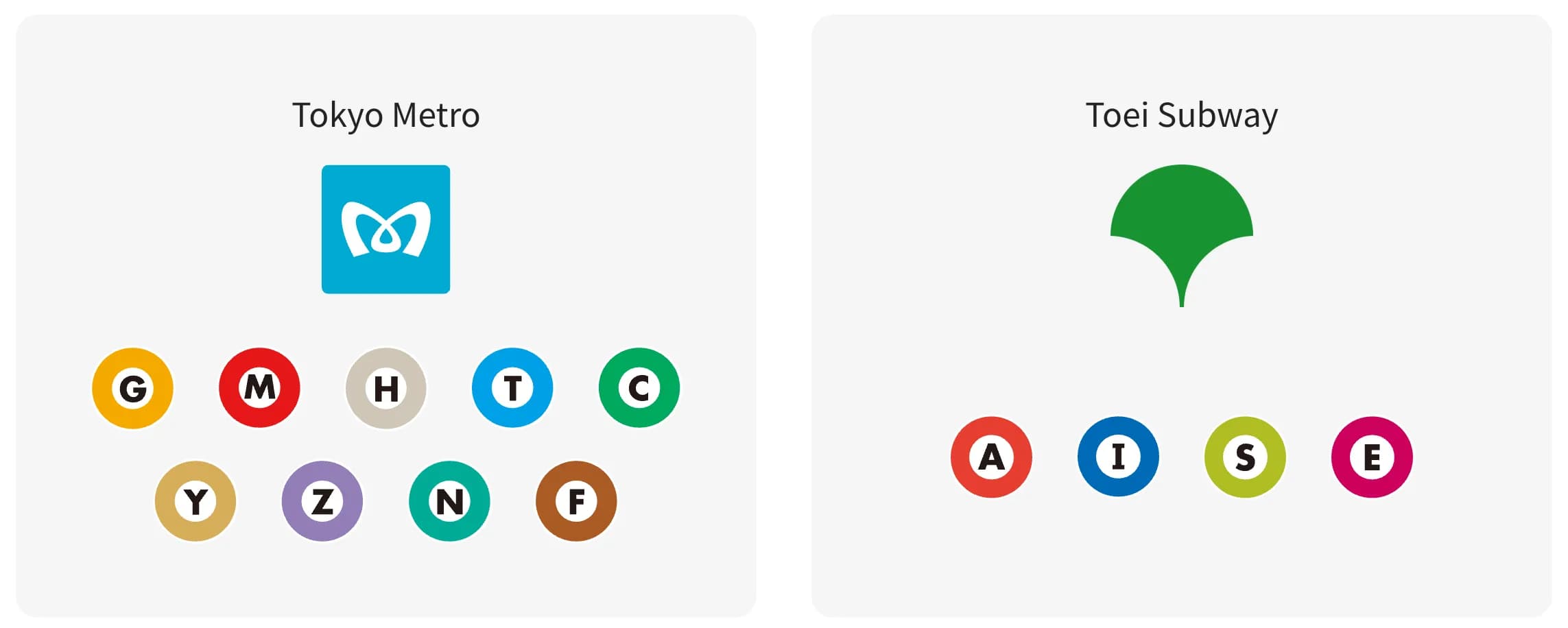
💡 Line List by Operator
| Operator | Logo | Owned Lines (Total: 13) |
|---|---|---|
| Tokyo Metro | Blue M | Ginza, Marunouchi, Hibiya, Tozai, Chiyoda, Yurakucho, Hanzomon, Namboku, Fukutoshin lines |
| Toei Subway | Green Leaf | Asakusa, Mita, Shinjuku, Oedo lines |
Using the Tokyo Subway Ticket
If you are worried about complex transfer fares, we recommend the Tokyo Subway Ticket. This pass allows for unlimited travel on all 13 lines of Tokyo Metro and Toei Subway for 24 to 72 hours, making it highly economical. (Note: Not valid on JR lines)
Exclusive TourCast Tips!
Easily Identify Lines via Logos and Codes on Google Maps
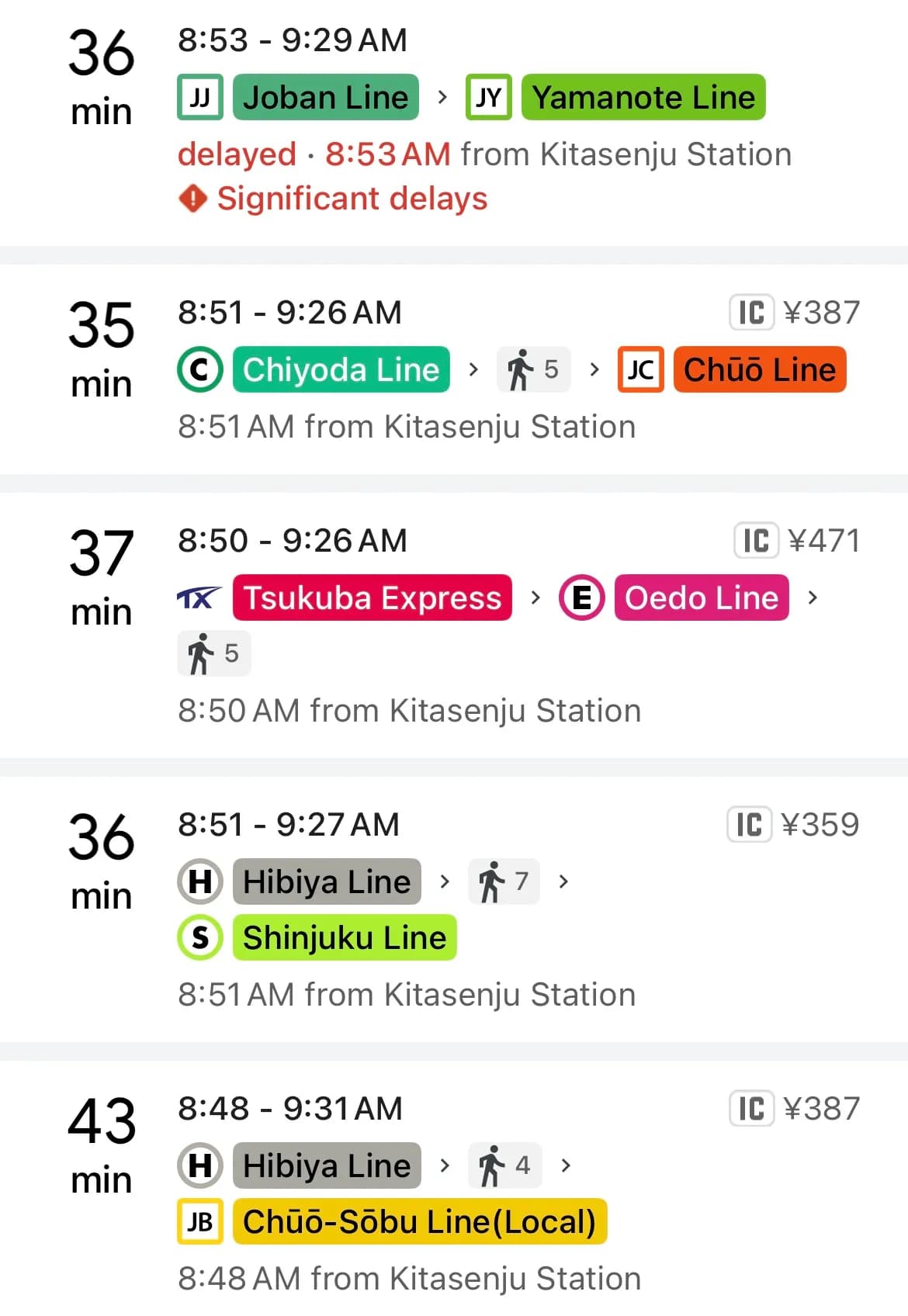
When searching for routes on Google Maps, it's fastest to check the alphabetical symbols instead of complex line names.Subway (Metro/Toei) lines are usually displayed with a single letter, which is often the first letter of the line's name. (e.g., G for Ginza line, M for Marunouchi line, A for Asakusa line)
In contrast, JR lines are marked with two letters starting with 'J', making them clearly distinguishable from subways.
- JY: Yamanote Line
- JC: Chuo Line Rapid
- JB: Chuo-Sobu Line Local
- JK: Keihin-Tohoku Line
Additionally, lines like TX (Tsukuba Express) and Ueno Tokyo Line are classified as private rail (Railway). By cross-referencing the icon colors and alphabetical codes on Google Maps, you can find the correct platform without getting lost even at complex transfer stations.
Tokyo Subway and Train Transfer Fare Systems & Free Transfer TipsRail↔Rail, Rail↔Subway, Subway↔Subway
The most confusing part of Tokyo travel is whether a fee occurs when transferring. In Japan, you must technically pay again when operators change, but discounts apply under specific conditions. Let's summarize the transfer formulas for each situation.
1) Rail – Rail (JR ↔ JR / Private ↔ Private)
When transferring between lines of the same operator, you only pay the fare for the total distance traveled without an extra fee.
- Transfer between JR lines: No extra charge when switching from the Yamanote Line (JY) to the Chuo Line (JC).
- Transfer within the same private rail: No extra charge when switching between Express and Local trains on the Odakyu Line.
2) Rail – Subway (JR/Private ↔ Subway)
Since the operators are completely different, free transfers are not possible. You settle the fare for the first train when exiting the gate and pay the basic subway fare again when entering the new gate.
- Example: JR Yamanote Line (150 yen) + Metro Ginza Line (180 yen) = Total 330 yen
3) Subway – Subway (Metro ↔ Toei)
Tokyo subways are divided into 9 Tokyo Metro lines and 4 Toei Subway lines. Although the operators differ, special discounts apply for transfer convenience within the 'Subway' category.
| Transfer Combination | Fare System | Features |
|---|---|---|
| Metro ↔ Metro | Free Transfer | Charged only based on total travel distance (Min. 180 yen~) |
| Toei ↔ Toei | Free Transfer | Low transfer frequency due to fewer lines, but the system is the same (Min. 180 yen~) |
| Metro ↔ Toei | 70 Yen Discount | 70 yen is deducted from the sum of the fares for each line (Same for cash tickets) |
💡 Transfer Precautions
- Transfer within 60 minutes: When transferring between Metro and Toei, you must tap your card at the next line's gate within 60 minutes of exiting the previous one to maintain the discount.
- Orange Ticket Gates: At some stations, you may need to exit the gates to transfer. In this case, paper ticket users must use the dedicated orange gates to ensure the ticket is returned and the transfer is processed. (IC card users can use any gate.)
Introduction of QR Tickets From March 25, 2026, passes such as the Tokyo Metro & Toei Subway Common 1-Day Ticket can be used directly via smartphone QR codes. If calculating fares every time is a hassle, utilizing QR-based unlimited passes is the most efficient method.
Exclusive TourCast Tips!
How to Use 'Transfer Gates,' the Doors Connecting Line Boundaries
In principle, free transfers do not apply between JR lines and subways/private rails. Usually, you must exit completely and re-enter, but some stations operate 'Transfer Gates (連絡改札口)' for easier switching.
Using these gates allows you to move directly between two lines without going outside, significantly shortening your route.
📍 Major Stations with Transfer Gates
- Within Yamanote Line: Shinjuku, Shinagawa, Nippori, Gotanda, Hamamatsucho, Takadanobaba, Nishi-Nippori, Ichigaya
- Tokyo Ward Area: Bakurocho / Yokohama: Yokohama Station
When passing through a transfer gate, IC card (Suica, etc.) users can simply tap to process the settlement and entry simultaneously. However, when using a paper ticket (magnetic) together with an IC card, the insertion order is critical.
⚠️ Insertion & Tapping Order (Extremely Important!)
Insert the Paper Ticket first → Then Tap the IC Card
* Reversing this order will cause an IC card error or prevent you from exiting at your destination.
💡 Example: Shimokitazawa → Shinjuku → Tokyo Station (Shinkansen Transfer)

- Arrive at Shinjuku from Shimokitazawa via the Odakyu Line (Enter by tapping IC card)
- Tap your IC card at the 'Transfer Only (乗り換え専用)' gate within Shinjuku Station to enter the JR Line
- At the Tokyo Station Shinkansen transfer gate: Insert Shinkansen Ticket first → Then Tap IC Card
You will encounter these gates most frequently when taking the Skyliner (Keisei Line) from Narita Airport and transferring to the JR at Nippori Station. Please remember this as it is a common spot for ticket insertion errors.
Precautions for Buying and Transferring with Tokyo Cash Tickets (Regular Tickets)Notes on purchasing section tickets with cash without an IC card or pass.
Regular tickets (magnetic tickets) refer to one-way paper tickets purchased with cash at vending machines for each trip, without using IC cards like Suica/PASMO or dedicated passes. When using cash tickets, settle and transfer methods differ from IC cards, so you must understand the following:
1) Use 'Norikoshi (Fare Adjustment)' for Insufficient Fares
Japanese train fares depend on travel distance. If you exit at a station further than what your ticket covers, you cannot pass through the gate.
- Adjustment Method: Insert your existing ticket into the yellow Fare Adjustment machine (精算機) located right next to the gates.
- Extra Payment: Insert the missing amount displayed on the screen, and a new 'Adjustment Ticket' will be issued. Insert this new ticket into the gate to exit.

2) The Secret of Orange Gates: Outside-Station Transfers
Due to station layout, some Tokyo subway stations require you to exit the gate completely and re-enter to transfer. In this case, paper ticket users must be careful when choosing a gate.
- Using a standard gate: The ticket will be collected by the machine, and the transfer process will not occur, meaning you must buy a new ticket.
- Using an orange gate: When you insert the ticket, it is returned to you with a hole punched in it. Collect this ticket and insert it into the gate of your next line within 60 minutes to maintain your free transfer.

💡 Key Stations Requiring Orange Gate Use for Transfers
- All Sections: Shibuya, Ikebukuro, Ueno, Mitsukoshimae, Otemachi, Iidabashi, Kudanshita
- Specific Transfers: Hibiya ↔ Yurakucho, Awajicho ↔ Shin-Ochanomizu, Uenohirokoji ↔ Naka-Okachimachi
⚠️ IC Cards are the Answer for Tokyo Travel!
Regular cash tickets are not only a hassle to check fares for every time, but they also carry a high risk of extra expenditure if a transfer error occurs. To ensure a smooth trip, we strongly recommend registering Mobile Suica/PASMO on your smartphone or using a physical IC card.