
Tokyo Transport Pass Guide: Finding Your Most Profitable CombinationCompare IC cards, pass combinations, and daily applications at a glance.
When traveling primarily within central Tokyo, you can choose one of the three following methods based on your travel style and accommodation location. As of 2026, the availability of all transport cards has returned to normal, offering even more options.
-
Using only IC Cards (Suica/PASMO)
- Pros: Simply tap and go without worrying about lines. It is the most convenient and hassle-free.
- Cons: No discounts are applied, making it the most expensive option if you travel frequently.
-
Combining IC Cards and Transport Passes (Recommended)
- Subway travel: Utilize the Tokyo Subway Ticket (24, 48, or 72-hour versions).
- JR Lines/Private Railways: Pay with an IC card.
- Pros: Significantly reduces costs for subway-heavy routes while remaining efficient by using the IC card only for necessary JR sections.
-
Customizing Passes by Daily Itinerary (Optimization)
- Day 1: Enter the city affordably with a Skyliner + Subway Ticket set from the airport.
- Day 2: For a shopping route focused on the JR Yamanote Line, use the Tokunai Pass.
- Days 3–4: Navigate every corner of the city center using the Subway Ticket.
💡 Transport Strategy Comparison (Based on a 4-Day Trip)
| Category | IC Card Only | Pass + IC Card Combination |
|---|---|---|
| Recommended Accommodation | JR Hubs like Shinjuku or Shibuya | Subway Hubs like Asakusa, Ginza, or Roppongi |
| Economy | Pay exactly what you use | Saves more with more travel (up to 40% off) |
| Convenience | Highest (No thinking needed) | Medium (Need to check lines) |
Exclusive TourCast Tips!
Your Accommodation Location Determines the Pass!
To put it simply, the location of your accommodation is the most important factor.
- Accommodation near JR Lines (e.g., Shinjuku): Instead of forcing a subway pass, using only an IC card is often more convenient for your route. However, if you ride the JR 4 or more times in one day, buy a Tokunai Pass (870 yen) on that specific day.
- Accommodation near Subway Lines: Since you'll take the subway from the moment you leave your hotel, the Tokyo Subway Ticket is almost always advantageous.
Notably, buying the Tokyo Subway Ticket as a bundle with airport transport (Skyliner, Keikyu, etc.) saves you about 500–700 yen compared to individual purchases. Don't forget to grab the pass set when buying your ticket from the airport to the city.
Accommodation Near Subway Stations (Metro/Toei): Skyliner Set TipsSave on transport costs by utilizing the Skyliner Round-trip + Tokyo Subway Ticket set
If you are using Narita Airport and your accommodation is near a subway station (Asakusa, Ginza, Roppongi, etc.), the Skyliner and Subway Ticket bundle offers the best value for your money.
1) Package Fare and Economic Analysis
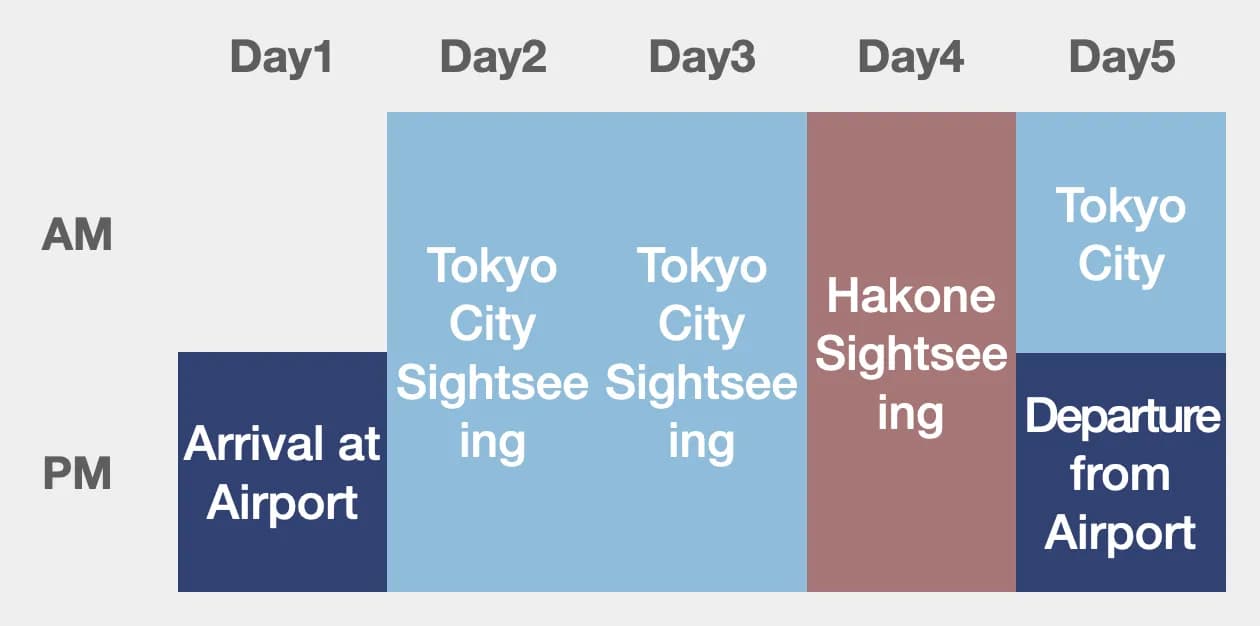
Let's assume a 5-day trip with accommodation near a subway station. Purchasing the Keisei Skyliner (Round-trip) + Tokyo Subway Ticket set results in the following costs:
- 24-hour set: 5,100 yen
- 48-hour set: 5,600 yen
- 72-hour set: 6,100 yen
Considering the standalone online discount for a Skyliner round-trip is about 4,500 yen, you are essentially getting unlimited subway rides for 3 days for only an additional 1,600 yen (for the 72-hour set). Since Tokyo subway fares start at 180 yen, it is profitable if you ride just 2 or 3 times a day.
2) Efficient Time Allocation Strategy
You can easily cover a 5-day itinerary by taking advantage of the fact that the passes are 'hourly.'
- Days 1–4: Activate your pass upon reaching the city center from the airport. If you use a 72-hour pass, subway travel is free until the same hour on the 4th day.
- Days 4–5: After the pass expires, use an IC Card (Suica/PASMO) and pay individually for necessary sections.
- Result: You can handle over 80% of your trip with the subway pass and minimize costs by using the IC card only for JR or private railway segments.
💡 Tip: Staying near a Subway Station?
Since you'll start your journey from the station right in front of your accommodation every time, your subway usage frequency will be overwhelmingly high. A major advantage of having the Subway Ticket is having no extra burden for transfer mistakes or route deviations.
Efficient Tokyo Itinerary Planning: Hourly DIY SchedulingCreate your own travel plan with the 1.0 / 0.8 / 0.5 rule
Most travel guidebooks provide recommended courses by the day, but these are difficult to adjust based on individual tastes or accommodation locations.
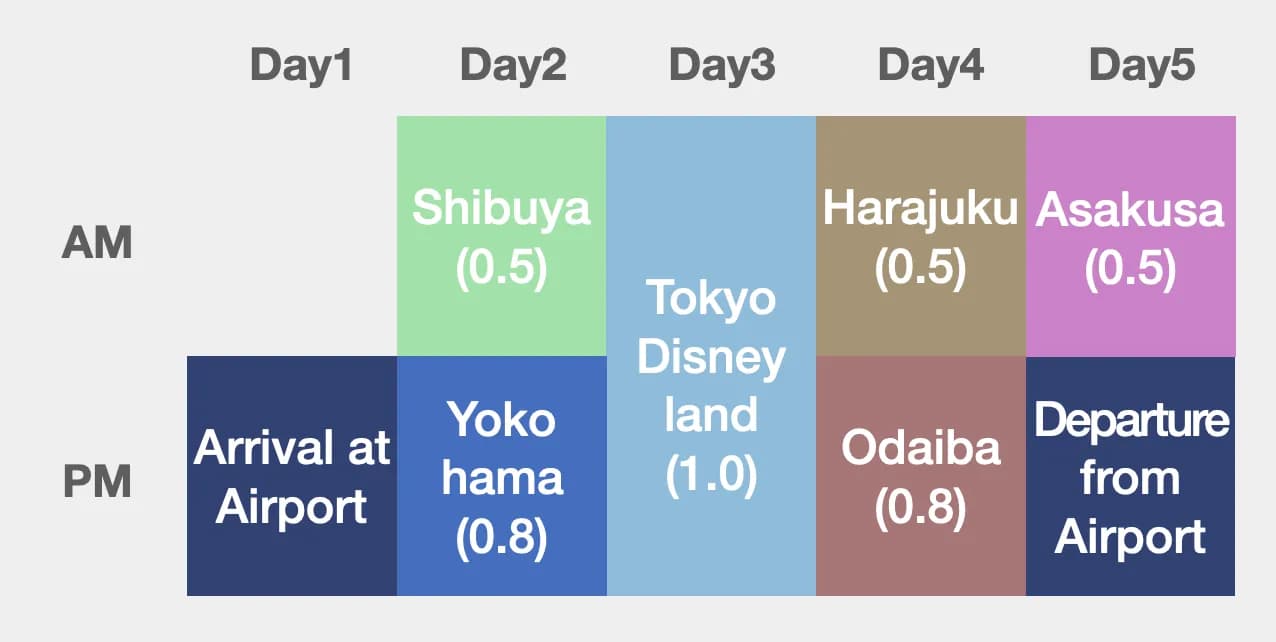
TourCast suggests a DIY (Do It Yourself) approach, quantifying the recommended duration of each attraction so travelers can combine them. Use the guide below to create your own packed schedule.
1) DIY Itinerary Formula (1.0 / 0.8 / 0.5)
You can easily design a daily schedule by classifying the energy and time required for each attraction into these three criteria:
- (1.0) Full-day Course: Places that require a full commitment from morning to evening, including travel time.
- (0.8) Afternoon + Evening Course: A heavy itinerary that starts after lunch and includes night views (approx. 8–9 hours).
- (0.5) Half-day Course: A light visit using only one block of time—either morning or afternoon (approx. 3–4 hours).
2) Recommended Values for Major Tokyo Attractions (as of 2026)
| Attraction | Value | Features & Duration |
|---|---|---|
| Disneyland / Sea | 1.0 | From open to close (at least 10–12 hours) |
| Odaiba | 0.8 | Includes shopping, teamLab Borderless, and night views (approx. 8 hours) |
| Yokohama | 0.8 | Round-trip travel and night viewing (approx. 7–8 hours) |
| Shibuya / Harajuku | 0.5 | Shopping and Shibuya Sky observatory (approx. 4 hours) |
| Asakusa Senso-ji | 0.5 | Traditional streets and temple sightseeing (approx. 3 hours) |
| PokéPark Kanto (New) | 0.8 | Opening in 2026, located inside Yomiuriland (approx. 6–7 hours) |
3) Core Points for Combining Itineraries
Simply adding up numbers to reach 1.0 isn't everything. For a trip with less fatigue, consider the following:
- Route Optimization: Group adjacent areas like 'Shinjuku-Shibuya-Harajuku' to save travel time.
- Pass Utilization: On days you use the Tokyo Subway Ticket, group subway-focused areas like Asakusa, Ginza, and Roppongi.
- Prioritize Reservations: Place locations with fierce competition for bookings, like Shibuya Sky or the Warner Bros. Studio Tour (Harry Potter), first and fill the remaining schedule around them.
Exclusive TourCast Tips!
Easily Plan Your Itinerary Using Night Views!
Most Tokyo trips end with night views. Instead of worrying about your daytime schedule first, try placing the night view spots you want to see first.
- Shibuya Sky: The hottest night view recently. Recommended in combination with Shibuya/Harajuku shopping.
- Roppongi Hills: The best place to see Tokyo Tower beautifully.
- Azabudai Hills: A rising star still popular in 2026.
- Odaiba: Rainbow Bridge and sea night views. Optimal for a date course.
Once you decide where you want to be at night, the daytime attractions and restaurants near that area naturally fall into place, making your route smoother.
Essential Pre-Trip Check: Verifying Festival & Event SchedulesTips for setting travel dates around fireworks, cherry blossom season, and Matsuri
Imagine coming home from your trip only to find out a famous festival was held while you were there.
It's never easy to time a trip for that period again. Just ignoring it might leave you with a sense of regret, or you might feel upset thinking you missed something grand. Therefore, before finalizing your Tokyo travel dates, it is wise to check information on major events or festivals held locally.
Specifically, seasonal fireworks, cherry blossom festivals, and Matsuri (traditional festivals) can significantly enhance your travel satisfaction if you time your itinerary correctly.
Tokyo Major Seasonal Event Guide
| Season | Major Events | Features |
|---|---|---|
| Spring (Mar–Apr) | Cherry Blossom Festival (Hanami) | When Ueno Park, Meguro River, and the entire city are dyed in cherry blossoms |
| Summer (Jul–Aug) | Sumida River Fireworks Festival | Japan's largest fireworks display (Hanabi). Vibrant atmosphere with locals in Yukata |
| Autumn (Oct–Nov) | Fall Foliage & Meiji Jingu Matsuri | Gingko trees at Meiji Jingu Gaien and various traditional ceremonial events |
| Winter (Dec–Feb) | Illuminations | Brilliant light decorations at Roppongi Hills, Ebisu Garden Place, etc. |
💡 Precautions When Checking Events
During festival periods, accommodation prices may skyrocket and public transport can be extremely crowded.
- Matsuri: During large festivals like the Asakusa Sanja Matsuri (May), surrounding roads may be closed.
- Fireworks: Crowds gather from the morning to secure spots, so plan your schedule with plenty of buffer time.
You can check real-time festivals and detailed event information on the Tokyo official tourism website calendar below.
This year, several large-scale commercial facility renewals and new theme park events are scheduled in central Tokyo. Checking the 'New' section of the official site before visiting may also lead to news about surprise pop-up stores or limited-edition merchandise sales.