PrefaceHow to plan Takamatsu nearby trips
The most popular nearby areas you can visit from Takamatsu as a day trip or a 1-night itinerary can be grouped into Kotohira, Naoshima, Shodoshima, Chichibugahama (Mitoyo City), and Okayama & Kurashiki Bikan Historical Quarter.
Because each destination requires a decent amount of travel time, it’s difficult to combine two places in one day, so most people visit them as one full day trip per destination. If you want to travel more slowly and comfortably, a 1-night itinerary is recommended.
In the main sections below, you’ll find detailed notes on how to use transport passes, key movement routes, and recommended attractions—use it to match your schedule and travel style.
Exclusive TourCast Tips!
How to choose a destination near Takamatsu
So which of these five places fits you best? Since each destination has a distinct travel vibe, it’s best to pick based on your style and timeline using the points below.
- Kotohira: Recommended if you prefer a traditional, historical atmosphere and a quiet Japan trip. You’ll need basic stamina because it’s 785 stone steps to the main shrine (1,368 steps total).
- Naoshima: Perfect for travelers who love art, architecture, and aesthetic photos. You can enjoy an art-focused trip with Yayoi Kusama works and Tadao Ando architecture.
- Shodoshima: Recommended if you want nature, a relaxed vibe, and a cozy island atmosphere. There’s a lot to see, including Olive Park, Angel Road, and Kankakei Gorge.
- Chichibugahama: If you want to enjoy what’s often called Japan’s best sunset—and the “Uyuni-style” reflection photos. The most popular spot for sunset-aesthetic travelers.
- Kurashiki Bikan Historical Quarter: Best for travelers who love traditional streets and historic architecture. The canal scenery and calm Edo-era atmosphere are the main charm.
Note that Naoshima and Shodoshima are island destinations that require a ferry, so in case of bad weather, strong winds, or rough waves, the boats can be canceled. Always check the operating status on the ferry company website before departure.
Also, to prepare for sudden cancellations, it helps to pre-plan one or two backup options (e.g., Ritsurin Garden, Takamatsu city sightseeing, Kotohira-gu Shrine). This makes your itinerary far more stable.
Around KotohiraPasses you need for Kotohira-gu Shrine and New Reoma World
1. Kinryo Sake Museum Brewery
A place where you can explore the history and brewing culture of the traditional sake brand ‘Kinryo (金陵)’, which has continued for over 200 years in Kotohira. It’s a museum created by opening up an old brewery, featuring brewing tools exhibits · a tasting corner · and a souvenir shop.
It’s an easy stop before or after visiting Kotohira-gu Shrine, and it fits naturally into the travel route.
Kinryo Sake Museum Brewery location Kinryo Sake Museum Brewery website2. Nakano Udon School (Kotohira Branch)
Kotohira’s most famous Sanuki udon-making experience. You can make udon using the traditional method—stepping on and kneading the dough. The process is short and easy, so it’s great for families · couples · and friends, and you can take your handmade udon home as a souvenir.
Nakano Udon School location Nakano Udon School website3. Konpira Omotesando
This is the starting point for the Kotohira-gu Shrine approach, and the key stretch of Kotohira travel—lined with traditional shops, tea houses, udon restaurants, and souvenir stores. You naturally pass through it before climbing the steps, and it’s where you can feel the local character most vividly.
Konpira Omotesando locationOmotesando (表参道) is a general term meaning the official worship path from the main gate of a shrine/temple to the main hall. It exists all over Japan and is not a proper noun tied to one specific place.
However, Tokyo’s Omotesando (表参道) street is a special case where this general term became a place name—originating as the approach to Meiji Jingu and later becoming the name of today’s shopping street.
4. Kotohira-gu Shrine
Known as Shikoku’s top shrine, Kotohira-gu (Konpira-san) is Kagawa Prefecture’s major sacred site, enshrining a deity that protects maritime safety.
The path to the main shrine has 785 stone steps, and the approach is lined with traditional shops and tea houses, making the walk enjoyable. At the top, you get an excellent view over the Kotohira town and the Sanuki Plain, which is why so many travelers visit.
It also serves as the head shrine of Konpira-related shrines across Japan and has long gathered deep devotion nationwide.
Kotohira-gu main shrine location Kotohira-gu website1) Konpira-san
Kotohira-gu (琴平宮) is widely known as Shikoku’s top shrine, and locally it’s even more commonly called “Konpira-san (こんぴらさん)”.
“Konpira-san” comes from the shrine’s former name Konpira (こんぴら) plus the honorific “san (さん)”, making it a friendly nickname.
So Kotohira-gu = Konpira-san—when locals say “I went to Konpira-san,” they mean Kotohira-gu.
2) Konpira walking stick
At the entrance, you can borrow a walking stick (100 yen) to help with the stairs. It reduces knee strain on the steep steps and genuinely helps for the climb to the main shrine (785 steps). When you’re done, you simply place it in the return box at the entrance.
6. New Reoma World
New Reoma World is a large theme park near Takamatsu with rides · a water park · restaurants · shopping · and resort lodging. It’s especially popular for families with kids, and it pairs well with an itinerary where you visit the park and then stay at a ryokan around Kotohira.
If you plan to visit, there’s a pass you should buy: the Kotoden New Reoma World Kippu.
Kotoden New Reoma World Kippu
-
A special set you can use together with a Kotoden 1-day pass
-
New Reoma World Free Pass
(includes admission + unlimited rides) -
Available for purchase across the Kotoden network
-
On-site purchase: 4,300 yen
-
With the pass: 3,800 yen → a much better-value “bang-for-buck pass”
- Students: 2,800 yen
- Children: 2,300 yen
- ※ Students include middle/high school + university (bring student ID)
Summer-only: Happy Passport
- Seasonal pass that includes the pool + free pass
- Adults 4,800 yen / Students 3,800 yen / Children 3,300 yen
Exclusive TourCast Tips!
Kotohira’s only day-use onsen
As of now, the only place in Kotohira where you can use a day-use onsen is Konpira Onsen Yumoto Yachiyo (こんぴら温泉 湯元 八千代).
- Hours: 11:00 ~ 14:30 (last entry 14:00)
- Fee: Adults 800 yen / Children 600 yen (includes onsen tax)
- Towels: Small towel 100 yen / Large towel 300 yen
- Open-air bath: Alternating system (even dates → women only / odd dates → men only)
- Private baths: For hotel guests only (day-use not allowed)
If you’re planning a day-use onsen, the most efficient route is Kotohira-gu Shrine (morning) → descend → Yachiyo onsen (around lunch). The onsen is only available until 2 PM, so time management matters.
Konpira Onsen Yumoto Yachiyo locationKonpira Onsen Yumoto Yachiyo day-use onsenNaoshimaHow to get to Naoshima and how to get around on Naoshima
Naoshima (直島), Japan’s representative art island where architecture, contemporary art, and island vibes blend together, is a special destination where the entire island is curated like one huge museum—centered around works by world-famous artists such as Yayoi Kusama and Tadao Ando.
Yayoi Kusama is one of Japan’s most iconic figures in contemporary art. With her signature themes of repetitive polka-dot patterns, bold colors, and infinite repetition, she has earned worldwide recognition. Raised in a conservative family in Nagano Prefecture where her artistic ambitions were opposed, she has shared that from childhood she experienced hallucinatory imagery where the boundary between reality and fantasy blurred. This inner anxiety and compulsive visual experience became a major root of her artistic world.
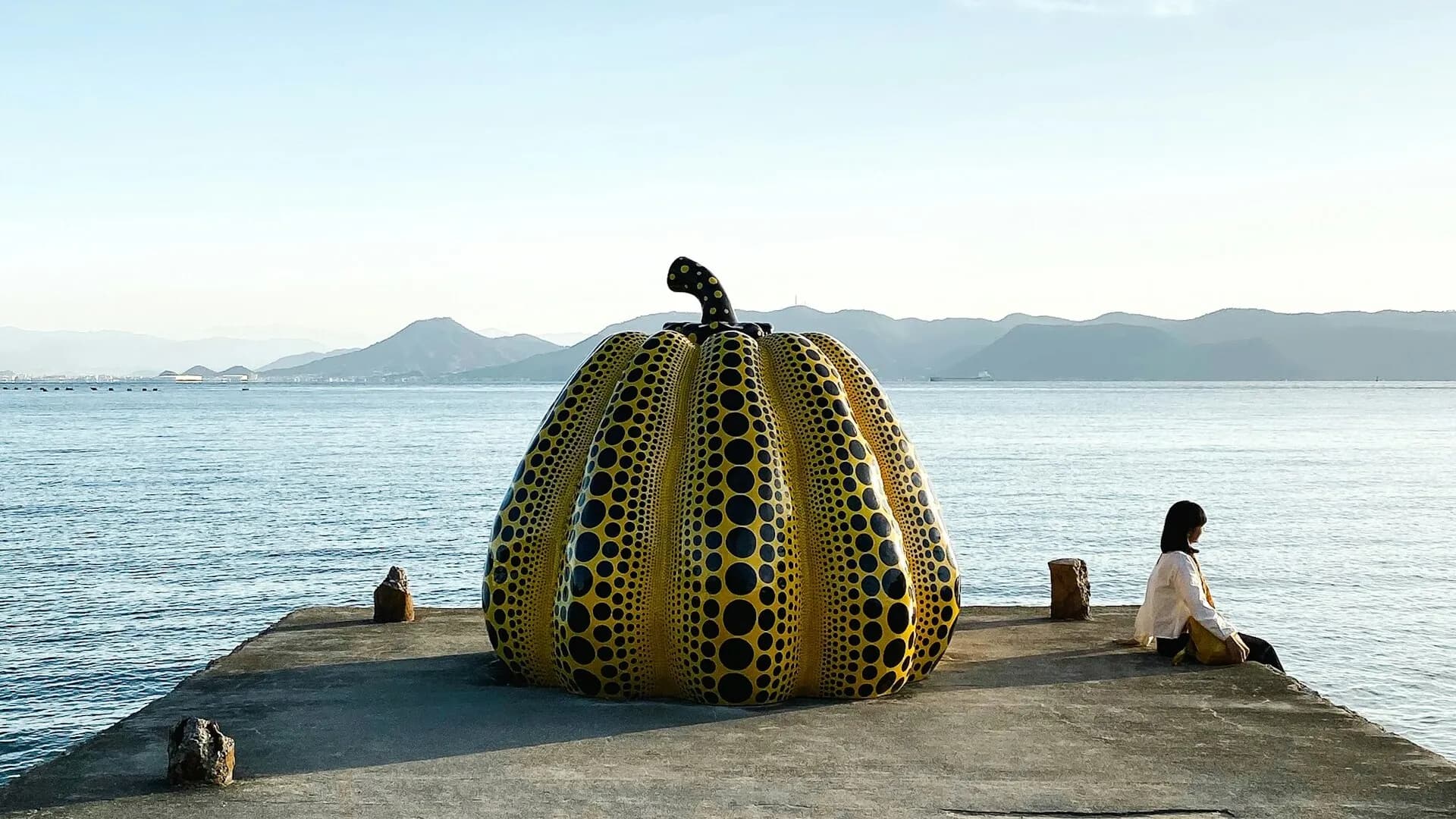
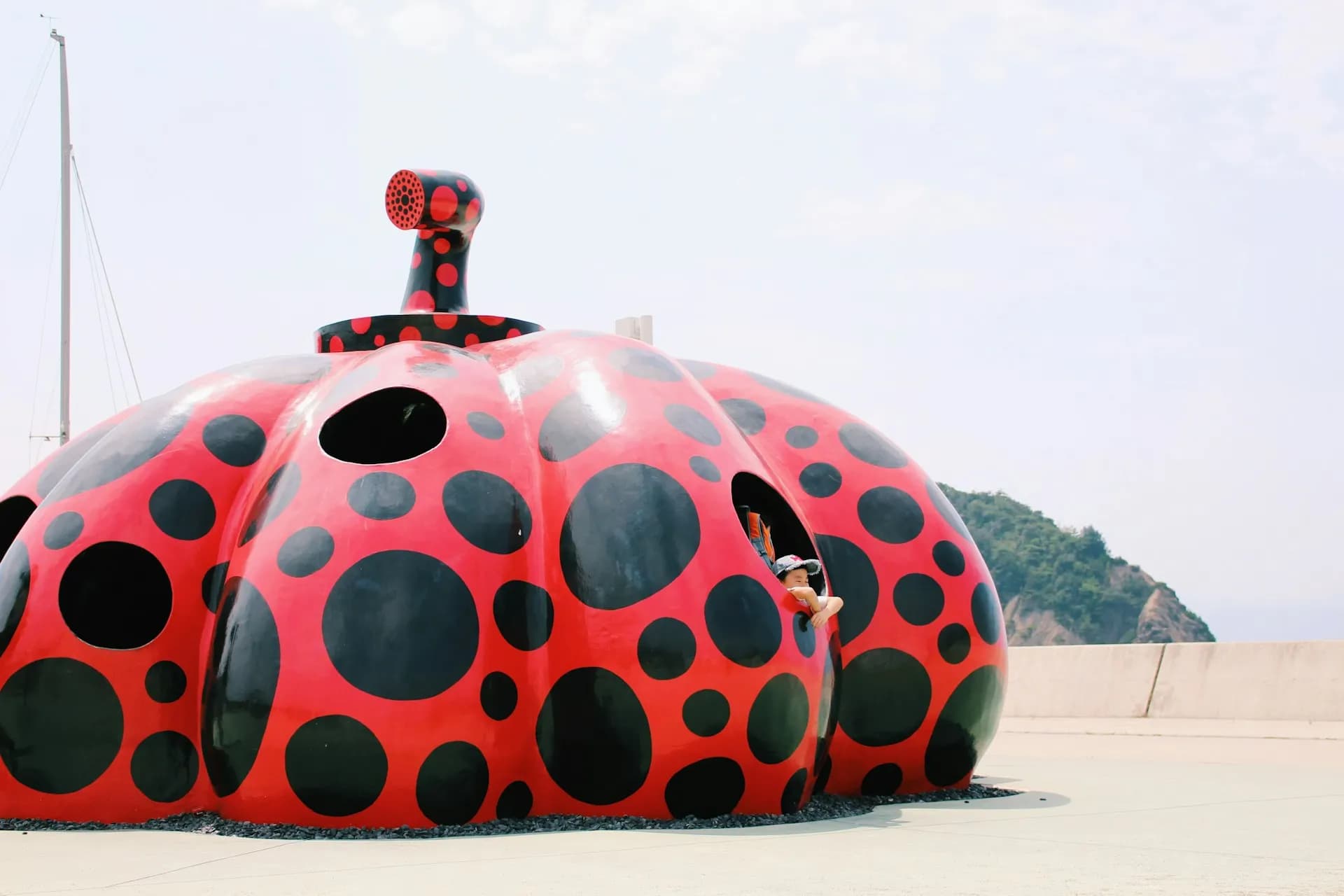
The “pumpkin” she encountered on her family’s farm in childhood remained a vivid memory and later evolved into her iconic “Pumpkin” series. The famous yellow and red pumpkin sculptures that have come to symbolize Naoshima are an extension of that motif.
Since the 1960s, she has chosen to voluntarily live in a psychiatric hospital in Tokyo, continuing a unique daily routine in which she resides at the hospital and goes to her studio to work every day. This is widely known as her way of sustaining her creative practice amid an unstable mental state.
The polka dots and Infinity Net patterns in Kusama’s works are not mere decoration—they are autobiographical motifs that visualize her inner world. Knowing this background can make the viewing experience feel much deeper.
In particular, museums, cafés, and the seaside scenery connect seamlessly, creating such a strong sense of artistic immersion that the phrase “the walking route itself is the exhibition” feels perfectly fitting.
Naoshima became globally famous because, starting in the late 1990s, the Benesse Art Site Naoshima project was actively developed, and the entire island drew attention as a model for “regional revitalization through art.” As a result, world-class works of architecture and art—such as the Chichu Art Museum, Benesse House, and the Lee Ufan Museum—gathered in one place, establishing Naoshima’s unique status as a true “art pilgrimage destination.”
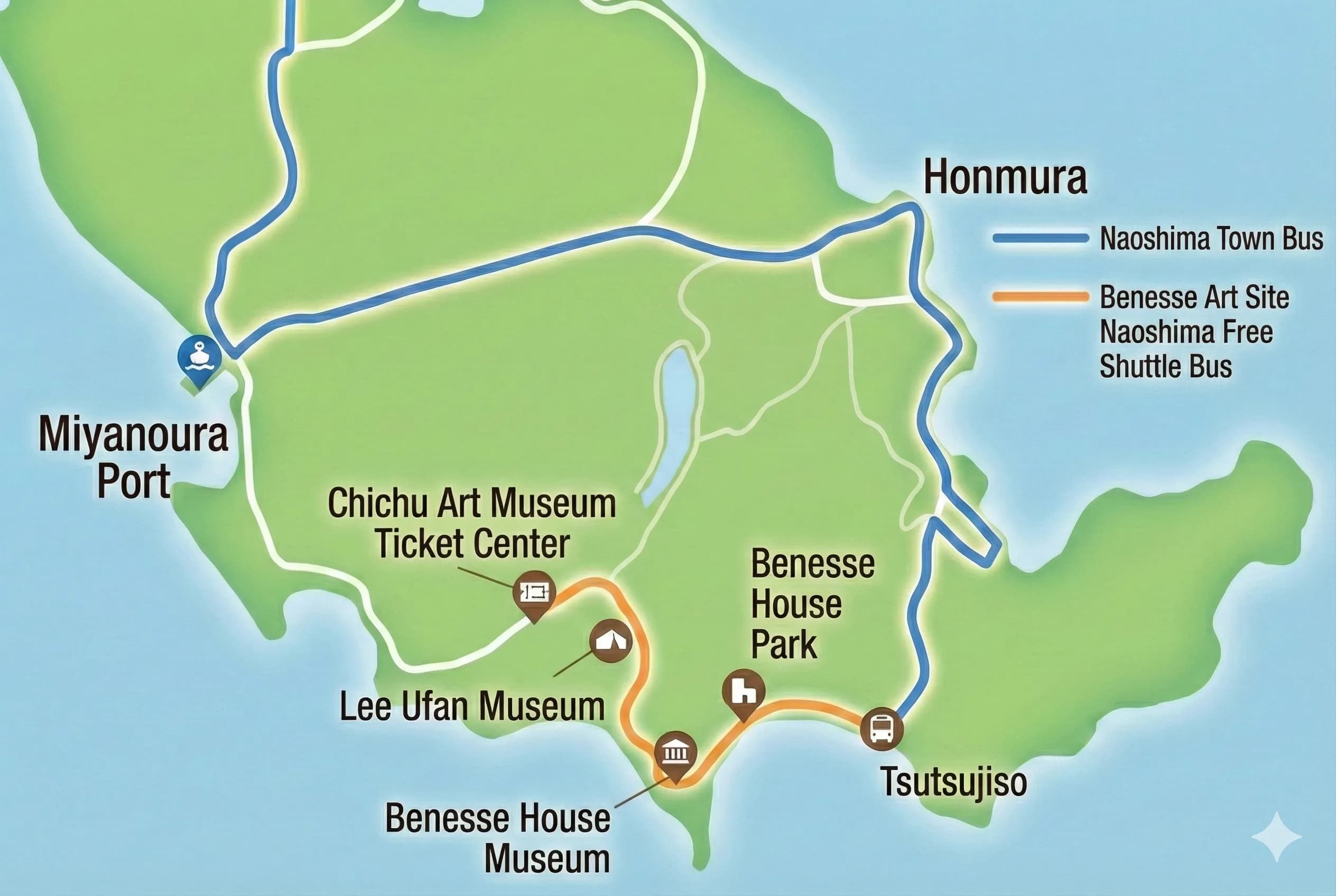
Planning a Naoshima trip becomes very easy once you understand the island’s core zones. The island is broadly divided into the following three areas. If you simply grasp their locations, a natural and efficient route falls into place.
- Miyanoura Port
- Honmura Area
- Benesse Art Site Area Once you understand this structure, your route, transportation choices, and viewing flow become cleanly organized.
1. How to get to Naoshima
1) How to reach Miyanoura Port (宮浦港) — Shikoku Kisen
With Shikoku Kisen, there are two ways to reach Naoshima’s Miyanoura Port: the ferry and the high-speed passenger boat. Since the ticket counters and boarding locations differ, be sure to confirm before departure.
Tickets can be purchased from 40 minutes before departure for the ferry, and 30 minutes before departure for the high-speed boat. Especially in peak seasons and on weekends, the high-speed boat can sell out (reach capacity), so it’s best to arrive early and wait with plenty of buffer time.
🚢 Ferry
- Fare: Adults 680 yen / Children 340 yen
- Travel time: About 50 minutes
- Notes: Spacious seating and less swaying, making it comfortable. If the weather is fine, it’s the safest all-around choice.
⛴️ High-speed boat
- Fare: Adults 1,590 yen / Children 800 yen
- Travel time: About 20 minutes
- Notes: Fast and convenient, but it sways more than the ferry and costs more.
Departing from Takamatsu
Where to buy ferry tickets (A) Ferry boarding point (2)Where to buy high-speed boat tickets (B) High-speed boat boarding point (3)
Departing from Miyanoura
Where to buy ferry & high-speed boat tickets Ferry boarding point High-speed boat boarding point2) How to reach the Naoshima Honmura (直島本村) route — Teshima Ferry
The Teshima Ferry is primarily a route between Takamatsu and Ieura Port (家浦港) on Teshima (豊島), but some services stop by Naoshima’s Honmura Port. Since it takes only about 30 minutes from Takamatsu, it can save time by reducing the need to travel from Miyanoura to Honmura.
Mar 20 – Nov 30 (peak season)
- Mon / Sat / Sun / holidays: 2 services per day
- Wed / Thu / Fri: 1 service per day
Dec 1 – Mar 19 (winter season)
- Mon / Fri / Sat / Sun / holidays: 1 service per day
- Tue / Wed / Thu: No service → Important!
🚢 Service details
- Fare: Takamatsu → Naoshima one-way 1,450 yen / Children 730 yen
- Travel time: Takamatsu Port → Naoshima Honmura Port about 30 minutes
- No reservations: First-come-first-served, capacity 70 passengers
-
Recommended when:
- You want to head straight toward Benesse House / Chichu Art Museum
- You want to save time on the Miyanoura → Honmura transfer
- However, if the bus departing from Miyanoura is full, you may not be able to board
- For departures from Naoshima, tickets are purchased on board
Takamatsu Port ferry boarding point (4) Ticket counter for departures from Takamatsu (B)
Naoshima Honmura Port ferry boarding point
2. Getting around on Naoshima
1) Naoshima Town Bus (Naoshima Municipal) — the 100-yen bus
- Miyanoura bus stop → Honmura Port → Tsutsujiso bus stop
- Fare: Adults 100 yen / Children 50 yen (one way)
- Capacity: 28 people → if full, you must wait for the next bus
- No coin changer on the bus
- Change is handled directly from the driver’s own cash → prepare 100-yen coins or small change in advance for smooth payment
- IC cards (Suica, etc.) are not accepted; cash only
Once you arrive on Naoshima, the most important thing is to go straight to the 100-yen bus stop and line up. Around arrival times, crowds can surge and the bus often fills up, so a bit of “timing game” is unavoidable.
If the bus is full, rather than rushing to re-line up immediately, it’s usually much more efficient to visit the nearby spots below first and wait for the next bus.
- Yayoi Kusama “Red Pumpkin”
- Naoshima Pavilion
- I♥湯 public bath (I Love Yu)
2) Benesse free shuttle bus
If you get off at the Tsutsujiso bus stop, within the Benesse Art Site Naoshima area, the Benesse free shuttle bus circulates the stops below at roughly 30-minute intervals.
- Tsutsujiso bus stop
-
Hiroshi Sugimoto Gallery
- ※ Drop-off only stop
- Benesse House Museum
- Lee Ufan Museum
- Chichu Art Museum
After 5 PM, shuttle operation is available only on days when the Chichu Art Museum is open until 6 PM, so be sure to check the operating schedule before visiting.
Benesse free shuttle timetable & detailsNaoshima’s museums sit on hilly terrain with significant elevation differences, and the Chichu Art Museum at the end of the route is the highest point. For that reason, the most efficient flow is to visit Chichu Art Museum first, then walk downhill or use the shuttle to move on to other museums.
While viewing, it’s best to check the next shuttle time and pace your visit accordingly.
3) Bicycle & motorbike rental
If the weather is good, renting a bicycle or motorbike instead of relying on buses is also recommended. Naoshima is about 2.5 km across, which can be tiring on foot, but is very manageable by bicycle—making for a freer, more relaxed island trip.
Rental shops are available at key hubs such as Miyanoura Port and Honmura. Choose based on your stamina, weather, and schedule.
- Electric bicycle: About 1,500 yen per day
- Motorbike: From about 2,500 yen per day
- However, riding is not allowed within the Benesse Art Site area
- If you bike from Miyanoura, you can ride up to the designated bicycle parking lot near the Chichu Art Museum entrance. Beyond that, you must continue on foot or by the Benesse shuttle; bicycles cannot enter the inner museum zones.
Some rental shops may ask to verify your passport, and for a motorbike you must have an International Driving Permit (Category A).
- In Korea, a Category A IDP requires a 2nd-class small motorcycle license (you cannot obtain it with a standard car license or moped license).
If you plan to explore Naoshima by bike, note that Japan’s bicycle rules are relatively strict, so it’s recommended to consult Guidebook – Common Part 2 “Bicycle Rental” before using one. There are many differences from Korea—bike lanes, parking rules, strict DUI rules, etc.—and knowing them in advance helps make your trip safer and more comfortable.
4) Car rental
If your group is around 4 people, renting a car is also a strong option. Rentals start from around the 6,000-yen range per day, and when split among four people the cost burden is small. You can tour the island efficiently without being constrained by bus schedules.
Bicycle & motorbike rental detailsFor car rental, an International Driving Permit is required. Be sure to check Japan’s traffic rules, parking rules, and insurance information in Guidebook – Common Part 2 “Rental Car Preparation”.
3. How to tour Naoshima
Naoshima has many museums and artworks scattered across the island, and even a quick look at the table below shows that it’s difficult to see everything in a single day. Since viewing times can be long and admission fees can add up, the most efficient approach is to first confirm openings based on your travel date, then select priority works and museums to build into your itinerary.
In particular, some museums operate with capacity limits, and entry can be difficult without advance booking, so online reservations are strongly recommended.
Benesse Art Site calendar Benesse Art Site reservations| Area | Facility | Online | On-site | Capacity | Notes |
|---|---|---|---|---|---|
Around | Miyanoura Gallery 6 | 520 yen | 520 yen | - | |
| I♥湯 public bath (I Love Yu) | - | 660 yen | No reservation needed 310 yen for ages 15 and under | ||
| Red Pumpkin | - | - | - | ||
Around | Art House Project (Common Ticket) | 1,200 yen | 1,400 yen | Access to 5 facilities | |
| Art House Project (Single Venue) | 600 yen | 700 yen | Choose 1 facility | ||
| Art House Project “Minamidera” | 600 yen | 700 yen | O | Not permitted for ages 5 and under | |
| Art House Project “Kinza” | 600 yen | 700 yen | O | Entry one person at a time | |
| Ando Museum | 600 yen | 700 yen | - | ||
| Naoshima New Museum of Art | 1,500 yen | 1,700 yen | Free for ages 15 and under (ticket required) | ||
Benesse | Yellow Pumpkin | - | - | - | |
| Chichu Art Museum | Weekdays 2,500 / Weekends 2,700 | Weekdays 2,800 / Weekends 3,000 | O | Free for ages 15 and under | |
| Benesse House Museum | 1,300 yen | 1,500 yen | Free for ages 15 and under & hotel guests | ||
| Hiroshi Sugimoto Gallery | 1,500 yen | 1,600 yen | O | Free for hotel guests | |
| Lee Ufan Museum | 1,200 yen | 1,400 yen | Free for ages 15 and under (ticket required) | ||
| Ring of Fire – Sun of the Lamb | 600 yen | 700 yen | O | Daytime viewing / Free for ages 15 and under | |
| Ring of Fire – Ulase Tukun’s Moon | 1,800 yen | 2,000 yen | O | Nighttime / Paid for ages 15 and under | |
| All areas | The Naoshima Plan – Water | Free | Free | No reservation needed |
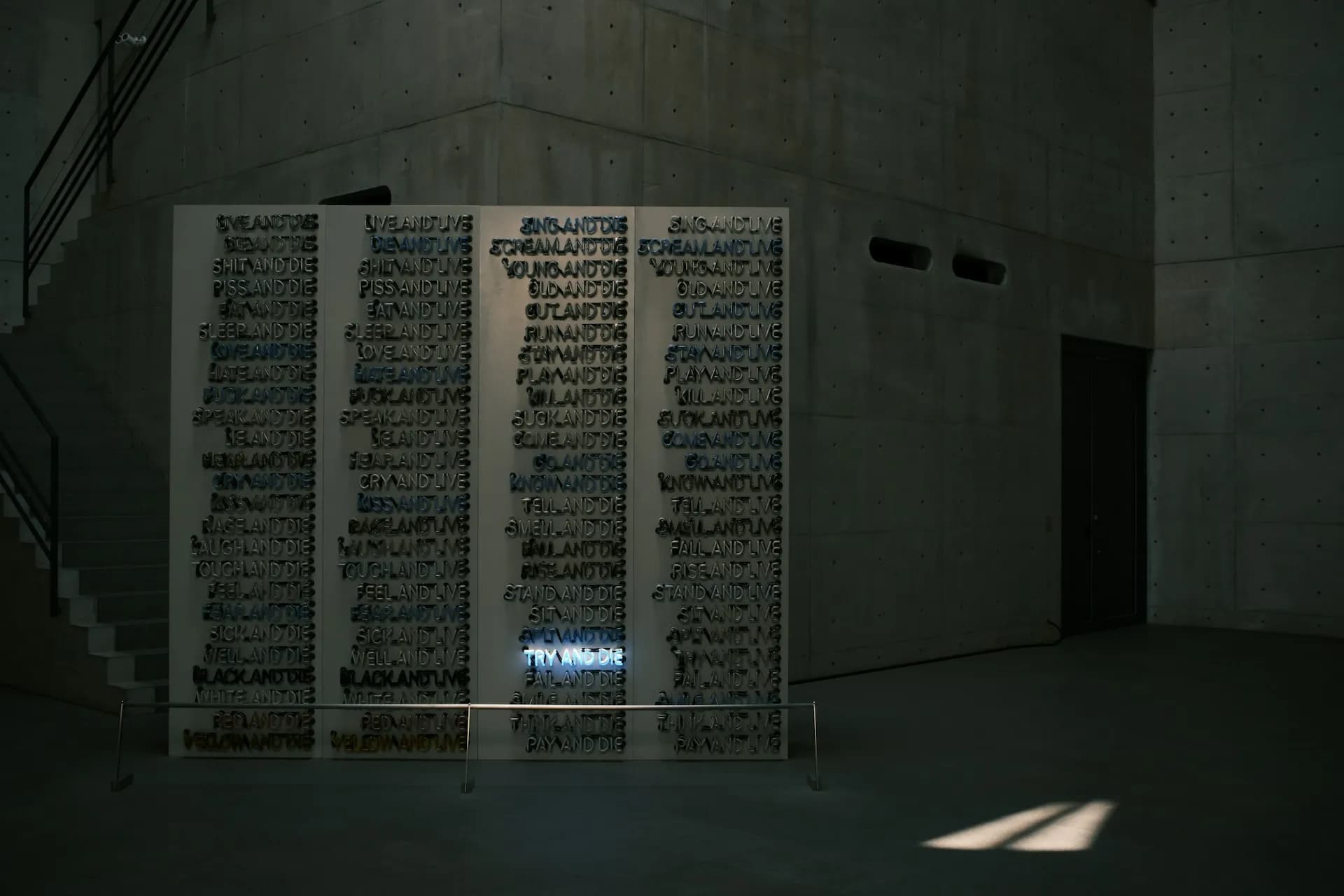
4. Lee Ufan Museum
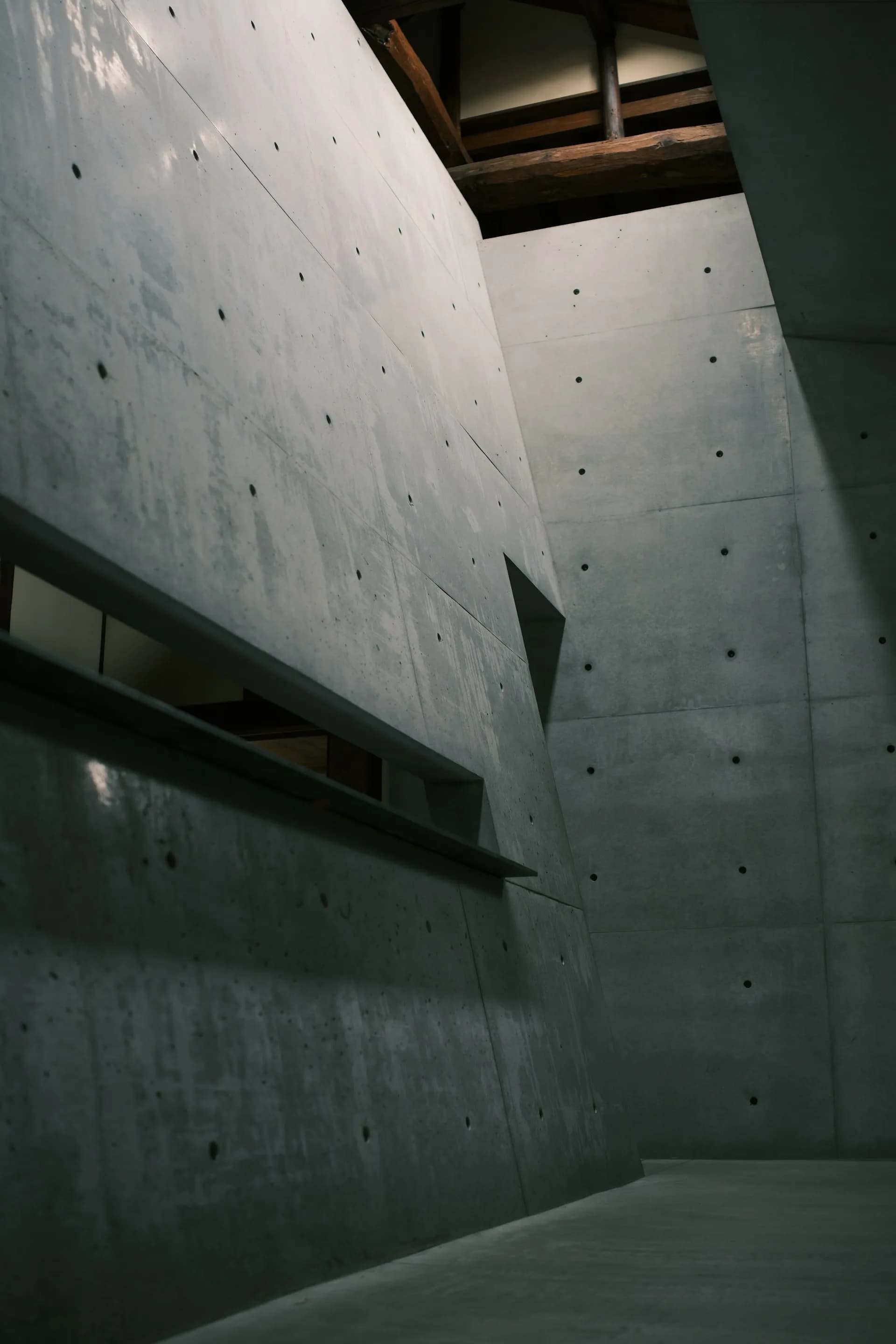
A museum dedicated to the works of world-renowned contemporary artist Lee Ufan (Korean-born). Designed by architect Tadao Ando, it’s characterized by a minimalist space where art, architecture, and nature blend together like a single installation.
You can view restrained paintings and sculptures grounded in the aesthetics of Mono-ha (物派), and together with Naoshima’s quiet landscape—reminiscent of the Mediterranean—it offers a highly contemplative and deeply immersive viewing experience.
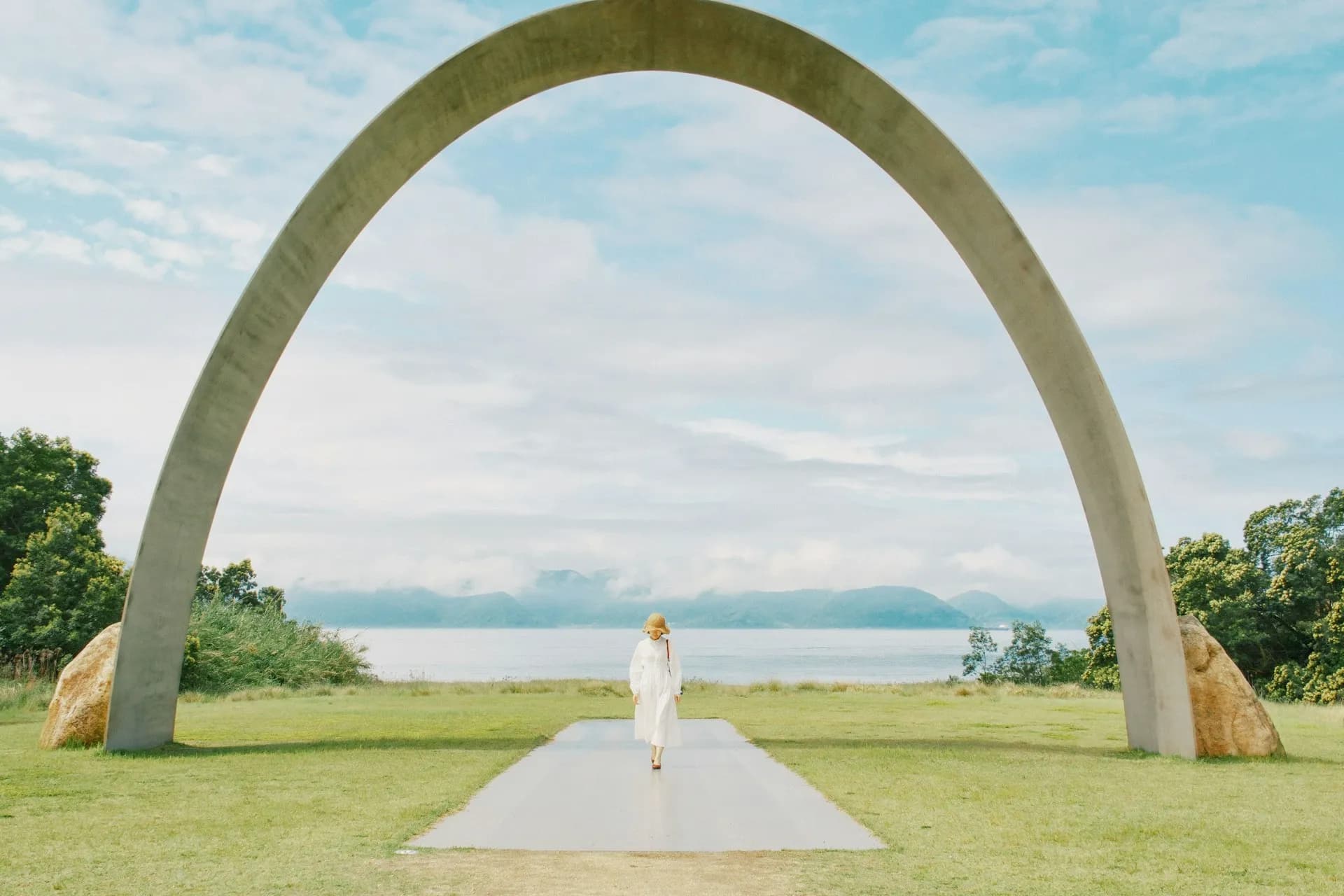
Not only the Lee Ufan Museum, but also Korean artist Do Ho Suh’s Hub/s work exhibited in Gallery 2 (B1F) of the Naoshima New Museum of Art is a must-see highlight, so it’s strongly recommended to include it in your travel route together.
ShodoshimaHow to get to Shodoshima, transportation, and recommended attractions
Located in the Seto Inland Sea, Shodoshima is well known for its mild climate, beautiful coastline, and its symbol as Japan’s first olive cultivation area.
In 1908, olive cultivation began in Shodoshima, Mie Prefecture, and Kumamoto Prefecture, but Shodoshima was the only place where the warm, dry climate matched consistently, which led to its unique brand as the “Olive Island” that continues today.
Across the island, Mediterranean-like scenery and traditional Japanese culture exist side by side. With a good balance of nature, art, food, and hands-on activities, it remains a popular destination for travelers from Japan and overseas.
In recent years, the island has become even more appealing with the Setouchi Triennale, famous film locations (Twenty-Four Eyes / 二十四の瞳), and a ropeway with some of the best views, earning its place as a “must-visit island.”
Shodoshima Tourism Association1. How to Get to Shodoshima
From Takamatsu, there are mainly three ferry routes to Shodoshima. Each port is different in access, nearby sights, and bus connections, so it is best to choose based on your travel plan.
- There used to be a ferry to Kusakabe Port (草壁港), but it has now closed
1) Tonosho Port (土庄港) — Shodoshima Ferry
This is the main gateway for Shodoshima. It offers the easiest access to Angel Road, and many local bus routes start here, so most travelers use this port. There are two options to reach Tonosho Port: a high-speed boat and a regular ferry.
- Pros
- Best access to Angel Road
- Many bus routes → easiest for getting around the island
- Many hotels, restaurants, and shops nearby
- Great as a base at the start of your trip
- Recommended for
First-time visitors to Shodoshima, or travelers planning an island trip mainly by public transport -
Shodoshima Ferry (High-speed boat)
- Travel time: about 35 minutes
- Frequency: 15 services per day
- Fare: Adult one-way 1,400 yen, round-trip 2,660 yen / Children 50% of the adult fare
-
Shodoshima Ferry (Regular ferry)
- Travel time: about 1 hour
- Frequency: 15 services per day
- Fare: Adult one-way 700 yen, round-trip 1,330 yen / Children 50% of the adult fare
- Note: Different character-wrapped ferries (Slowpoke, Takaki-san, Shimachan) operate depending on the service
- Boarding is possible with the Kagawa Mini Rail & Rail Pass (show your pass at the ticket counter, exchange it for a boarding ticket, then board)
Where to buy ferry tickets (A) Ferry boarding point (2)
Where to buy high-speed boat tickets (B) High-speed boat boarding point (3)
Tonosho Port high-speed boat boarding point Tonosho Port ferry boarding point
2) Ikeda Port (池田港) — Kokusai Ryobi Ferry
A quieter, more relaxed port than Tonosho, and a good option for reaching the south and central parts of Shodoshima.
- Pros
- Calm atmosphere
- Cafes and small shops for a slower-paced trip
- Relatively close to Olive Park, making travel easier
- Shorter routes to sights in the south and central areas
- Recommended for
Travelers who prefer a quieter trip and the island’s peaceful atmosphere - Kokusai Ryobi Ferry
- About 1 hour one way
- 11 services per day
- Adult one-way 700 yen, round-trip 1,330 yen / Children 50% of the adult fare
- Boarding is possible with the Okayama Kagawa Wide Pass (show your pass at the ticket counter, exchange it for a boarding ticket, then board)
Ikeda Port location
3) Sakate Port (坂手港) — Jumbo Ferry
A quiet port in the southeast of the island. It is a good base for reaching nature scenery and viewpoint spots in eastern and southeastern Shodoshima. With fewer tourists, it is especially good for coastal drives and cycling trips in a peaceful atmosphere.
- Pros
- Easy access to viewpoint spots in the east and southeast
- Fewer tourists, so travel is more comfortable
- Great for an east-coast drive or cycling trip
- Recommended for Travelers who want to focus on eastern natural scenery
- Jumbo Ferry
- About 1 hour 15 minutes one way
- 2 to 3 services per day
- Adult one-way 700 yen, round-trip 1,400 yen / Children 50% of the adult fare
- Free shuttle bus from JR Takamatsu Station bus terminal, Platform 8
2. Getting Around Shodoshima
1) Olive Bus
This is the main public transport on Shodoshima. It connects the ports (Tonosho, Ikeda, Sakate) with key sights such as Angel Road and Olive Park.
- Fare depends on distance/sections
- IC cards such as Suica are accepted
- 1-day pass: Adult 1,600 yen / Child 800 yen
- Tonosho Port → Angel Road: 200 yen
- Angel Road → Olive Park: 500 yen
- Olive Park → Tonosho Port: 500 yen
→ If you ride only about three times, paying separately can be cheaper, but if you plan more trips, the 1-day pass is clearly better value - Available on the bus, at Tonosho Minato Terminal, Ikeda Port, Sakate Port, and the shop onboard the Jumbo Ferry, etc.
- Boarding is also possible with the Kagawa Mini Rail & Ferry Pass
Shodoshima has several different Olive Bus routes, so when you search on Google Maps, you often see multiple routes in different colors for the same destination.
In particular, when searching Tonosho Port → Angel Road, many routes appear, and the travel method can be very different, so you must check carefully.
-
Red route
- Drops you off about 1 km away from Angel Road, so you need to walk
-
Purple route
- Takes a long detour, so it is not efficient
On Shodoshima, bus routes can vary a lot, so it is very important to confirm the route and the departure/arrival times before you travel.
2) Bicycle Rental
From Tonosho Port to Olive Park is about 11 km. By e-bike, it takes around 40 to 50 minutes.
Cycling can be a great option in good weather, but in mid-summer heat and humidity, it can be tiring. It is safer to think of it as a backup option to the Olive Bus. It works well when bus timings do not match, or when you want to enjoy the island scenery at a relaxed pace.
Hello Cycling app
- Create an account and register a payment card (most Korean cards and travel cards work)
- E-bike pricing
- 200 yen per 15 minutes
- 2,000 yen for 12 hours
Since the island has gentle hills and winding coastal roads, an e-assist bicycle is much easier.
Hello Cycling official website3) Motorbike and Car Rental
If you have a Korean 2nd-class small motorcycle license, your international driving permit will show Class A, which allows you to legally rent a motorbike in Japan. If you do not have this license, you cannot get Class A, so you cannot ride a motorbike and you can only rent a car.
For a group of around four people, renting a car is usually the most convenient option. It makes it much easier to manage time and routes for getting around the island and nearby areas.
4) Bus Tour
This is the easiest way to see Shodoshima, but recent price increases may make it feel expensive. The tour is led by a Japanese guide, and you can listen to audio guides in Korean, English, and Chinese through a separate app, so you can enjoy the trip without language stress.
- Operating time: Departs 10:15 from Tonosho Minato Tourist Center → Arrives 16:15
- Price: Adult 9,800 yen / Child 6,200 yen
- Walk-in boarding: Possible if seats are available (however, cash payment only)
- Not included: Lunch, and ferry fare to Shodoshima
If the official booking page does not open properly or booking is difficult, you can also book through an OTA (online travel agency) like below. However, prices are often higher than the official site, so it is best to use this only when convenience is your priority.
5) Taxi Tour
For four people, a taxi tour costs 17,400 yen for 3 hours and 34,800 yen for 6 hours. It can be a good option when you want to travel comfortably in a shorter time, and with four people it can even be a more cost-effective choice than the bus tour.
It is especially recommended for families or small groups who want to focus on specific places and travel efficiently.
- Note: Entrance fees and costs such as the Kankakei Gorge ropeway are not included
Exclusive TourCast Tips!
How to make your Shodoshima trip easier
For Shodoshima, it is much easier to buy ferry tickets and bus passes in advance as digital tickets using the JapanTransit app, instead of lining up on site. In the app, go to Tickets → Area → Kagawa, then you can buy Shodoshima ferry tickets and the Olive Bus 1-day pass right away.
- However, even if you pay in the app, you cannot board the ferry directly. Before departure, you must show the digital ticket at the ticket counter and exchange it for a printed boarding pass.
Also, the Shodoshima Pass is basically a “bundle purchase” digital pass that lets you pay for the Olive Bus 1-day pass + multiple ferry tickets in one payment. It mainly reduces the hassle of buying several tickets separately, and it does not usually mean a bundle discount (lower fares).
Download for iOSDownload for AndroidSee details for the Olive Bus 1-day passSee Jumbo Ferry detailsSee Shodoshima Ferry detailsSee Shodoshima Pass details
If you only want to buy ferry tickets, another option is the SHIKOKURURI digital ticket. After a simple registration, you can select only the route you need and pay right away, which is especially convenient for travelers who do not need a bus pass. In this case as well, remember that you must exchange the digital ticket for a printed boarding pass at the ticket counter before boarding.
See SHIKUKORURI digital ticket details3. Recommended Attractions
1) Angel Road
A signature scenic spot of Shodoshima, this is a sandbar that appears twice a day depending on the tide. You can walk across to the island only during low tide (around two hours before and after), and it is also known as the “Path of Love.”
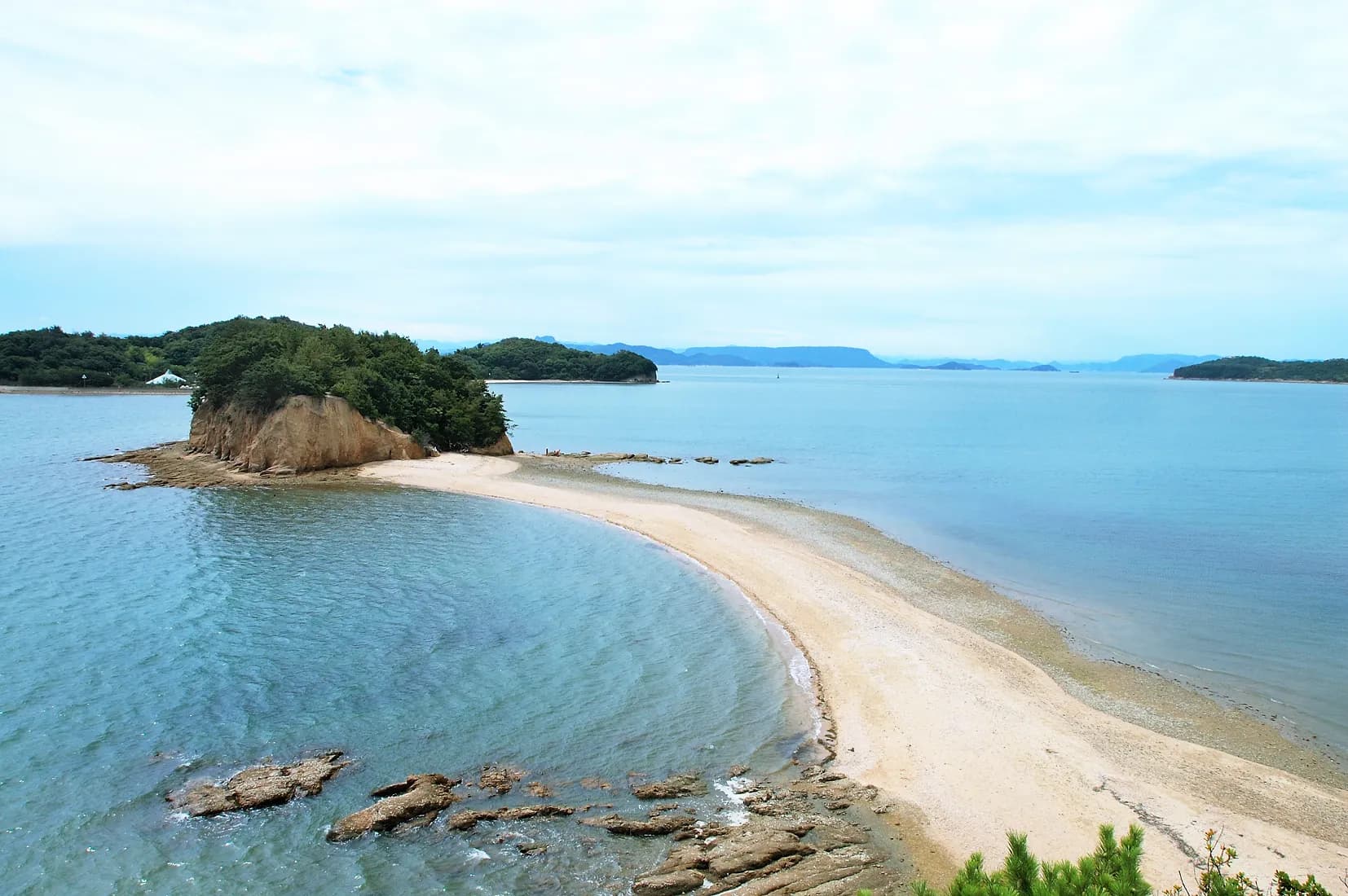
Since Angel Road is a sandbar that appears only around low tide, you must check the daily tide timetable, which changes every day.
Example: “午後 16時30分 ~ 22時30分”
- 16:30 → Best viewing time (low tide)
- 22:30 → Time when it fully disappears (high tide)
Recommended visiting time:
- Arrive around 15:30, one hour before low tide → watch the water recede
- 16:30 (low tide) → best time to walk across
- Arriving around 17:00 is also fine (the water starts to rise slowly)
Like Angel Road, sandbars and sea paths that appear only at low tide can be seen not only in Japan but also in Korea. The most famous example is Jindo Miracle Sea Road, and you can also see similar sea paths at low tide in places like Jeju Woljeongri, Yeosu, and Wando.
2) Olive Park
Shodoshima Olive Park is a relaxing landmark with a white windmill, olive groves, and blue sea, creating a Mediterranean-like atmosphere. It was developed based on the island’s history of becoming the first place in Japan to successfully cultivate olives in 1908. With walking paths, viewpoints, cafes, and photo spots, it is an easy place to spend time at a comfortable pace.
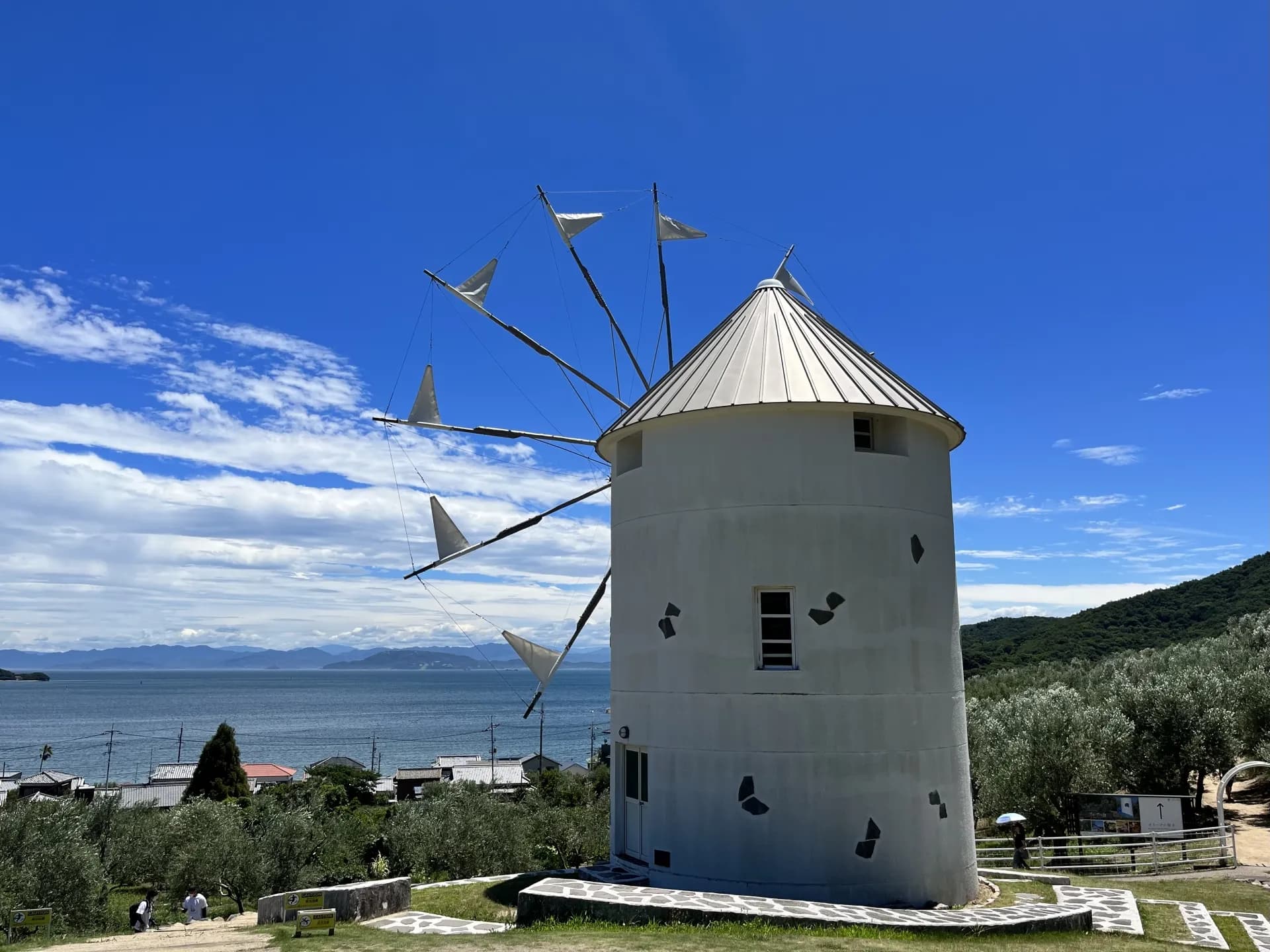
This spot is famous not for an anime, but as a filming location for the live-action movie Kiki’s Delivery Service. The “Guchokipan Bakery” set from the film has been moved into the park and now operates as the gift shop “Corico”, making it a must-visit for fans. It is also interesting that the original story of Kiki’s Delivery Service is a novel. The live-action film is based on the novel’s setting, while the animation is another version shaped by Director Hayao Miyazaki’s interpretation.
Olive Park also offers free broom rentals (08:30–17:00), so the most popular activity is taking a “Kiki-style photo” with the windmill and sea in the background. For these reasons, the entire park is loved as a top Shodoshima destination where nature, film, and photo spots come together.
- 08:00 ~ 17:00
- Free entry
- Open year-round
3) Kankakei Gorge
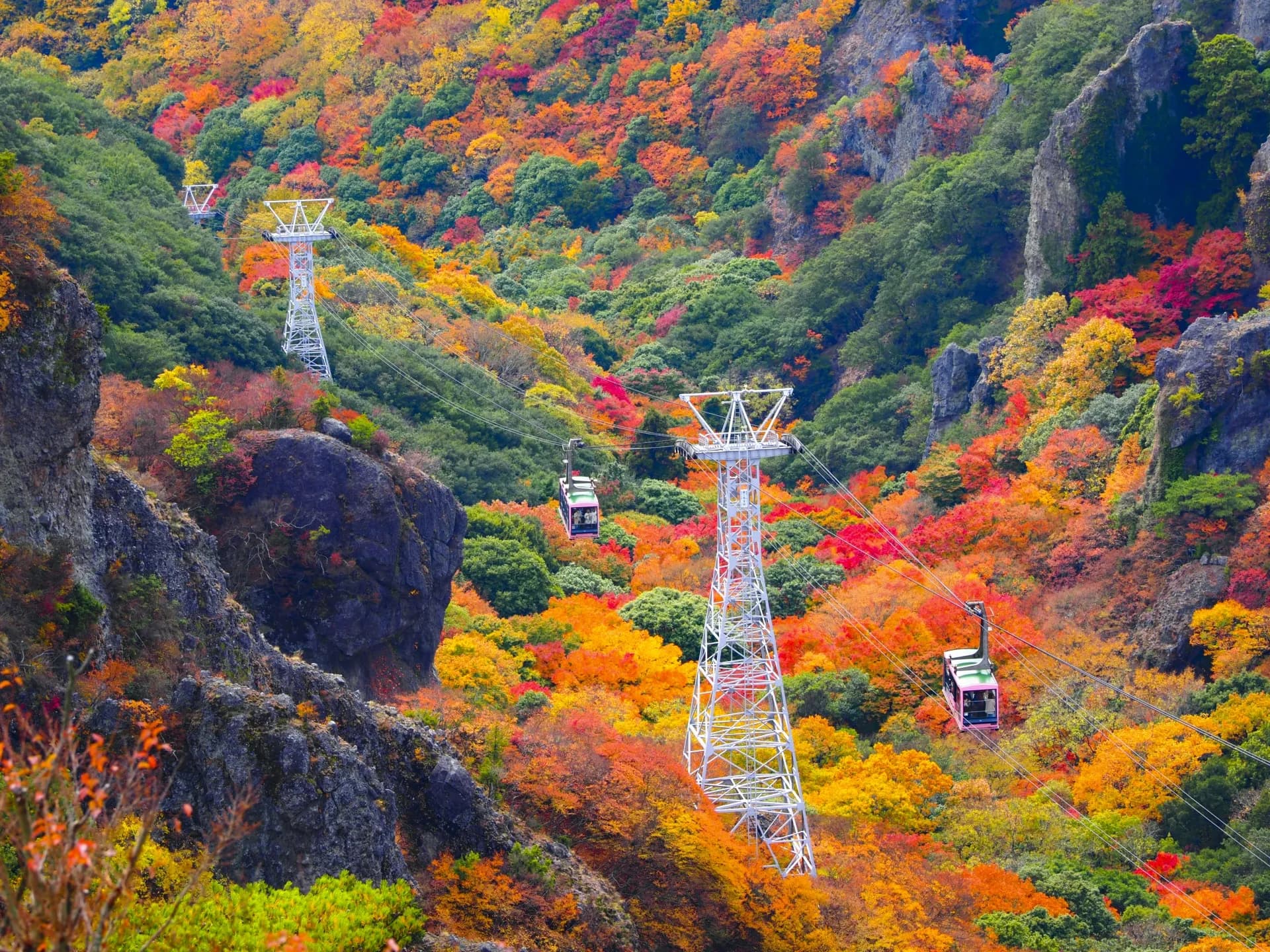
Kankakei Gorge (寒霞渓) is one of Shodoshima’s most famous scenic highlights, and it is often listed among Japan’s three great gorges. The view of dramatic rock formations with the Seto Inland Sea is impressive, and it is especially popular during the autumn foliage season.
The main experience is the ropeway (about 5 minutes) connecting Sancho (summit) and Kountei (紅雲亭, lower station), with wide views of the gorge and sea on the way up. At the top, there are viewpoints and short walking trails, so you can enjoy it even with a simple visit.
If you love nature views and photography, this is a must-visit place on Shodoshima.
- Operating hours: In winter, runs until 16:40; in other seasons, until 17:00
- Public transport access: Take the bus and get off at Kountei (紅雲亭), then use the ropeway
- Important: If you take the ropeway one way only, there is no public transport from Sancho (summit), so you must walk down for about 1 hour. A round trip is recommended.
- Ropeway fares (vary by season)
- One way: 1,200 to 1,500 yen
- Round trip: 2,160 to 2,700 yen
Before visiting, be sure to check the operating days and service status on the official website. There is also a free shuttle bus connecting Kusakabeko Port (草壁港) → Kountei (紅雲亭), but it does not run every day, so check the Access section on the website.
Kankakei Ropeway official website Kankakei Ropeway access (check timetable) Kusakabeko bus stop location4) Choshikei Monkey Park
A unique hands-on attraction where you can see groups of wild monkeys up close in Shodoshima’s natural setting. It is located in the Choshikei Gorge area in the center of the island, and is home to more than 500 Japanese macaques.
The park is operated in a way where people and wild monkeys coexist, so you can observe them naturally at a relatively close distance. Feeding experiences are available for a fee, and the surrounding forest and valley landscape is also nice for a nature walk.
- Hours: 08:20 ~ 17:00 (last entry 16:30)
- Admission: Adult 450 yen / Child 250 yen
Important - Do not show food (they are wild animals)
- Avoid eye contact and do not get too close
It is recommended for families and travelers who enjoy nature experiences, but you cannot get there by public transport, so you need a rental car or similar.
Choshikei Monkey Park location Choshikei Monkey Park official websiteFrom August 1, 2025, the park entered a temporary closure due to staff shortages, and it has also been removed from bus tour itineraries. If you plan to visit, make sure to check the official website for current operations before you go.
5) Marukin Soy Sauce Museum
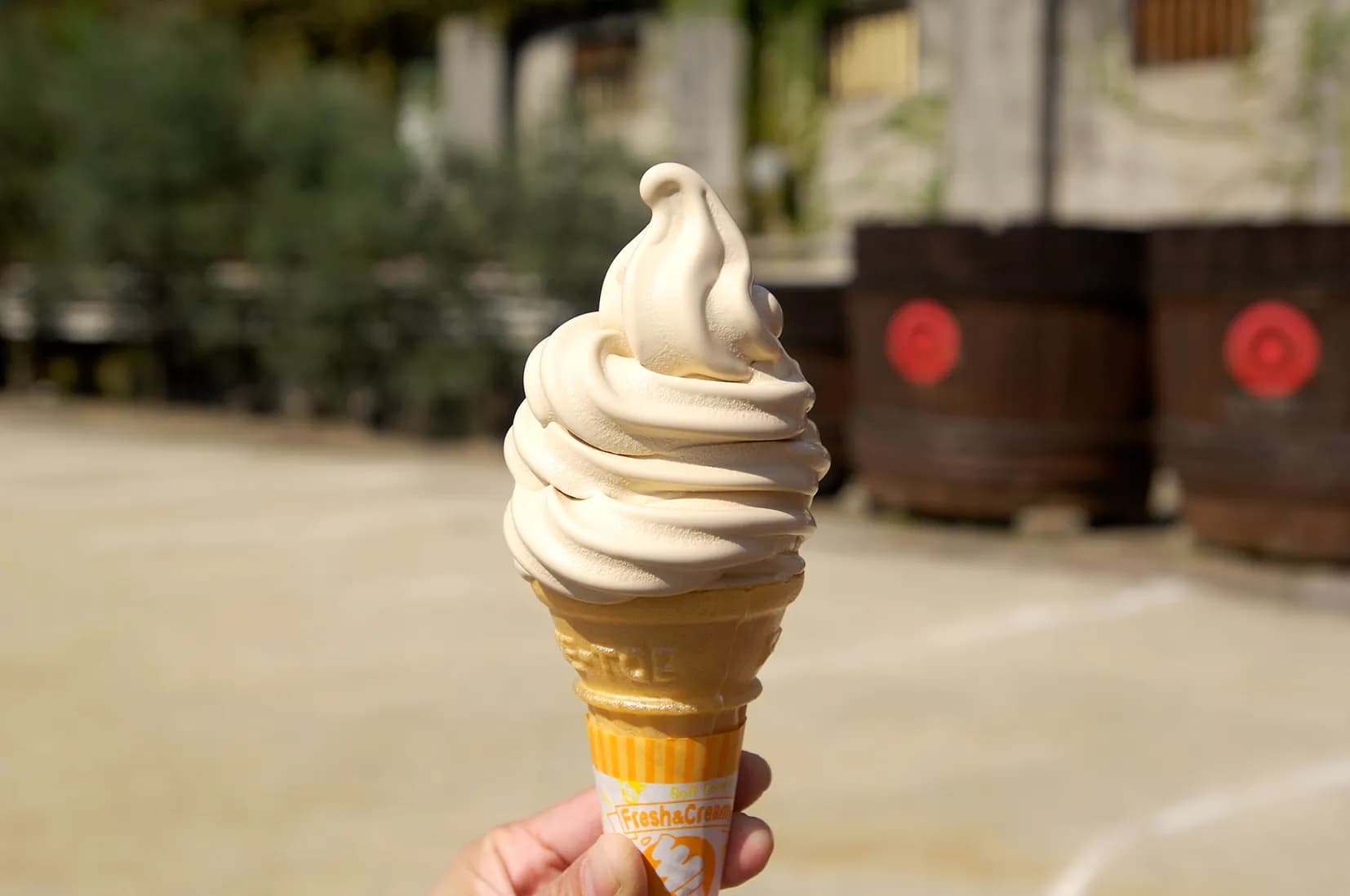
The Marukin Soy Sauce Museum is a space created by preserving a traditional soy sauce brewery that is over 100 years old. You can walk through the old brewery buildings and learn in detail how soy sauce is fermented and aged. There are exhibits that explain Shodoshima’s soy sauce industry history and daily culture, and the soy sauce soft-serve ice cream, which you can try only here, is also very popular with travelers.
- Hours: 09:00 ~ 16:00
- Closed: Irregular closures except New Year holidays
- Admission: Adult 500 yen / Child 250 yen
6) Twenty-Four Eyes Movie Village
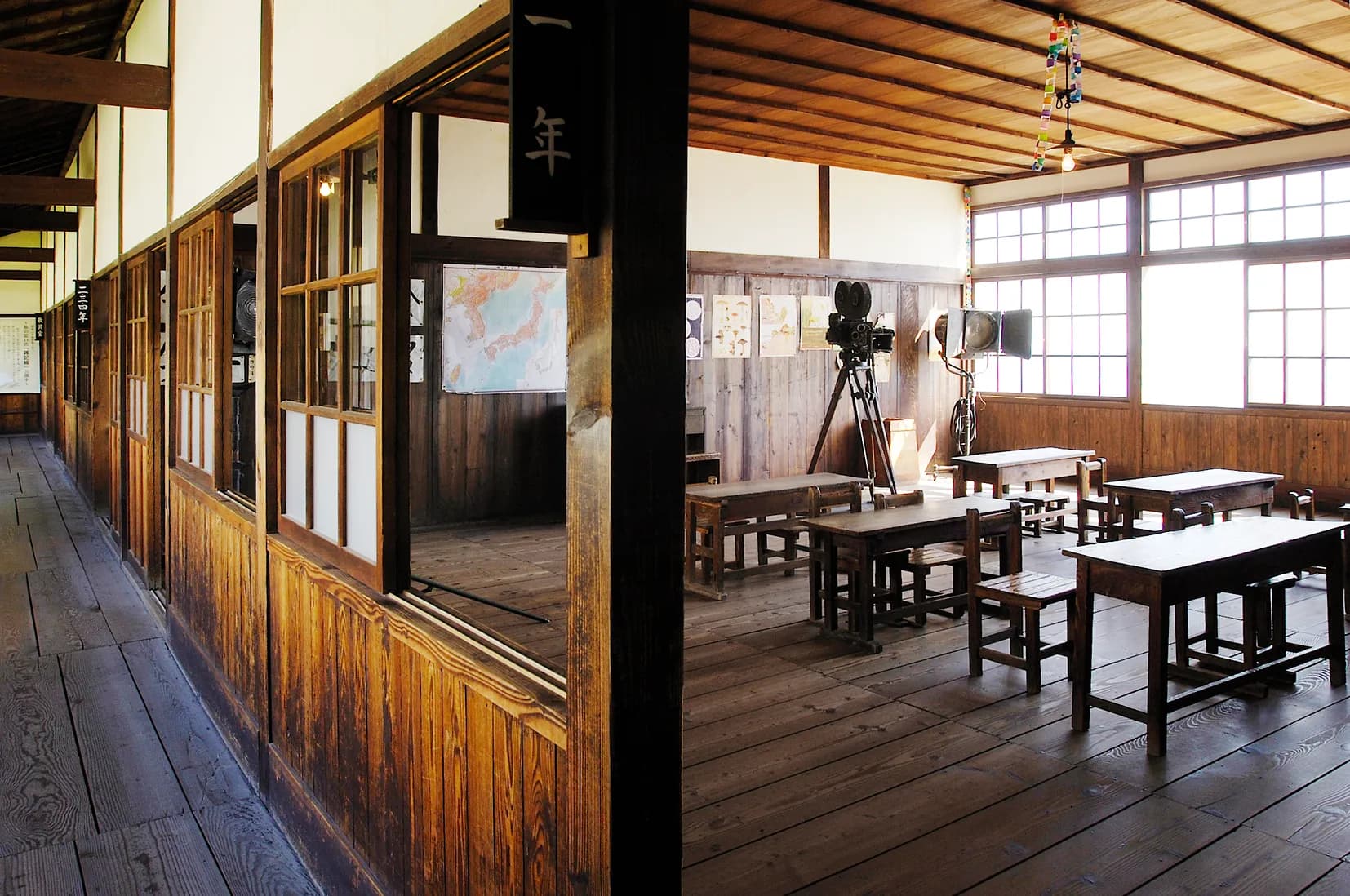
On Shodoshima’s southern coast, the “Twenty-Four Eyes Movie Village” is a theme attraction created by preserving the film set from the 1987 movie, based on the novel Twenty-Four Eyes. In a quiet setting overlooking the Seto Inland Sea, it recreates a rural Japanese school and village from the Showa period (1920s–1950s), giving you the feeling of stepping into a movie scene.
You can see simple classroom sets, stone paths, and an old shopping street, and there are also cafes and a museum that match the atmosphere of the story. Combined with the calm seaside scenery, it is also very popular as a photo spot.
Twenty-Four Eyes is a famous story that has been remade many times, including as TV dramas. As a movie, it was produced in the 1954 version and the 1987 version. Today’s Movie Village is mainly based on the 1987 filming location.
-
Admission (varies by season)
- Movie Village: Adult 850 to 1,000 yen
- Misaki Branch School: Adult 330 to 450 yen
- Set ticket (Movie Village + Branch School): Adult 950 to 1,160 yen
- Children pay 50% of the adult fare
- Hours: 09:00 ~ 17:00 (last entry 16:30)
- Closed: Open year-round
-
Olive Park → Movie Village travel
- About 40 minutes by bus
- About 10 minutes by small boat
-
Boat service information
- Operating period: Mid-March to end of November
- No service: Wednesday and Thursday (runs during local holiday periods)
- Operating hours: 09:30 ~ 16:30
- Fare: Adult one-way 500 yen / Child 250 yen
- Movie Village + round-trip boat set: Adult 1,800 to 1,900 yen
Boat official page Boat boarding point
ChichibugahamaChichibugahama, known as Japan’s Uyuni Salt Flat
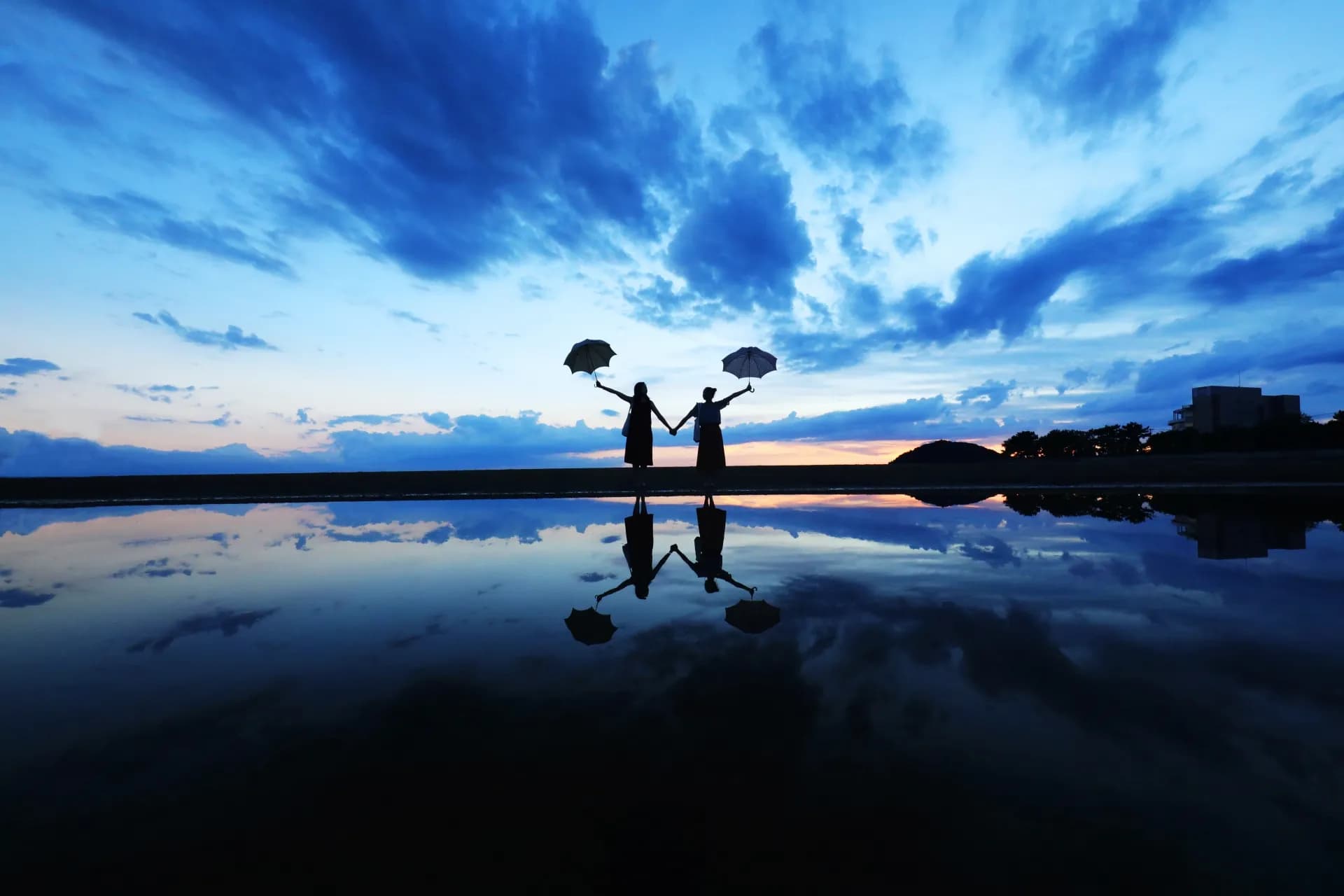
A famous reflection photo spot, often called “Japan’s Uyuni Salt Flat”. At sunset, the sky’s colors reflect in the shallow tidal pools, creating a mirror-like scene. When the golden evening sky meets the calm sea, not only photographers but also regular travelers can capture a special shot, making it one of Shikoku’s top sunset locations.
To see Chichibugahama at its best, low tide and sunset need to match. Before you go, it is important to check the time on the official site or a tide table. There are cafes and walking paths nearby, so it is also a nice place to stay longer. It is a popular, atmospheric beach recommended for families, couples, and photo travelers.
In particular, the time just before sunset when the wind often becomes calm—known as “Yunagi (夕凪) in the Seto Inland Sea” (a natural moment when the sea becomes very still)—is the best time for clean reflections, because the surface hardly ripples. Visiting at this time gives you the clearest mirror-style photos.
Useful items include beach sandals or slippers, a small towel, and a leisure mat. A tripod also helps for stable portrait photos. Using a red umbrella can make silhouettes and poses stand out more and create a more atmospheric look.
The most beautiful moment at Chichibugahama is when the sunset matches the low-tide period, so an afternoon visit is usually best. A very efficient plan is to visit Kotohira-gu Shrine in the morning, then travel to Chichibugahama in the afternoon.
If you plan one day for Kotohira-gu Shrine + Chichibugahama and the next day for Shodoshima, the Kagawa Mini Rail & Ferry Pass is especially useful. It covers JR limited express non-reserved seats, all Kotoden lines, the ferry to Tonosho Port, and the Shodoshima Olive Bus, which can greatly reduce transport costs.
For more details on the Kagawa Mini Rail & Ferry Pass, see Guidebook – Shikoku Part 2: Takamatsu Travel Guide.
Okayama & Kurashiki Bikan Historical QuarterKurashiki Bikan Historical Quarter with the Okayama Kagawa Wide Pass
1. Okayama Kagawa Wide Pass
This is a pass that allows 3 consecutive days of unlimited JR local train non-reserved seats, with Takamatsu Station as the base: to the west as far as Tadotsu and Kanonji, to the north as far as Okayama and Kurashiki, and to the east as far as Sanuki-Aioi Station. It also covers a bus between Okayama → Shin-Okayama Port, the Kokusai Ryobi Ferry between Shin-Okayama Port ↔ Tonosho Port, and the Kokusai Ryobi Ferry between Takamatsu Port ↔ Ikeda Port, making it very flexible.
- When boarding the ferry, show the pass at the ticket counter, exchange it for a boarding ticket, then board
For example, Takamatsu ↔ Kurashiki Station costs 1,840 yen one way (3,680 yen round trip), but this pass costs 3,500 yen for 3 days. So if you plan to visit Okayama and Kurashiki, it is always good value.
You can buy the pass on the website or through the Tabiwa app. Membership registration is required. Also, even if you buy on the web, you can only use it through the Tabiwa app, so you can choose whichever registration and purchase method is easier.
The app does not support language switching. The website can be translated in the browser, but sign-up errors are common on translated pages, so it is best to follow the notes below.
Notes for Sign-up & Purchase
- Set the area selection to せとうち (Setouchi).
- Turn off auto-translation and sign up in the original Japanese.
- If you need translation, use another device to view the translated page while signing up on the original page
- Or ask an AI using screenshots
- In the Name (Kanji) field, only Kanji characters commonly used in Japan are accepted. Therefore, convert your name to Katakana and enter it in full-width Katakana.
- In the katakana name field, enter the same full-width format.
- Enter your phone number in the 010xxxxxxxx format.
- Enter the postal code for your hotel address.
- If you get an input error, you can use the postal code of a nearby building.
- After purchase, you can use it in the Tabiwa app. Log in with the WESTER ID + password sent by email, and the pass will link automatically.
Exclusive TourCast Tips!
Okayama Kagawa Wide Pass vs Kagawa Mini Rail & Ferry Pass
The Okayama Kagawa Wide Pass costs 3,600 yen for 3 days, while the Kagawa Mini Rail & Ferry Pass costs 6,000 yen for 2 days. At first glance, the Wide Pass looks much cheaper.
However, the two passes have completely different coverage and purposes, so you should not compare them by price alone. Depending on your itinerary, the “best value pass” can change, so use the guide below.
| Item | Okayama Kagawa Wide Pass | Kagawa Mini Rail & Ferry Pass |
|---|---|---|
| Price | 3,600 yen | 6,000 yen |
| Validity | 3 days | 2 days |
| JR coverage | Okayama ↔ Kurashiki ↔ Kagawa (general Sanuki area) ※ If you use limited express trains, you must buy a limited express ticket separately | JR only within Kagawa ※ Within the valid area, you can use limited express non-reserved seats |
| Kotoden | Not available | Unlimited use of all Kotoden lines for 2 days |
| Shodoshima access | Kokusai Ryobi Ferry (Takamatsu–Ikeda) | Shodoshima Ferry (Takamatsu–Tonosho) + Includes Olive Bus 1-day pass |
| Best recommended itineraries | Kurashiki Bikan Historical Quarter + Okayama Castle + Korakuen Linked trip with Takamatsu city and Kotohira | Continuous itinerary: Kotohira + Chichibugahama + Shodoshima Trips focused around the Takamatsu area |
| Best for | Trips that include Okayama and Kurashiki Travelers who use JR often | Kagawa area + Shodoshima visit Travelers who use Kotoden often |
| Value point | Break-even with just one Okayama–Kagawa JR round trip Clear savings when adding Kurashiki | Includes 2 days of Kotoden + Shodoshima ferry and bus Best efficiency with the Chichibugahama + Shodoshima combo |
If you plan to travel from Takamatsu to Kurashiki (Bikan Historical Quarter), choosing the Okayama–Kagawa Wide Pass with wide JR coverage is the most reliable way to save money. Also, if you plan to travel for three days including Kotohira, Chichibugahama, and Shodoshima mainly by JR, and in Shodoshima you plan to use a bus tour or taxi tour instead of the Olive Bus, the Wide Pass is also a better option.
On the other hand, if you plan a 2-day trip of Kotohira → Chichibugahama → Shodoshima and you plan to use the Olive Bus 1-day pass in Shodoshima, the Kagawa Mini Rail & Ferry Pass is more efficient, as it includes limited express non-reserved seats on the JR Takamatsu–Tadotsu section.
In short, the biggest criteria for choosing is whether you will travel to Okayama and whether you will use the Olive Bus in Shodoshima.
2. Key Attractions
1) Korakuen
One of Japan’s Three Great Gardens, Korakuen is Okayama’s top landmark. It is known for its landscaping, where wide lawns, ponds, bridges, pavilions, and tea houses connect naturally. The scenery changes by season, and it is especially famous for spring cherry blossoms, autumn leaves, and quiet early-morning hours.
Okayama Castle can be seen behind the garden, making the walking route efficient. The wide views of a classic Japanese garden and many photo spots leave a strong impression on travelers.
From JR Okayama Station, you can reach it easily by local bus or tram. For a group of 3 to 4 people, a taxi can be a faster and more efficient option.
In particular, there are night openings during late April to early May (Golden Week, until 21:30), all of August (until 21:30), and mid to late November (until 20:30), offering a different atmosphere from daytime. If you visit during these periods, an efficient plan is to explore Kurashiki Bikan Historical Quarter in the morning, then go to Korakuen in the afternoon and enjoy the night visit.
- Hours
- 3/20 ~ 9/30: 07:30 ~ 18:00
- 10/1 ~ 3/19: 08:00 ~ 17:00
- Last entry is 15 minutes before closing
- 500 yen for ages 15 and over
- Free for high school students and younger
- Note: Even if you are 15 or older, high school students are free (proof such as a student ID may be required)
- Set ticket: Korakuen + Okayama Castle set: 720 yen
- Open year-round
2) Okayama Castle Main Keep
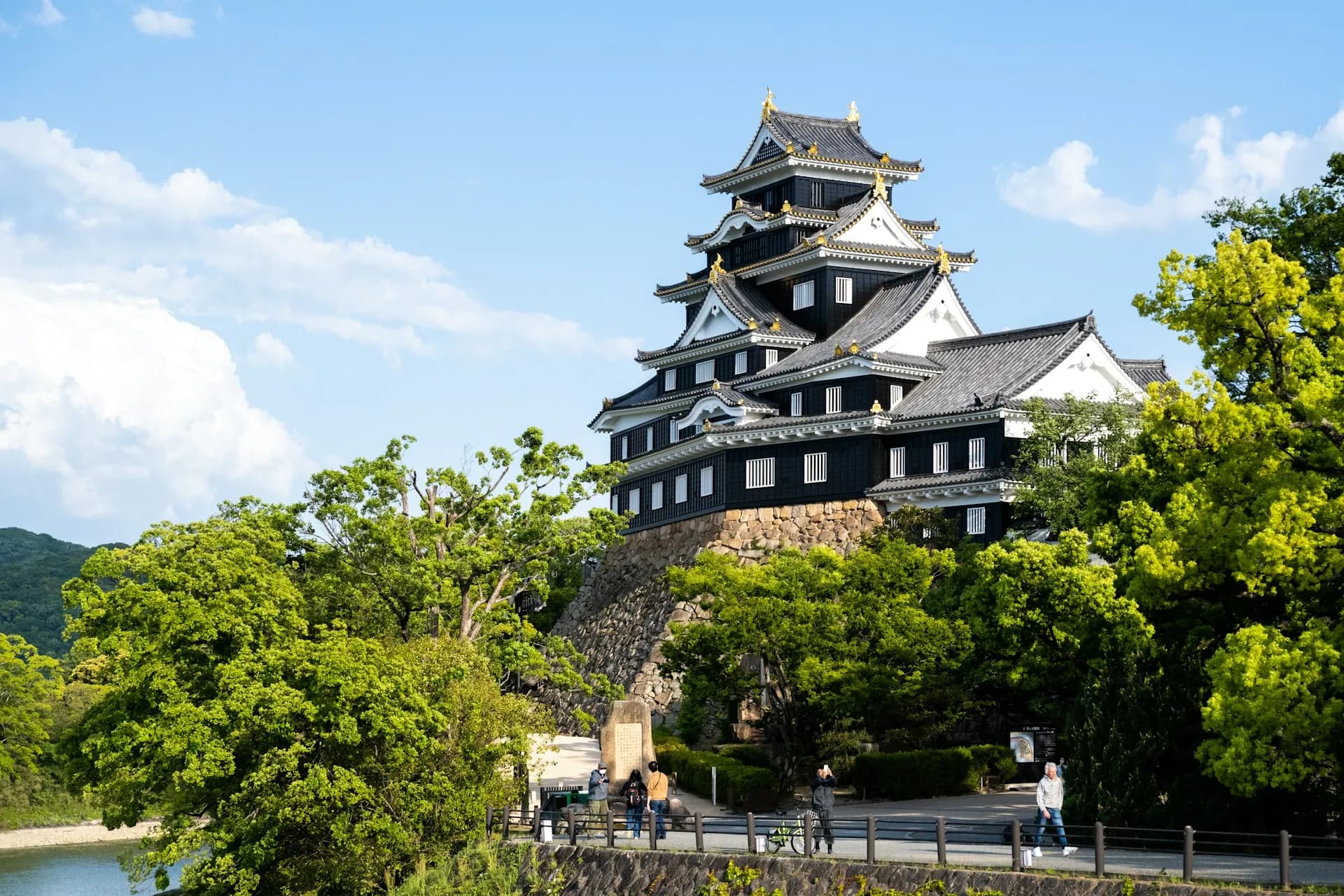
The most distinctive feature of Okayama Castle is its black exterior, which gives it the nickname “Crow Castle (烏城)”. The outside keeps the traditional Japanese castle style, but the inside was renewed in 2022 and reopened as a modern space focused on exhibitions and hands-on experiences, making it popular with families.
The castle is directly connected to Korakuen by a single bridge, so it is easy to visit both together. From the upper observation area, you can see wide views of Okayama city and Korakuen. The deep, clear look of the black castle walls in sunlight is also a favorite photo spot.
- 09:00 ~ 17:30 (last entry 17:00)
- 400 yen for ages 15 and over, 100 yen for elementary and junior high school students
- Set ticket: Korakuen + Okayama Castle set: 720 yen
- Closed: 12/29 ~ 12/31
3) Kurashiki Bikan Historical Quarter
Kurashiki Bikan Historical Quarter (倉敷美観地区) is an atmospheric area in Okayama Prefecture, where Edo-period storehouses (kura), white-walled streets, and canals come together. The calm mood created by traditional wooden buildings, white plaster walls, and the Kurashiki River canal makes it a popular walking area to experience classic Japanese beauty.
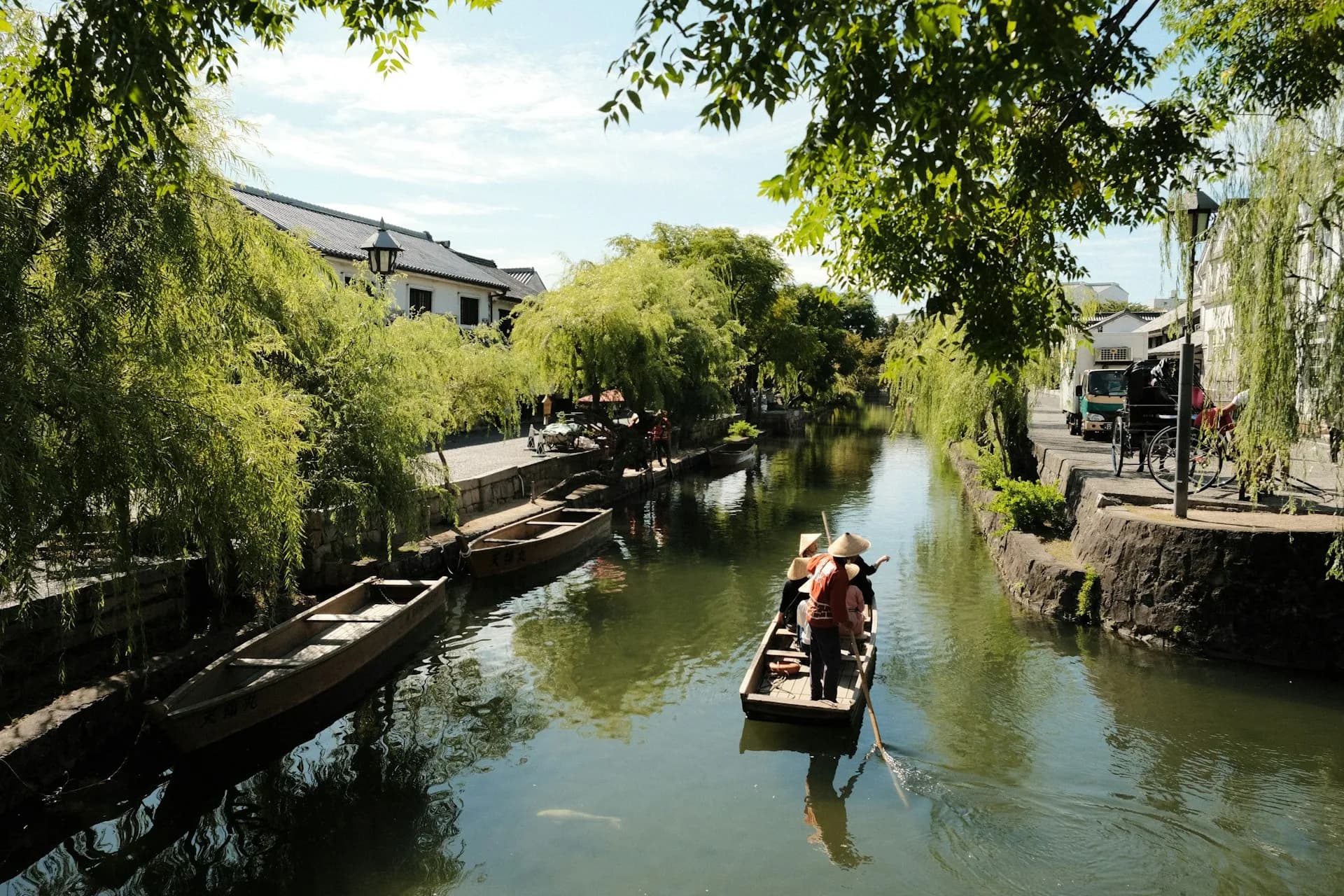
The area has many unique cafes, galleries, gift shops, and museums, making it ideal for browsing and spending time slowly. Along the canal, you can also enjoy a boat ride operated by a boatman in traditional clothing, adding to the travel experience. The soft light of the afternoon and early evening is especially popular for photos.
The quarter is not very large, so it is a course you can cover in about 2 to 3 hours. It also works well as a one-day plan together with Korakuen and Okayama Castle. It is about a 10-minute walk from JR Kurashiki Station, so access is excellent.
Kurashiki Bikan Historical Quarter location See Kurashiki Bikan Historical Quarter details4) Ohara Museum of Art
Ohara Museum of Art (大原美術館) is Japan’s first private museum dedicated to Western art. It is a cultural symbol of the Kurashiki Bikan Historical Quarter and one of the area’s most important sights. It was founded in 1930 by businessman Ohara Magosaburo, based on advice from painter Kuroda Seiki, and it has played an important role in introducing Western modern art to Japan.
Its collection covers a wide range, from works by masters such as El Greco, Monet, Matisse, Gauguin, and Rouault to Japanese modern art. In particular, El Greco’s Passion works and Impressionist pieces leave a strong impression not only on art fans but also on general travelers. In addition to the main building, there are also a crafts gallery and a newer wing, so you can enjoy the exhibitions like a relaxed walk.
Located in the center of the Kurashiki Bikan Historical Quarter, it is easy to visit. The contrast between the traditional streetscape and the Western-style architecture is often considered a highlight of a Kurashiki trip.
-
Entry hours
- December to February: 09:00 ~ 15:00
- March to November: 09:00 ~ 17:00
- Last entry: Until 30 minutes before closing
-
Admission
- Adult 2,000 yen
- Students under 18: 500 yen
-
Closed days
- Closed every Monday
- There are also many irregular closed days, so be sure to check the official website before visiting.