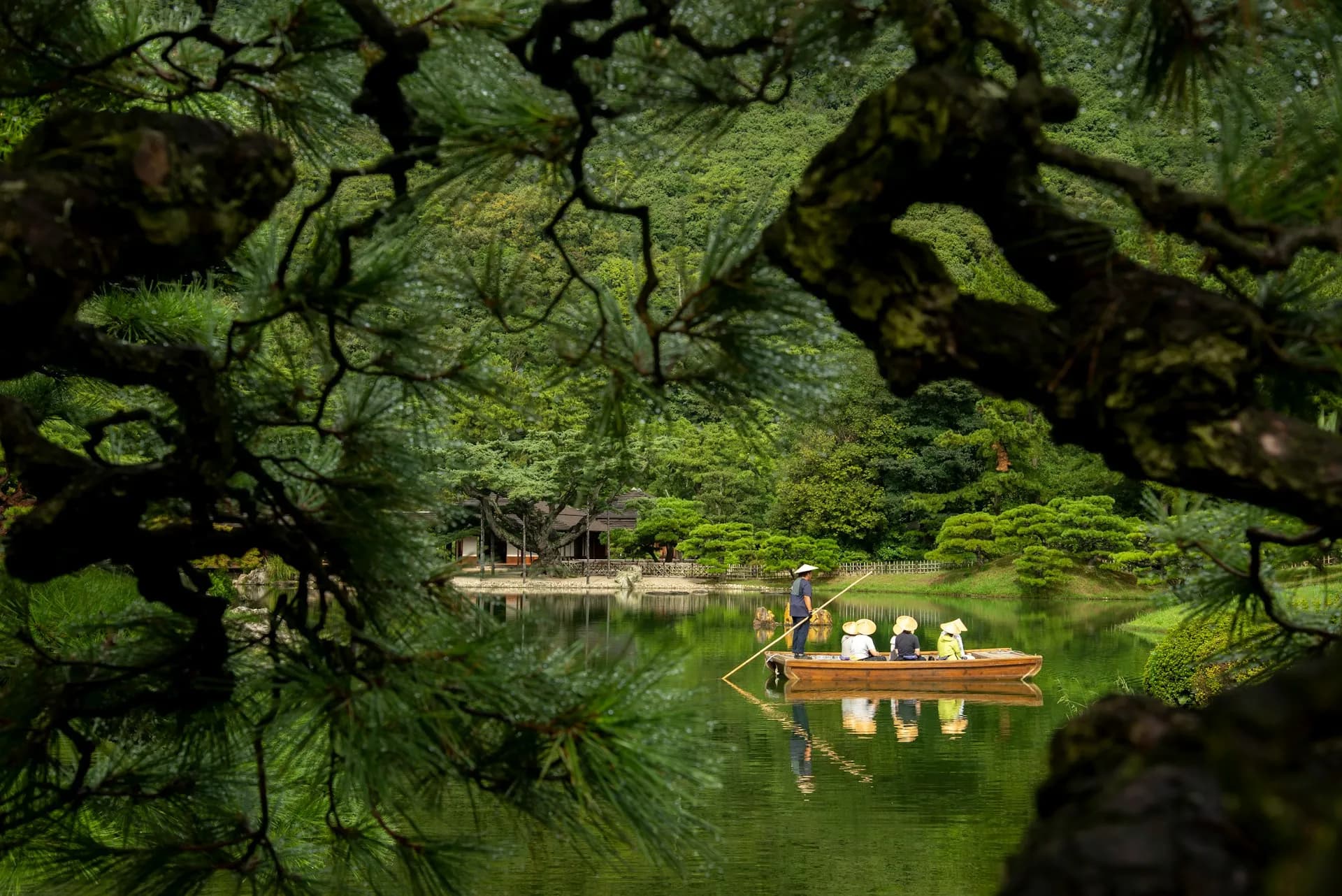
IntroductionOverview of the Shikoku (四国) region
1) Japan’s four main islands
The four main islands are Honshu (本州), home to Tokyo, Nagoya, and Osaka; Kyushu (九州), home to Fukuoka, Yufuin, Kagoshima, and Miyazaki; Hokkaido (北海道), home to Sapporo and Otaru; and Shikoku (四国), which comes from four old provinces.
2) The origin of the name “Shikoku”
“Shikoku (四国)” literally means four provinces. In ancient times, the following four regions existed, and their names continue into today’s administrative areas.
| Old name | Current name | Main areas |
|---|---|---|
| Iyo (伊予) | Ehime Prefecture | Matsuyama City, Imabari City, and more |
| Sanuki (讃岐) | Kagawa Prefecture | Takamatsu City, Naoshima, Shodoshima, and more |
| Awa (阿波) | Tokushima Prefecture | Tokushima City, Naruto City, and more |
| Tosa (土佐) | Kochi Prefecture | Kochi City, Shimanto City, and more |
In particular, Sanuki udon, one of Japan’s most famous udon styles, comes from the old Sanuki province—today’s Kagawa Prefecture (Takamatsu area).
Also, Tokushima’s traditional dance performance, Awa Odori (阿波おどり), comes from the old Awa (阿波) province, just as the name suggests.
3) Regional characteristics of Shikoku
Shikoku is the smallest of Japan’s four main islands. With many mountain areas, it was often a lower priority in national development plans. As a result, its level of development is generally lower than Kyushu and Hokkaido, and even Okinawa.
However, this is also why Shikoku is valued by travelers: you can experience the calm atmosphere and local character of Japan’s smaller cities. Many towns are not overly “tourist-focused,” and traditional scenery and everyday life are still well preserved.
Flight informationWhat to check before booking flights
At present, the direct flights to Shikoku are as follows.
| Departure | Arrival | Airline |
|---|---|---|
| Taipei | Matsuyama | EVA Air |
| Shanghai | Takamatsu | Spring Airlines |
| Taichung | Takamatsu | STARLUX |
| Hong Kong | Takamatsu | Hong Kong Express |
| Taipei | Takamatsu | China Airlines |
There are no direct flights to Tokushima or Kochi, so travelers usually enter Shikoku via Matsuyama or Takamatsu.
If you are flying from Taipei, you can also plan an open-jaw route such as “Matsuyama IN → Takamatsu OUT”. However, intercity travel can take time, so check the sample travel times below before booking.
-
Matsuyama → Takamatsu
- About 2 hours 30 minutes by limited express train, reserved seat one-way 6,890 yen
-
Takamatsu → Tokushima
- About 1 hour 10 minutes by limited express train, reserved seat one-way 3,570 yen
Planning a Shikoku tripHow should you plan a trip in Shikoku?
Because cities in Shikoku are not very large, a 2-night, 3-day trip is usually enough if you only plan to explore the city centers. If you want to add a day trip to nearby areas (such as a bus tour), 3 nights and 4 days is a good length.
Takamatsu is especially flexible: you can add Okayama/Kurashiki as a day trip or spend a day each on Naoshima and Shodoshima, so even a 4-night, 5-day trip can be packed with variety if you base yourself in Takamatsu.
For other areas, if you have more than 4 nights, it is usually much more efficient to combine two or more prefectures rather than staying in only one.
To reduce travel time and transportation cost, the most practical approach is to book flights with an open-jaw plan such as Matsuyama IN → Takamatsu OUT (or the reverse), meaning you book separate one-way flights for different cities.
If you already booked a round trip to one city, you can enjoy a more relaxed pace, but your route may feel repetitive and less varied.
For that reason, it is important to choose your flights carefully based on your itinerary style.
Safety tips for Shikoku travelIn small cities, pay more attention to safety
Big cities can have areas with higher risk because there are many people, but smaller cities often have many quiet streets and fewer people, which can create different kinds of risk.
After dark, it is best to avoid walking alone through nightlife districts or very empty areas. The fewer tourists there are, the more important it is to stay aware of your surroundings.
A key figure to know in ShikokuKobo Daishi and the history of Shikoku
Kobo Daishi (弘法大師), born in 774 in the old Sanuki province (today’s Kagawa Prefecture), founded Shingon Buddhism.
As you travel around Shikoku, you will often see places connected to him.
There is a legend that he struck the ground with his staff to bring out water in a village that suffered from shortages. Also, Yashimaji (屋島寺), which you pass when heading up to the Yashima viewpoint in Takamatsu, is the 84th temple on the Ohenro pilgrimage route of 88 temples.
2) What is Ohenro (お遍路)?
Ohenro (お遍路) is a pilgrimage that starts in Tokushima and continues through Kochi, Ehime, and Kagawa, visiting a total of 88 temples associated with Kobo Daishi.
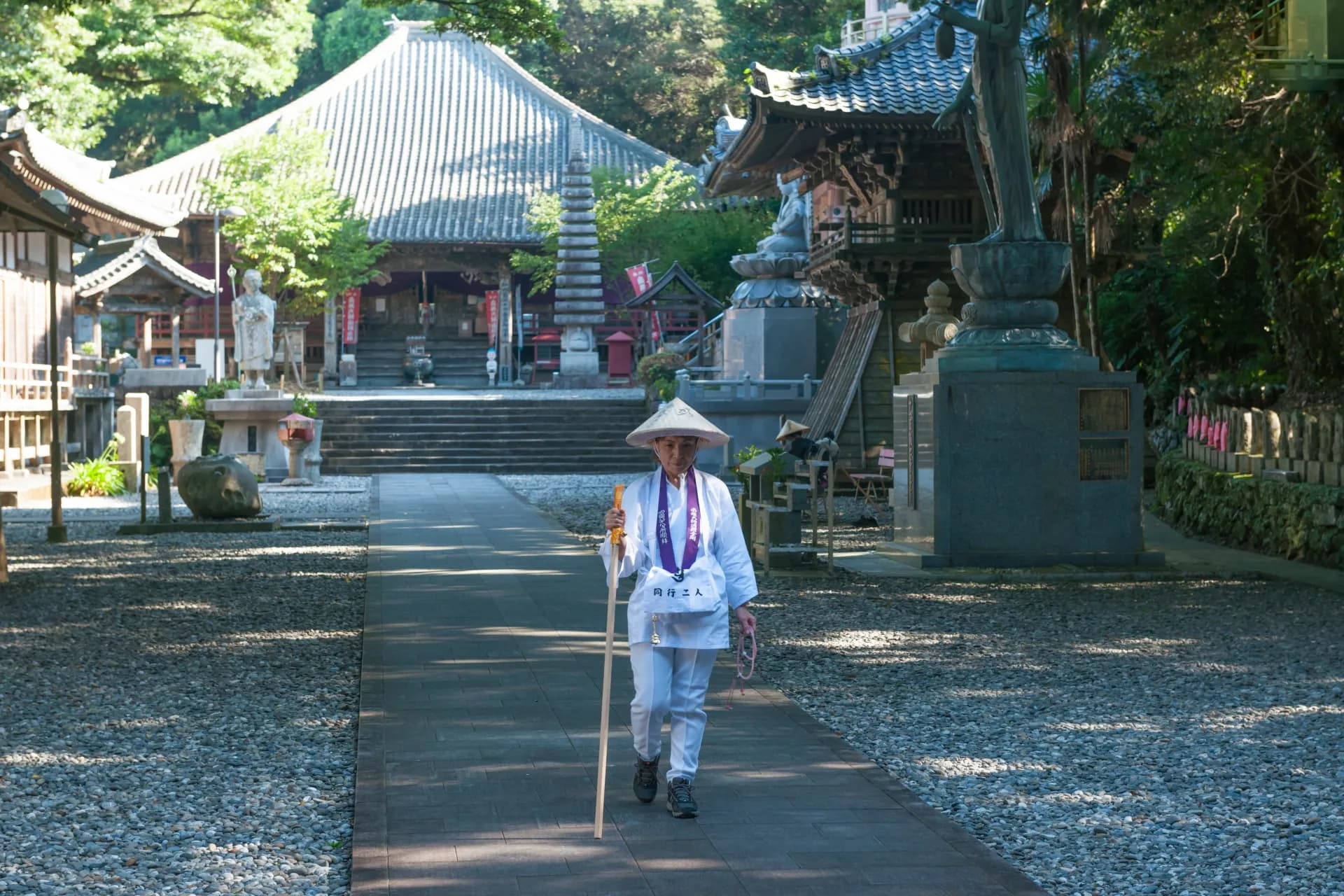
If you see someone walking with a straw hat, white clothing, a bag, and a staff, they are likely an Ohenro pilgrim.
Ohenro pilgrims often carry a bag with the words “同行二人 (どうぎょう ににん, dōgyō ninin)”. This means “You are not walking alone—you walk together with Kobo Daishi”, and it is considered a key symbol of the pilgrimage spirit.
3) Difficulty and symbolism of the pilgrimage
Traditionally, Ohenro was seen as such a demanding journey that people had to be prepared to face death. The full route is about 1,400 km, and there is even a story that if someone died during the pilgrimage, their staff became their gravestone.
At each temple, you can collect stamps, and some pilgrims also receive handwritten temple calligraphy. Stamps can also be placed on the pilgrim’s white clothing, and this clothing could later be used as burial clothes. Ohenro is not just travel—it is often seen as a deep journey of reflection on life and death.
Learn more about Ohenro