
Osaka & Kansai Transport Pass Guide: Choosing the Optimal Transport Option for YouWhy you must understand transport passes before planning your itinerary.
If it's your first time traveling to Osaka, the sheer number of transport passes can feel overwhelming.
One of the most common mistakes is to plan an itinerary first and then try to fit a transport pass into it. This often leads to situations where you have to re-adjust your already-fixed schedule. It is much more efficient to understand the characteristics and usage conditions of the transport passes first before designing your itinerary.
For example, some might mistakenly believe the Amazing Pass is a universal pass for everything in Osaka and buy four 1-day passes for a 4-day trip. However, this often results in a financial loss. Therefore, it is crucial to familiarize yourself with the functions and effective ranges of each transport pass while preparing for your trip.
Which Transport Cards Can You Buy in the Kansai Region?Information on purchasing ICOCA and KANSAI ONE PASS cards.
The basic concept of transport cards is explained in the 'Essentials Part 2 - Transport Information' section, so here we will focus on ICOCA and KANSAI ONE PASS, which can be purchased directly in Osaka.
1) ICOCA
The most common rechargeable IC card, usable on subways, buses, and at convenience stores throughout Japan.

- Purchase Info: Can be purchased immediately at station ticket machines in units of 1,000 yen to 5,000 yen (includes a 500 yen deposit).
- For Children: Must be issued at a station Ticket Office (Green Window) by presenting a passport. (Cannot be bought at ticket machines.)
- ⚠️ Warning: Universal City Station does not have a Ticket Office, so you cannot issue a child ICOCA there. Prepare one in the city or at the airport beforehand.
- Validity: Valid for 10 years from the last date of use.
2) KANSAI ONE PASS
A special IC card created for international travelers, combining transport card functions with discount benefits at major tourist attractions.

- Purchase Info: Sold only at a fixed price of 3,000 yen (includes 500 yen deposit). As it is for international tourists only, a passport is required.
- Key Features:
- High souvenir value featuring the Astro Boy character.
- No expiration date; can be used anytime on future trips.
- Limited availability at Kansai Airport and selected major stations.
- Offers discounts and special benefits at over-privileged facilities in the Kansai region, such as the Umeda Sky Building observatory.
- ⚠️ Warning: There is no child version. If traveling with a child, choose a standard child ICOCA instead.
3) At-a-Glance Comparison
| Category | ICOCA | KANSAI ONE PASS |
|---|---|---|
Purchase Price | From 1,000 yen (Selectable) | 3,000 yen (Fixed) |
Child Version | Available (at Ticket Offices) | Not Available |
Extra Benefits | Basic Transport Function | Discounts/Special Offers at Attractions |
Where to Buy | Most Railway Stations | Airport & Hub Stations |
Essential Transport Passes for Osaka TravelComplete guide to Railway Pass, Joy Pass, Osaka Amazing Pass, and e-Pass.
1) KANSAI RAILWAY PASS (Formerly Kansai Thru Pass)
The long-beloved Kansai Thru Pass ceased sales in April 2024 and was succeeded by the KANSAI RAILWAY PASS. Note that unlike the previous version, Kyoto buses and Randen trains are no longer covered, and prices have increased, making a schedule check essential before purchase.
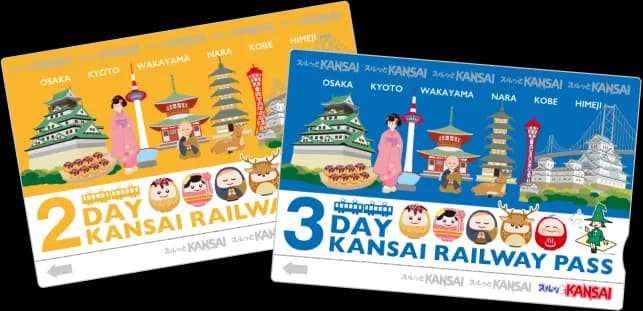
- Coverage: Subways and Private Railways throughout Kansai, including Osaka, Kyoto, Kobe, Nara, and Himeji.
- Price: 2-Day 5,200 yen / 3-Day 6,500 yen (Half price for children).
- Features: Usable on non-consecutive days (e.g., use on Monday, then again on Wednesday).
- Warning: JR, Kyoto Municipal Subway, and buses in the Kansai region are NOT covered. Randen trains in Kyoto are also excluded.
2) Osaka Amazing Pass vs. Osaka e-Pass
These are the two most considered passes for Osaka city sightseeing. The core difference is the inclusion of transportation.
| Category | Osaka Amazing Pass | Osaka e-Pass |
|---|---|---|
Transportation | Unlimited Subway/Bus | None (Need separate IC card) |
Free Facilities | Approx. 40 locations (Includes Castle Tower) | Approx. 20 locations (Excludes some) |
1-Day Price | 3,500 yen | 2,400 yen |
- Osaka Amazing Pass: Advantageous for those moving frequently and visiting many major attractions (like Osaka Castle). Free Facility List
- Osaka e-Pass: Suitable for those who already have an IC card or prefer a walking-based itinerary.
3) KANSAI JOY PASS (Have Fun In Kansai)
A 'selectable' pass where you choose 3 or 6 attractions to visit.
- Advantage: Valid for 7 days from the first day of use, allowing for a flexible schedule.
- Major Facilities: Umeda Sky Building, Harukas 300, Solaniwa Onsen, etc.
- Pro-Tip: You can easily get your money's worth by visiting just 3 facilities with high individual entry fees (e.g., Toei Uzumasa Movie Park at 2,400 yen).
- Facility List: As available spots may change, check the Facility List before visiting.
4) Osaka Metro & City Bus 1-Day Pass (Enjoy Eco Card)
The most popular basic pass for both locals and travelers. Provides unlimited use of subways and buses within Osaka city for one day.
- Fare:
- Weekdays: Adult 820 yen / Child 310 yen
- Weekends/Holidays: Adult 620 yen / Child 310 yen
- Coverage: All Osaka Metro lines + Osaka City Bus (excludes some routes).
- Features: Provides discounts at approx. 20 tourist facilities upon presenting the QR screen.
- How to Buy: Available as a digital ticket via the SURUTTO QRtto website or as a physical ticket at subway station vending machines.
5) 26-Hour & 48-Hour Tickets (Digital Only)
An evolved version of the '1-Day/2-Day' concept, these passes are calculated by hours from the first point of use. This is overwhelmingly advantageous for travelers starting their journey in the afternoon.
- Fare:
- 26-Hour Ticket: Adult 1,000 yen / Child 500 yen
- 48-Hour Ticket: Adult 1,700 yen / Child 850 yen
- Coverage: Exclusive to all Osaka Metro lines (Osaka City Bus excluded).
- Key Advantages:
- Valid by Hour: If you first pass a gate at 3 PM, a 26-hour ticket is valid until 5 PM the following day.
- Includes Yumeshima Station: Covers the artificial island area, widening your travel range.
- Precautions: Since it excludes Osaka City Bus and the Imazato Liner, choose this only for subway-centric itineraries.
- How to Buy: Purchase via the SURUTTO QRtto website or online travel agencies (OTAs) like Klook, and use via QR code.
Exclusive TourCast Tips!
Comparison Guide: Osaka Amazing Pass vs. e-Pass vs. Joy Pass
The KANSAI JOY PASS, Osaka Amazing Pass, and Osaka e-Pass may seem similar but have distinct characteristics.
While all three offer free entry or discounts to a set number of attractions, they differ in usage method, validity, and included transportation.
| Pass Name | Core Summary | Includes Transport |
|---|---|---|
| Joy Pass | Choose 3 or 6 attractions | No (Can choose Keihan voucher as a spot) |
| Amazing Pass | Unlimited free entry to ~40 facilities | Yes (Subway/Bus unlimited) |
| e-Pass | Free entry to ~20 major attractions | No |
The primary differences between the Amazing Pass and e-Pass are transport inclusion and free entry to the Osaka Castle Tower.Since the e-Pass lacks transport functions, you must combine it with an IC card like ICOCA or an Eco Card (Metro ticket).
Conversely, the Joy Pass offers differentiated benefits such as Umeda Sky Building (free before 17:00), Harukas 300 free entry, and 1,000 yen discounts at designated restaurants. If you plan to visit Toei Uzumasa Movie Park in Kyoto, the Joy Pass is the best option.
- Best city sightseeing + unlimited transport = Osaka Amazing Pass
- Focus on specific entries + maximum value = e-Pass + Eco Card
- Observatory tours + Kyoto Movie Park = Joy Pass
Amazing Pass vs. Subway Pass vs. IC Card: Which is More Profitable?Rational selection criteria based on travel frequency and route.
1) Osaka Amazing Pass vs. Subway Pass + e-Pass
If you are planning to tour Osaka city, it's smarter to calculate your movement patterns and intended visits rather than just blindly buying the Amazing Pass.
- Amazing Pass (All-in-One): If the sum of individual entry fees—including the Osaka Castle Tower (~600 yen)—exceeds 2,500–3,000 yen, the Amazing Pass remains profitable. It is suitable for those who want to pack 3–4 attractions into one day.
- Subway Pass + e-Pass (The Value Combo): Recently, the combination of the Osaka e-Pass (2,400 yen) and a 1-Day Subway Pass (620 yen on weekends) bought locally has become more popular. It is over 500 yen cheaper than the Amazing Pass yet covers most core highlights like observatories and cruises.
| Comparison | Osaka Amazing Pass | 1-Day Pass + e-Pass |
|---|---|---|
Recommended Schedule | Intense visit to 4+ facilities | 2–3 core spots + relaxed movement |
Key Benefits | Includes Osaka Castle Tower | Excludes Castle Tower, covers observatories |
Price Range (1-Day) | 3,500 yen | Approx. 3,020 yen (Weekend) |
2) Transport Pass vs. Contactless (Credit Card Tap)
If your travel frequency is low, just use your own credit card without worrying about passes.
- Contactless Payment: You can tap credit cards (with the wave symbol) or Apple Pay on Osaka subways and major private rails (Hankyu, Hanshin, etc.). If you board fewer than 3 times a day, this is much more convenient and economical than a pass. (Note: JR remains unavailable.)
- ICOCA: If you frequently use JR lines (e.g., to USJ) or Kyoto buses where contactless is not supported, this is still an essential item.
3) Sample One-Way Fares for Major Sections
Use these fares to judge if a pass will pay for itself. (You generally need 3–4 rides to exceed 1,000 yen.)
- Umeda ↔ Kyoto Kawaramachi (Hankyu): 410 yen
- Osaka Namba ↔ Kobe Sannomiya (Hanshin): 420 yen
- Osaka Namba ↔ Kintetsu Nara (Kintetsu): 680 yen
- Yodoyabashi ↔ Fushimi Inari (Keihan): 420 yen
- Umeda ↔ Himeji (Hanshin & Sanyo Direct): 1,320 yen
Exclusive TourCast Tips!
What about Child Amazing Pass and e-Pass?
Note that Osaka Amazing Pass and e-Pass do not have separate child versions. This can be quite confusing for parents planning a family trip.
While buying an adult pass for a child is the simplest solution, depending on the child's age and the attractions planned, paying separate child fares and entry fees may be significantly cheaper.
Cost Comparison Example for Children (Elementary Student)
Let's calculate the cost for a child (ages 6 to under 12) visiting three core Osaka highlights.
| Item | Child Individual Fare |
|---|---|
| Enjoy Eco Card (Child 1-Day) | 310 yen |
| Osaka Castle Tower | Free (Middle school & under) |
| Umeda Sky Building | 500 yen |
| HEP FIVE Ferris Wheel | 1,000 yen |
| Total | 1,810 yen |
With this itinerary, a child can enjoy the day for just 1,810 yen. This is about half the cost of buying an adult Amazing Pass for 3,500 yen.
TourCast provides a separate Child Fare Summary Table by Attraction in the guidebook for this purpose. Check that data to carefully decide if your child really needs a pass.
- Fares as of April 1, 2026. Use for reference only as local conditions may change. (Amounts in JPY)
- Green background: Entry via Amazing Pass only. Blue background: Entry via e-Pass only.
- Student IDs may be required; passports can often substitute if unavailable (varies by attraction).
How to Use Hankyu Tourist, Hanshin 1-Day, Keihan, and Kintetsu Rail PassesSelection guide for major Kansai private rail passes by revamped price, route, and conditions.
Recently, private rail passes in the Kansai region have gone digital and increased significantly in price. Purchasing based on past value may lead to a loss, so understanding the current fare system is vital.
1) Hankyu Tourist Pass
The previous physical cards have been discontinued, and it is now issued only as a Digital Ticket (QR).
- Price: 1-Day Pass 1,300 yen (Significant increase)
- Break-even Point: Since the Umeda ↔ Kawaramachi (Kyoto) round-trip is 820 yen, you need to board at least 4 times a day to get your money's worth.
- Recommendation: If simply doing one round-trip between Osaka and Kyoto, using a contactless card or ICOCA is much more economical.
2) Hankyu Hanshin 1-Day Pass
A new integrated pass replacing the previous individual tourist passes.
- Coverage: All Hankyu lines + All Hanshin lines + Kobe High-speed Rail.
- Price: 1-Day Pass 1,600 yen
- Usage Tip: You only break even if you do a 'forced march' itinerary hitting both Kyoto (Arashiyama, etc.) and Kobe (Sannomiya, etc.) starting from Osaka in one day. Not recommended for most travelers.
3) Keihan Pass (Kyoto & Osaka)
Worth considering if you are grouping Kyoto's Fushimi Inari, Kiyomizu-dera (Gion), and Uji using the Keihan line.
- Major Types:
- Kyoto-Osaka 1-Day: 1,650 yen (24-Hour: 1,850 yen)
- Kyoto-Osaka + Osaka Metro Pass: 2,160 yen
- Decision Criteria: A Yodoyabashi ↔ Fushimi Inari round-trip is 960 yen. You need to ride the Keihan 5 or more times in one day to justify the 1,650 yen price.
4) Kintetsu Rail Pass
Boasts overwhelming efficiency for traveling from Osaka to Nagoya or Mie (Ise-Shima) via Nara.
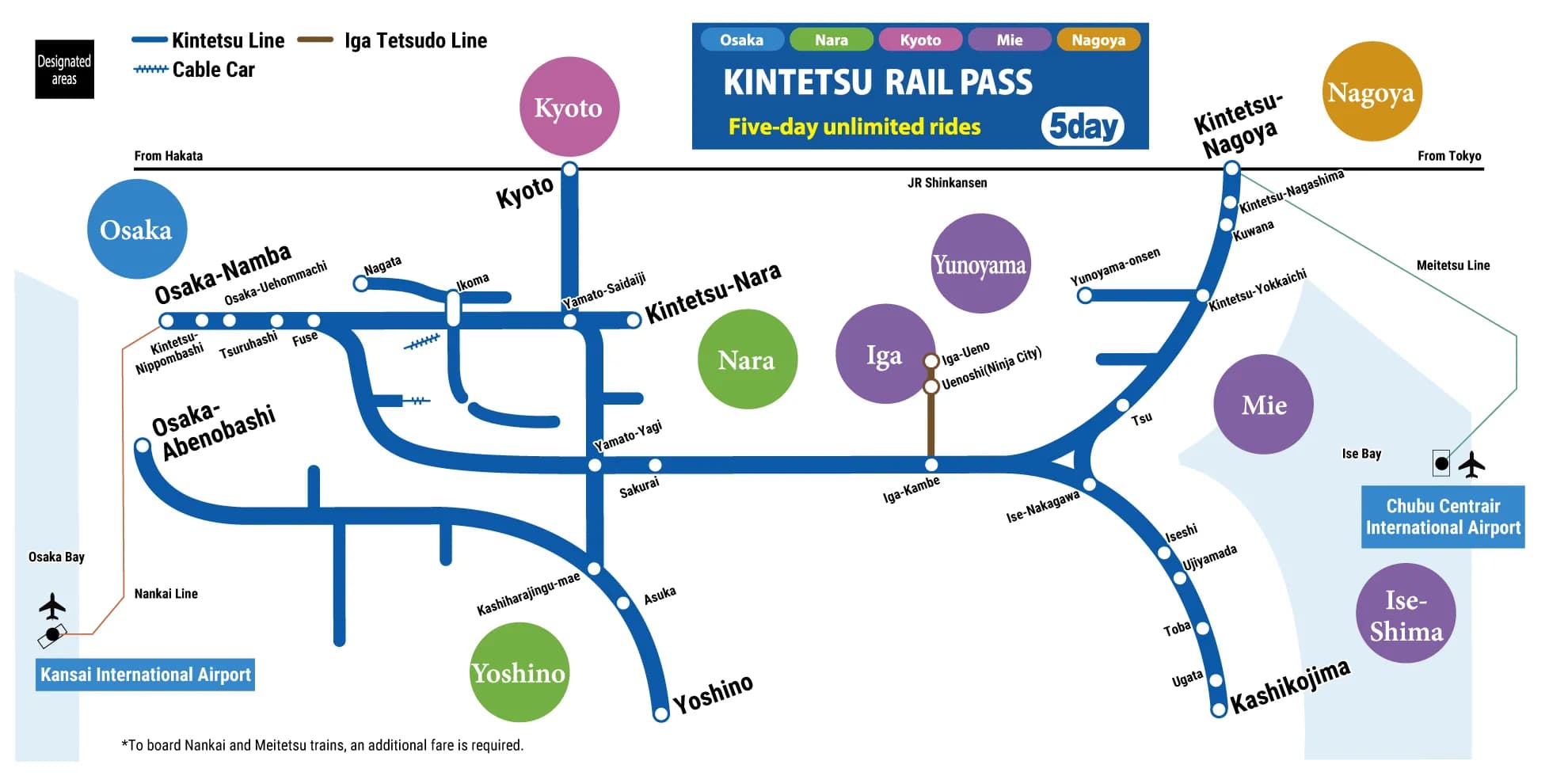
- 1 & 2-Day Pass: Focused on the Osaka-Nara-Kyoto sections. Includes Nara buses, making it useful for Nara day trips.
- 5-Day Pass (Standard/Plus): Useful for travelers moving from Osaka to Nagoya. (Can ride the 'Hinotori' with separate limited express ticket purchase.)
- Warning: Check for winter closing periods (approx. Jan–Feb) for Ikoma Sanjo Amusement Park.
Exclusive TourCast Tips!
Is the Kintetsu Rail Pass really a good deal for Osaka–Nagoya?
Searching for ways to get from Osaka to Nagoya often brings up the Kintetsu Rail Pass, but gains and losses vary wildly by travel style.
| Transport Mode | Duration | Cost (One-way) |
|---|---|---|
| Kintetsu Local (Pass) | Approx. 3 hrs 50 mins (2+ transfers) | Included in Pass |
| Limited Express Hinotori | Approx. 2 hrs 15 mins (Direct) | Approx. 4,990 yen (Fare + Express fee) |
| Shinkansen | Approx. 50 mins (Direct) | Approx. 6,700 yen |
Using only local trains with the Kintetsu 5-Day Pass (4,900 yen) is very cheap, but the near 4-hour travel time and frequent transfers are physically draining. If you want to ride the Hinotori with the pass, you must pay round-trip express fees (~4,260 yen), at which point the total cost is barely different from a standard individual booking.
- For a Day Trip: We recommend individual bookings for the time-efficient Shinkansen or the comfortable Hinotori.
- For Busy Itineraries: The Kintetsu Rail Pass is the right answer only if you plan to thoroughly explore Mie (Ise-Shima) and Nara in addition to Nagoya over 5 days.
- Route Tip: To eliminate travel time entirely, consider multi-city flights like Osaka in – Nagoya out.
Note: The Kyoto–Nagoya leg takes approx. 2 hrs 20 mins by local train. IC card errors are frequent where operators change, so always buy a physical paper ticket before boarding.
Special Passes for Kyoto and Arima Onsen RegionsSmart usage of Kyoto city transport tickets and Arima Onsen packages.
1) Kyoto Subway 1-Day Pass
A subway-only pass cutting across Kyoto city from north-to-south and east-to-west.
- Coverage: All Kyoto Municipal Subway lines (Karasuma Line, Tozai Line).
- Price: 1-Day Pass 800 yen (Child 400 yen).
- Features: While historically less used as Kyoto is bus-centric, its value has risen in 2026 due to severe bus congestion. It's a great way to avoid crowds if your hotel is near a subway station (Kyoto Sta., Shijo, Karasuma-Oike, etc.).
2) Kyoto Subway & Bus 1-Day Pass
The 'gold standard' for Kyoto travel. Since the bus-only 1-day pass was abolished in 2024, this has become the most rational alternative.
- Coverage: Kyoto Municipal Subway + Municipal Bus + Kyoto Bus (partial) + Keihan Bus (partial).
- Price: 1-Day Pass 1,100 yen (Child 550 yen).
- Decision Criteria: Since a regular bus fare is 230 yen, you break even with 5 or more daily trips.
- Pro-Tip: Allows use of the Sightseeing Express Buses (EX100, EX101) which run on weekends and holidays without extra charge, offering great time-saving effects.
3) Kyoto Sightseeing Express Bus (EX100, EX101)
Express routes introduced in June 2024 specifically for tourists, connecting major spots with minimal stops.
- EX100 (Raku Raku Ginkaku-ji): Kyoto Sta. → Kiyomizu-dera (Gozojaka) → Gion → Heian Jingu → Ginkaku-ji.
- EX101 (Raku Raku Kiyomizu-dera): Direct from Kyoto Sta. → Kiyomizu-dera (Gozojaka).
- Fare: 500 yen per ride.
- Usage: As individual fares are high, it is standard practice to use these unlimitedly with the Subway & Bus 1-Day Pass (1,100 yen).
4) Arima Onsen Taikou-no-yu Package Ticket
Useful for visiting the large hot spring theme park 'Taikou-no-yu' in Arima Onsen from Osaka or Kobe.
- Contents: Round-trip train (Hankyu or Hanshin) + Kobe Railway + Taikou-no-yu Entry.
- Price: Hankyu version 3,150 yen / Hanshin version 2,950 yen.
- Advantage: Since Taikou-no-yu entry alone is usually 2,700–3,000 yen, your transport becomes essentially free or even cheaper.
Exclusive TourCast Tips!
What is the most useful transport pass in Kyoto?
While Hankyu passes were briefly discontinued, they are now available again as digital tickets (1,300 yen). However, due to the significant price hike, their value is not what it used to be.
Many say the Keihan Pass is great for Fushimi Inari, but you may actually lose money if you don't use the Keihan line at least five times a day.
| Movement (Keihan Line Example) | Individual Fare |
|---|---|
| Osaka (Yodoyabashi) → Fushimi Inari | 480 yen |
| Fushimi Inari → Demachiyanagi (toward Ginkaku-ji) | 300 yen |
| Demachiyanagi → Gion-shijo (Kiyomizu/Nishiki) | 240 yen |
| Gion-shijo → Osaka (Yodoyabashi) | 490 yen |
| Total | 1,510 yen |
Even after doing all popular courses, the total is 1,360 yen, which is cheaper than a 1,650 yen Keihan Pass. Thus, a simple round-trip or just 3–4 rides makes the pass more expensive.
- For 5+ Rides: Buy the Keihan Pass to fully explore outlying areas like Uji or Chushojima.
- For General Itineraries: It is much more efficient in terms of time and cost to use an IC card or Contactless card to ride JR, Hankyu, Keihan, and Randen freely without worrying about line boundaries.
When You Should Utilize JR LinesMajor sections like the Airport, Kyoto, Kobe, and USJ where JR is more efficient.
If it's your first trip, distinguishing between JR lines and Subway/Private rails can be confusing. Passes like the Amazing Pass or e-Pass mentioned earlier mostly exclude JR lines. So when and why should you take a JR train in Osaka?
1) Within Osaka City: 'Not Recommended' unless for specific spots
For sightseeing in central Osaka (Namba, Umeda, Shinsaibashi), the Midosuji Subway Line is fastest and most convenient. Taking a JR train to move within the city often involves detour routes or complex transfers.
- Exception: Taking the JR Universal City Station is mandatory for Universal Studios Japan (USJ). You must take the JR line here regardless of pass status.
2) Inter-city Travel: JR for Speed and Efficiency
When leaving Osaka for Kyoto or Kobe, JR's 'Special Rapid' (Shin-Kaisoku) trains are often overwhelmingly faster than private railways.
| Section | Transport | Duration | Features |
|---|---|---|---|
| Osaka ↔ Kyoto | JR Special Rapid | Approx. 29 min | Arrives at Kyoto Sta. (Fastest) |
| Hankyu Railway | Approx. 43 min | Arrives at Kyoto-Kawaramachi Sta. | |
| Airport ↔ Kyoto | JR Haruka | Approx. 83 min | No transfer, most convenient |
| Private + Subway | Approx. 130 min | At least 2 transfers required |
3) Precautions for JR Lines
- Visiting Nara: JR Nara Station is about 1 km further from major sights (like Nara Park) than the Kintetsu Nara Station. Use the Kintetsu line to minimize walking.
- No Contactless Payment: While Osaka subways and private rails now support credit card tap payments, JR lines still do not as of 2026. To go to USJ, you must buy a physical ticket or use a rechargeable card like ICOCA.
- Check Pass Coverage: Unless it's a pass issued by JR West (like a Kansai Area Pass), most 'Osaka Passes' do not cover JR lines.
💡 Expert Tip Use the Subway for central Osaka and the JR Special Rapid to reach Kyoto or Kobe quickly. Get into the habit of checking for the 'JR' logo on Google Maps routes to save both time and money.
How to Use JR Kansai, Wide Area, and Mini PassesChoosing the optimal JR pass based on travel range and duration.
For travelers moving frequently between cities (Kyoto, Kobe, Himeji) rather than just staying in Osaka, a JR Pass becomes a powerful tool.
1) JR Kansai Area Pass (Includes Haruka)
Suitable for moving directly from Kansai Airport to Kyoto or for day trips focused on JR lines.
- Core Benefit: Use of the 'HARUKA' airport express reserved seats (up to 2 times) and non-reserved seats.
- Bonus Benefit: Includes vouchers for Kyoto Subway 1-Day Pass and Keihan/Hankyu Kyoto Line 1-Day Passes (extremely useful for Kyoto city sightseeing).
- Fare: 1-Day (2,800 yen) to 4-Day (7,000 yen) for adults.
- Warning: Limited express trains other than Haruka (e.g., Kuroshio, Thunderbird) require extra fees.
2) JR Kansai Wide Area Pass (Includes Shinkansen)
A must-buy for travelers extending beyond Osaka to outlying Kansai regions like Okayama, Tottori, and Kinosaki Onsen.
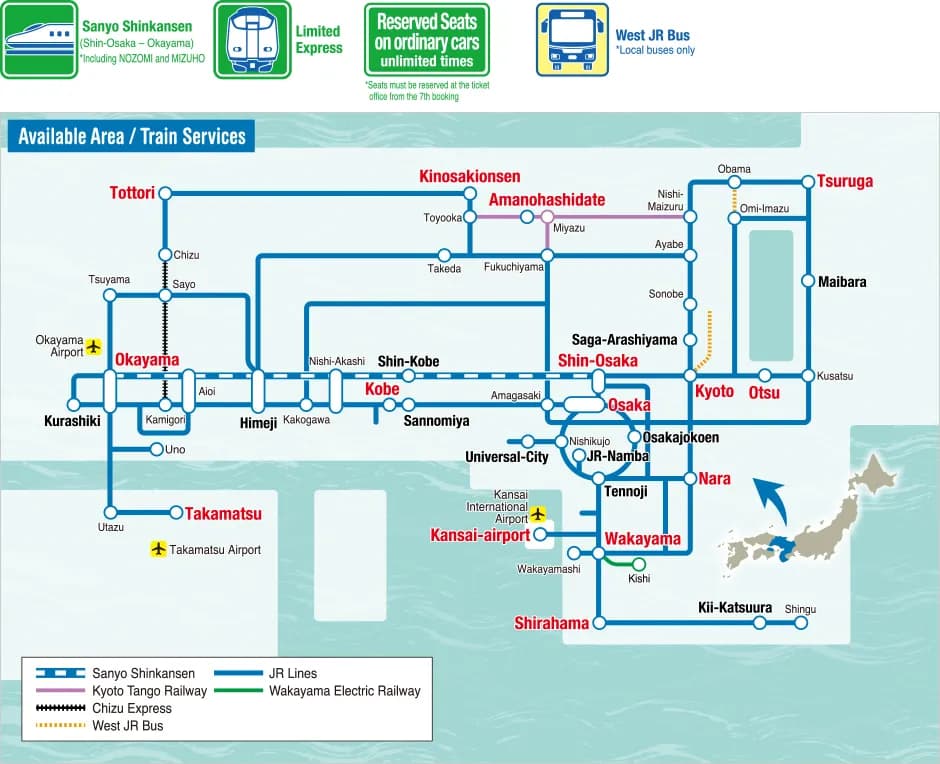
- Core Benefit: Allows use of the Sanyo Shinkansen (Shin-Osaka to Okayama) and major limited express reserved seats.
- Fare: 5-Day Pass 12,000 yen.
- Recommended Schedule: You break even by making just one round-trip to high-fare sections like Amanohashidate, Ine-no-Funaya, or Okayama-Kurashiki.
- Pro-Tip: Includes the Chizu Express section, making travel toward Tottori very efficient.
3) JR Kansai Mini Pass
A pass for budget travelers who don't need limited express trains but want to visit Kyoto, Kobe, and Nara using local trains.
- Fare: 3-Day Pass 3,000 yen (averages 1,000 yen per day).
- Advantage: Unlimited use of JR local trains, including the Kansai Airport Rapid (standard).
- Decision Criteria: If your hotel is near JR Osaka Station (Umeda), this solves nearby regional travel much cheaper than subway passes.
- Warning: Riding limited express trains like Haruka requires both full separate fares and express tickets; use only local/rapid trains.
Ekirinkun Usage Tip Holders of JR Kansai or Wide Area passes can utilize free bicycle rental services at major stations (Kyoto, Umeda, etc.). Exploring Kyoto's alleys by bicycle is highly enjoyable, so give it a try!