Osaka & Kansai Railway System: Complete Guide to Distinctions and Transfer Rules for JR, Subway, and Private RailUnderstanding transfer restrictions and fare differences by line.
When preparing for a trip to Japan, you've likely heard at least once that transportation costs are high because transfers between different lines aren't possible.
You can understand this as being half right and half wrong. Let's examine the actual differences in the complex railway system of the Kansai region.
📖 Learning Tip
The content below is written based on 'Essentials Part 2 - Japan Transport System Information.' If you are not yet familiar with basic Japanese train concepts (Local, Express, Limited Express, etc.), reading the previous part first will make this much easier to understand.
Subway = Train?!A guide to distinguishing between Subway, Private Rail, and JR lines to avoid confusion with transport passes.
In Japan, Subways (地下鉄) and Trains (電車/Private Rail) are entirely different modes of transport. Understanding this distinction accurately will help reduce confusion when using transport passes and make planning your movement much smoother.
1) Train Distinctions by Operator
| Category | Major Operators (Lines) | Features |
|---|---|---|
| Municipal Subway | Osaka Metro, Kyoto/Kobe Municipal Subway | Operated by local governments, connecting city centers. |
| Private Rail (Train) | Nankai, Hankyu, Hanshin, Kintetsu, Keihan, etc. | Operated by private companies, specializing in inter-city travel. |
| JR Lines | JR Kansai Airport Rapid, Osaka Loop Line, Nara Line, etc. | Based on national rail (Japan Rail), handles regional networks. |
- Subway: Lines such as the Osaka Metro that connect every corner of the city.
- Private Rail (私鐵): Primarily used for traveling to specific regions like Nankai (Airport), Hankyu/Hanshin (Kobe/Kyoto), or Kintetsu (Nara).
- JR Lines: Although companies vary by region, they are collectively referred to as 'JR Lines.' Technically they are trains, but in Japan, they are generally classified separately for reasons such as pass coverage.
2) Kansai Contactless (Touch Payment) Status Guide
Currently, the payment environment in Osaka and the Kansai region has become very convenient. You can pass through ticket gates directly using your existing contactless cards (Visa, Mastercard, etc.) or Apple Pay.
- Available Lines:
- All stations of Osaka Metro, Nankai Line, Kintetsu Line, Hankyu Line, and Hanshin Line.
- Osaka City Bus and Kobe Municipal Subway.
- Unavailable Lines:
- JR West: Currently, JR lines do not support contactless card touch payments. When visiting Universal Studios Japan (USJ), you must purchase a separate JR ticket or use a traditional IC card (such as ICOCA).
- Kyoto Region Status:
- Kyoto Municipal Subway and buses do not support contactless payments, so if you plan to travel throughout Kyoto, it is safest to carry a physical IC card.
💡 Summary Guide
If you are only traveling within Osaka city, a contactless credit card is sufficient without issuing a separate transport card. However, if you plan to visit USJ (using JR) or take Kyoto bus tours, combining it with a traditional rechargeable IC card or pass is the best way to prevent route inefficiency.
Transfer Rules Frequently Confusing in OsakaUnderstanding transfer availability by line and operator.
Transfer rules in Osaka begin with checking 'Is it the same operating company?' Understanding the characteristics of Japanese railways, where fares are newly generated every time you pass through a ticket gate, will help you calculate your travel expenses more accurately.
1) Summary of Transfer Availability by Line
| Transfer Combination | Availability | Notes |
|---|---|---|
| Subway ↔ Subway | Possible | Free transfers between Osaka Metro lines. |
| Same Private Rail ↔ Private Rail | Possible | Transfers within Hankyu, Hanshin, etc. |
| Subway ↔ Private Rail/JR | Impossible | Must exit gate and pay for new ride. |
| Private Rail A ↔ Private Rail B | Impossible | e.g., No free transfer between Hankyu ↔ Hanshin. |
| Private Rail ↔ JR Line | Impossible | Completely different operating systems. |
2) Detailed Transfer Guide
① Transfers Between Subway (Osaka Metro) Lines
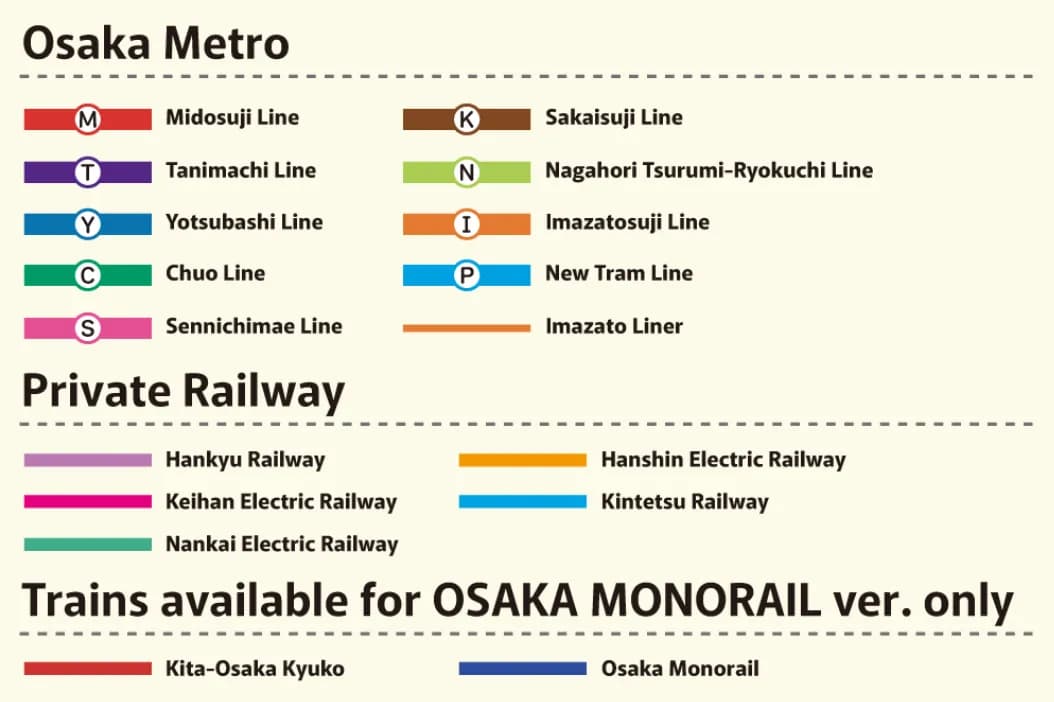
Lines belonging to the Osaka Metro, such as the Midosuji Line (red) and Tanimachi Line (purple), allow for free transfers inside the ticket gates even if the line names differ.
- The above-ground New Tram is also part of the Osaka Metro and is treated as a subway for transfer benefits.
② Transfers Within the Same Operator (Private Rail)
Just like transferring to the Hankyu Arashiyama Line while riding a Hankyu train, free transfers are possible between lines belonging to the same company (Hankyu, Hanshin, Kintetsu, etc.).
③ Transfers Between Different Operators (Caution!)
This is where most mistakes occur. If the operating companies differ, you must pass through the ticket gate to exit, then purchase a new ticket or tap your card to re-enter.
- Example: When going from Namba Station to Universal Studios Japan (USJ), you take the Hanshin Line to Nishikujo Station, then switch to the JR Line. At this point, you must exit the Hanshin gate and enter the JR gate, incurring two separate fares.
💡 Tip to Ease Transfer Worries
To reduce the hassle of buying tickets every time you transfer, use a rechargeable IC card like ICOCA or utilize contactless credit cards (touch payment), which became widespread in 2026. This significantly shortens travel time as you don't have to line up at ticket machines.
Are There Four Namba Stations? Multiple Umeda Stations Too?Station distinction guide so even first-timers won't get lost in Osaka.
If you are visiting Osaka for the first time, distinguishing between the various Namba and Umeda stations is the biggest hurdle. Despite similar names, the operating companies and platform locations are completely different. Just knowing which company operates the line you are taking will significantly reduce your chances of getting lost.
1) Distinguishing Major Stations in the Namba Area
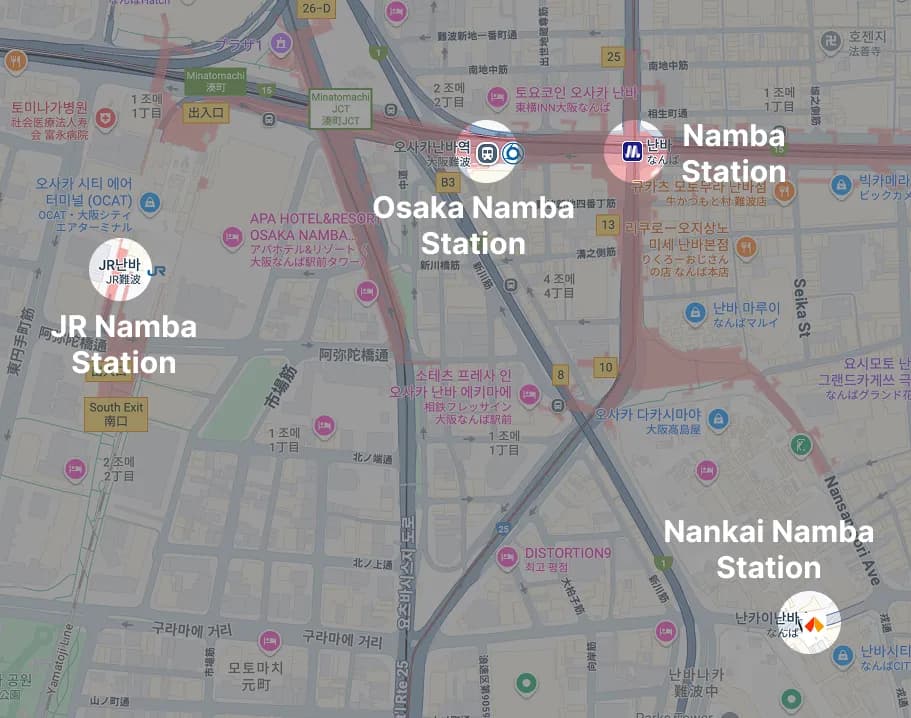
While Namba stations are connected by underground passages or shopping malls, the distances between them are quite large, and going to the wrong one can waste a lot of time.
| Exact Station Name | Lines (Operator) | Major Destinations |
|---|---|---|
| Nankai Namba Station | Nankai Main/Koya Line | Kansai Airport (Rapi:t) |
| Subway Namba Station | Midosuji, Sennichimae, Yotsubashi Lines | Throughout Osaka (Umeda, etc.) |
| Osaka-Namba Station | Kintetsu Nara Line / Hanshin Namba Line | Nara, Kobe (Sannomiya) |
| JR Namba Station | JR Yamatoji Line, etc. | Toward Kyoto, Tennoji |
2) Distinguishing Major Stations in the Umeda Area
Umeda is so complex it is often called the 'Umeda Dungeon.' Note that subway stations have different names depending on the line.
- JR Osaka Station: The hub where all JR lines stop. (Kyoto, Kobe, Kansai Airport, etc.)
- Subway Umeda Station: Served by the Midosuji Line (red), most frequently used for city travel.
- Osaka-Umeda Station: The terminal station for private rails Hankyu and Hanshin. Hankyu goes toward Kyoto/Kobe, and Hanshin toward Kobe.
- Higashi-Umeda / Nishi-Umeda Stations: Subway stations for the Tanimachi Line (purple) and Yotsubashi Line (blue), respectively.
3) Don't Confuse with 'Shin-Osaka Station'
Shin-Osaka Station (新大阪駅) is a separate station located 3 subway stops away from Umeda.
- This is the station primarily used for taking the Shinkansen.
- Note that you cannot take the Shinkansen from the regular Umeda or Osaka stations.
💡 Navigation Tip
Station signposts in Osaka clearly display the line's unique alphabetical color and number. When the text is confusing, following the color-coded lines on the floor or walls is the most accurate way. (e.g., Follow the red line for the Midosuji Line.)