Osaka City Tour: Core Landmark Value Course with the 1-Day Amazing PassComplete conquest of core attractions enjoyed with the 1-Day Amazing Pass
In this section, we introduce a course that allows for a maximum value itinerary by utilizing the 1-Day Osaka Amazing Pass. The Osaka Amazing Pass is considered an essential item for city tourists as it covers both train travel and entrance fees to major tourist sites.
- Note: The Harukas 300 Observatory is not eligible for free entry with the Amazing Pass; only partial discounts apply. If you want free entry to an observatory, it is best to use the 'Umeda Sky Building' (note the entry time limit). Alternatively, using the Kansai Joy Pass to enjoy both Harukas 300 and Umeda Sky Building is a great option. However, for the Kansai Joy Pass as well, be sure to verify the entry availability of your desired facilities before purchasing.
💡 TourCast Tip: Essential Checks When Using the Amazing Pass
- Free Benefits: Free entry or free rides are available at over 40 tourist facilities in Osaka city.
- Usage Count: Free use is limited to once per facility, only on the day the pass is used.
- Advance Check Required: Some facilities have conditional discounts or free use restrictions based on time and period. You must check operating hours, closing days, and application conditions before visiting.
Tombori River Cruise ReservationA popular night view course that must be booked first to avoid missing out
On the day you use the Osaka Amazing Pass, the first thing to handle is the Tombori River Cruise reservation. This is because it operates on an on-site reservation system, making it very difficult to use during popular times (night view) without an advance booking.
We recommend arriving at the site by 10:00 AM, when the reservation ticket office opens. By securing your preferred evening boarding pass using your Amazing Pass, you can spend the rest of your day efficiently without worry.

- Amazing Pass Benefit: Free reservation and boarding upon presentation of the pass.
- Operating Info: Departs every hour on the hour and half-hour. Total operating hours are 11:00 – 21:00.
- Note: Operations may be suspended without notice due to river water levels, bad weather, or vessel maintenance, so checking before visiting is necessary.
Exclusive TourCast Tips!
Want to book a cruise online in advance?
If you want to save time in the morning, we recommend WONDER CRUISE, which allows for online advance reservations, as an alternative.
- With Amazing Pass: Online reservation and free boarding are possible for any time slot.
- With Osaka e-Pass: Only slots after 17:00 are available, so you must check the usage conditions and times when booking.
💡 TourCast Tip
The most popular time slots are from right after sunset until 8:00 PM. These slots often sell out between 10:00 AM and 11:00 AM. Amazing Pass travelers should stop by the ticket office to exchange their boarding pass immediately after checking out of their accommodation or before starting their morning schedule.
Osaka CastleThe final battlefield of Toyotomi and Tokugawa, a fortress where history breathes
1) Main Tower (Tenshukaku)
Osaka Castle is a symbolic castle of Japan, construction of which was begun in 1583 by Toyotomi Hideyoshi, the unifier of Japan's Sengoku period. After Oda Nobunaga died due to a subordinate's betrayal just before unification, Hideyoshi, who rallied Nobunaga's forces, mobilized 100,000 workers to complete a massive fortress decorated with brilliant gold leaf to flaunt his power.
After the death of Hideyoshi, power struggles between daimyos over the succession intensified. Tokugawa Ieyasu seized actual power after winning the Battle of Sekigahara in 1600. Through the 'Winter Siege of Osaka' in 1614 and the 'Summer Siege of Osaka' in 1615, he completely destroyed the forces of Hideyoshi's son, Hideyori, and opened the Edo Shogunate era.
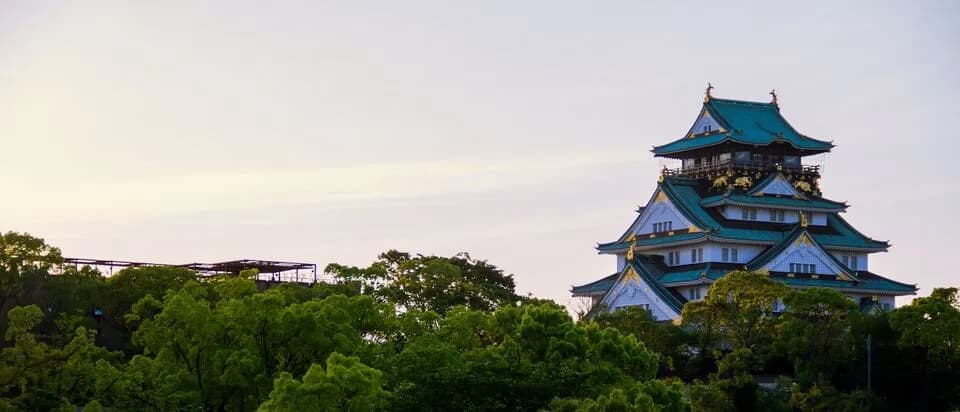
Osaka Castle, which burned down during the battles, was later rebuilt by the Tokugawa family. At that time, they reduced the scale of the castle but built the main tower higher to erase traces of the Toyotomi era and establish the authority of the new age.
The current tower is a concrete restoration from 1931. The 8-story interior museum features various exhibits regarding the history of Osaka Castle and the life of Toyotomi Hideyoshi.
- Usage Benefit: Free entry upon presentation of the Osaka Amazing Pass.
- Hours: 09:00 – 17:00 (Last entry 16:30)
- Hours extended by 1–2 hours during specific seasons (cherry blossoms, summer peak, etc.)
- Closing Days: December 28 – January 1.
💡 TourCast Tip
The view of Osaka city from the top floor of the main tower is another highlight of this castle. After leisurely exploring the interior museum to understand the dynamic history of the Sengoku period, enjoy the Osaka skyline from the observatory.
2) Osaka Castle Nishinomaru Garden
Nishinomaru Garden was created in 1931 using donations from citizens and is known as the former site of the residence of Toyotomi Hideyoshi's primary wife. With about 300 cherry trees planted, it is very famous as a spring cherry blossom spot and is a prime photo spot for viewing the main tower from the most beautiful angle.
The garden is characterized by scenery that changes with every season. It is a place where you can feel another charm of Osaka Castle, harmonized with cherry blossoms in spring, azaleas in summer, and autumn foliage.
- Usage Benefit: Free entry possible upon presentation of the Osaka Amazing Pass.
- Hours: 09:00 – 17:00 (Until 16:30 from Nov–Feb)
- Regular Closing: Every Monday (The following day if it's a public holiday), Dec 28 – Jan 4.
Exclusive TourCast Tips!
A 20-minute walk to the tower; is there an easier way?
Most navigation apps suggest a 20-minute walk (1.5km) after getting off at Tanimachi Yonchome Station. Because Osaka Castle Park is so vast, you will face a significant walk regardless of which station you use.
If the weather is nice, walking for a stroll is fine, but if you have companions who find walking burdensome, such as young children or the elderly, it is wise to utilize the paid transport operating within the park.
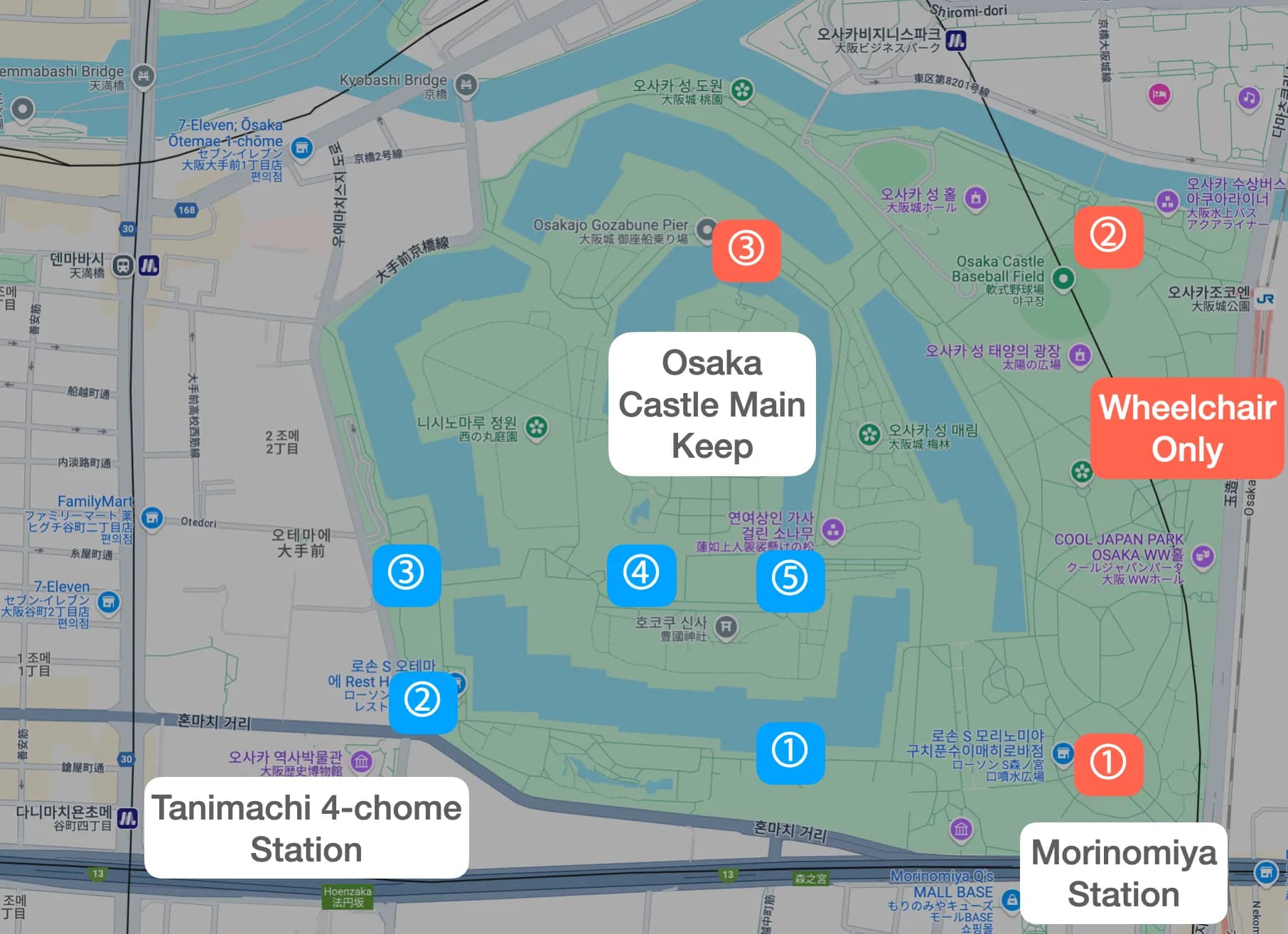
- Road Train (Red Line): Runs from the direction of Morinomiya Station/JR Osakajokoen Station to Gokurakubashi (near the main tower).
- Electric Car (Blue Line): Runs from the direction of the Jonan Bus Parking Lot to Sakuramon/Hokoku Shrine.
- Operating Hours: 09:30 – 17:30 (Closed on the first Thursday of every month).
| Passenger Type | Road Train | Electric Car | 1-Day Pass |
|---|---|---|---|
| General (Middle School – 64) | 400 yen | 300 yen | 1,000 yen |
| Children & Seniors (65+) | 200 yen | 200 yen | 600 yen |
| Disabled (with ID) | Free | - | |
※ The 1-Day Pass is an integrated ticket allowing unlimited use of both the road train and electric car for one day.
Osaka Museum of Housing and LivingA time travel to an Edo-period Osaka village
Located within the Osaka Municipal Housing Information Center, this is Japan's first museum themed on housing and lifestyle. Rather than just displaying artifacts, it features a meticulously recreated full-scale Edo-period Osaka village, providing a space where you can vividly experience life at that time.
Despite being an indoor exhibition, it uses lighting to simulate day and night, and the atmosphere, which feels like an Osaka street during a festival, is impressive.
- Kimono (Yukata) Experience: Available for a fee of 1,000 yen, which has increased from previous years. (Limited to first 100 people per day, 30-minute duration) If you want the experience, it is best to visit in the morning.
- Usage Benefit: Free entry to permanent exhibitions upon presentation of the Osaka Amazing Pass.
- Hours: 10:00 – 17:00 (Last entry 16:30)
- Regular Closing: Every Tuesday, Year-end/New Year (Dec 29 – Jan 2), and other temporary closing days.
💡 TourCast Tip
The first floor of the building where the museum is located connects to the Tenjinbashisuji Shopping Street, one of Osaka's famous markets. After visiting the museum, we recommend walking along this shopping street, which is famous for being the longest in Japan, and enjoying local snacks.
HEP FIVE Ferris WheelEnjoy a 106m urban view from the middle of Umeda
In Japan, amusement parks and Ferris wheels are staple date courses for couples, so you can easily find Ferris wheels throughout the city. Using the Osaka Amazing Pass, you can ride the HEP FIVE Ferris Wheel, the Tempozan Ferris Wheel in the port area, and the Redhorse Osaka Wheel (Japan's largest) all for free.
However, Tempozan and the Osaka Wheel are located in the outskirts, requiring significant travel time. If your schedule is tight, choosing the HEP FIVE Ferris Wheel in central Umeda, which is highly accessible and surrounded by shopping malls, is most efficient.
Standing at 106m, the striking red Ferris wheel is a landmark of Umeda, offering a panoramic view of the Osaka city center for about 15 minutes, making it ideal for enjoying the brilliant night skyline.
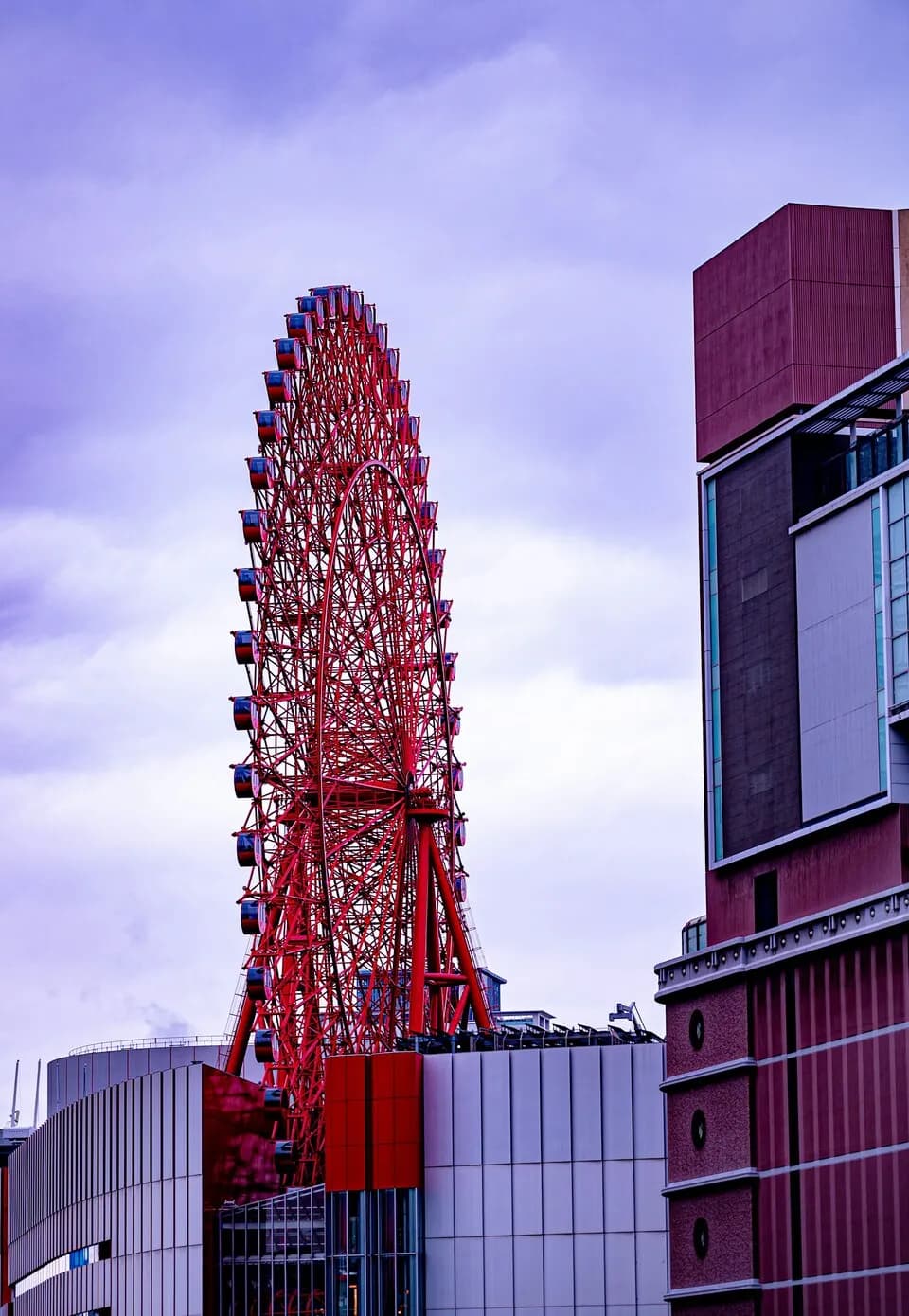
- Usage Benefit: Free ride possible upon presentation of the Osaka Amazing Pass.
- Hours: 11:00 – 23:00 (Last boarding 22:45)
- Regular Closing: Irregular (Checking the website in advance is recommended).
💡 TourCast Tip
Speakers are provided inside the gondola, so you can connect your smartphone and enjoy the view with your own music. Also, note the giant red whale sculpture hanging in the entrance of the HEP FIVE mall where the Ferris wheel is located—it's a great spot for a photo.
Umeda Sky Building ObservatoryA 360-degree Osaka panorama reached via mid-air escalator
Once considered the premier observatory for looking down on Osaka city, the Umeda Sky Building (Kuchu Teien Observatory) now seems to have yielded that title to the Harukas 300.
However, its unique charm remains strong. The thrilling experience of riding the mid-air escalator connecting the two buildings is a highlight in itself, and upon reaching the rooftop, you can fully experience the Osaka sky through the 360-degree fully open-air structure. The night view enjoyed while directly facing the wind without glass windows provides a sense of liberation hard to find at other observatories.
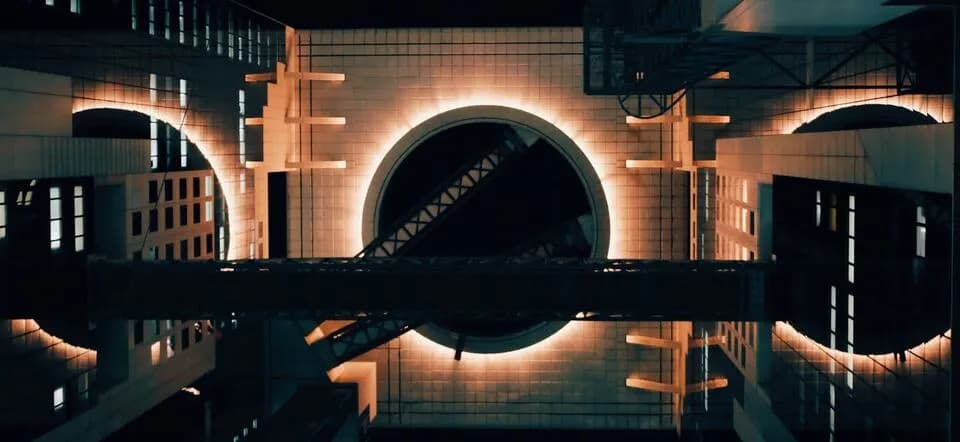
If you're hungry after viewing, stop by Takimi Koji, the retro restaurant alley recreating the Showa era on the B1 floor. You can enjoy an atmosphere that feels like stepping back into the past along with the food.
- Usage Benefit: Free for Amazing Pass holders entering before 15:00
- Entering after 15:00: 10% discount on the admission fee
- Hours: 09:30 – 22:30 (Last entry 22:15)
- Open year-round
💡 TourCast Tip
The Amazing Pass free entry time is restricted to until 3:00 PM. Therefore, the most economical route is to view the Sky Building in the afternoon and enjoy the night view from the HEP FIVE Ferris Wheel, which allows for free evening boarding with the Amazing Pass.
Shitennoji TempleThe start of Japanese Buddhism, a thousand-year temple where Baekje culture lives
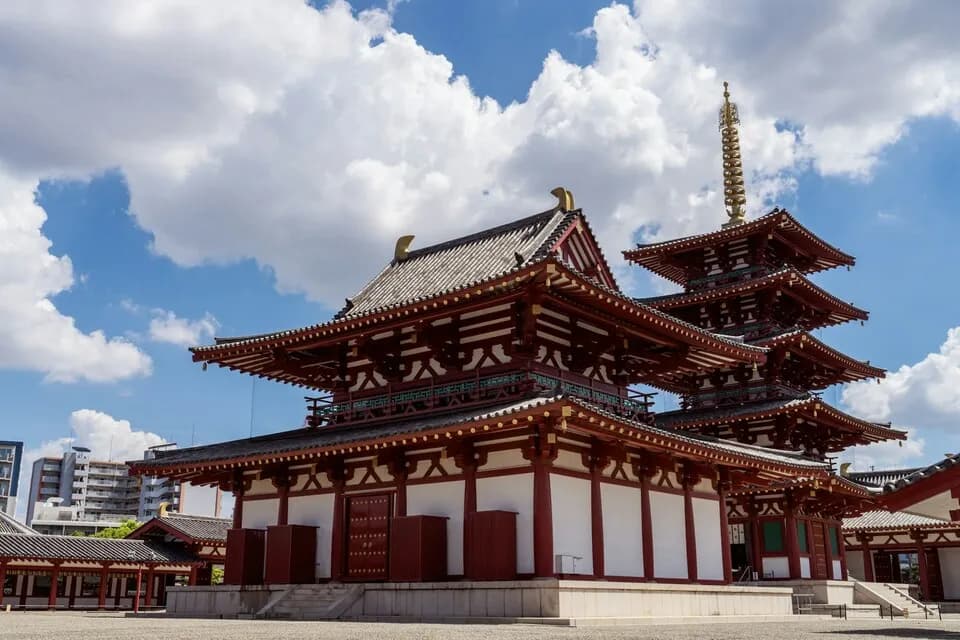
Shitennoji is Japan's first royal temple, founded by Prince Shotoku, and can be considered the starting point of Japanese Buddhism. The Buddhist culture transmitted from the ancient Korean kingdom of Baekje took root here and has continued its tradition to this day.
To understand the background of Shitennoji, one cannot omit the Soga clan, the Prince's maternal relatives. At the time, Japan saw a fierce power struggle between the Soga and Mononobe clans regarding the adoption of Buddhism. The victorious Soga clan established Buddhism as the state religion, and Shitennoji was built to offer gratitude to the Four Heavenly Kings (Shitenno) for victory.
Prince Shotoku, taught by the Baekje monk Hyechong, spread a philosophy emphasizing Harmony (Wa). This 'Wa' philosophy is deeply ingrained in modern Japanese life, found in terms like Washoku (Japanese food) and Washitsu (Japanese-style room). He also emphasized the Iitokotori (taking the good parts) spirit—being willing to accept good things—which became the foundation for the openness and practicality of Japanese culture today.
Significantly, Shitennoji is a temple built with the technological prowess of Baekje artisans. The Baekje artisan Yu Jung-gwang was granted the surname 'Kongo' by the Japanese royal family and settled in Japan. He founded the specialized temple construction company Kongo Gumi, which was once recorded as the oldest company in the world.
- Usage Benefit: Free entry to the Central Temple Grounds and Honbo Garden upon presentation of the Osaka Amazing Pass.
- Hours:
- Apr–Sep: 08:30 – 16:30
- Oct–Mar: 08:30 – 16:00 (Last entry to the garden is 30 mins before close)
- Open year-round
💡 TourCast Tip
Shitennoji faithfully follows the 'Baekje-style layout,' where the inner gate, pagoda, main hall, and lecture hall are arranged in a straight line. This architectural style was transmitted from the ancient Korean peninsula (Baekje), providing a rare opportunity to directly confirm vivid traces of ancient East Asian cultural exchange in architecture.
Tsutenkaku TowerThe symbol of Shinsekai, now updated with thrilling attractions
If you've seen a unique tower resembling a robot's head in Japanese manga or dramas, it's likely Tsutenkaku, the symbol of Shinsekai. Meaning 'building reaching to heaven,' this tower is the landmark of the Shinsekai area, where the atmosphere of Osaka's working class lives on.
The current Tsutenkaku is the second-generation building, rebuilt in 1956, originally designed with motifs from Paris's Eiffel Tower and Arc de Triomphe. The first tower was destroyed by fire, but since its reconstruction, it has become a symbolic presence in modern Osaka history, recorded as the first observatory in Japan to install an elevator.
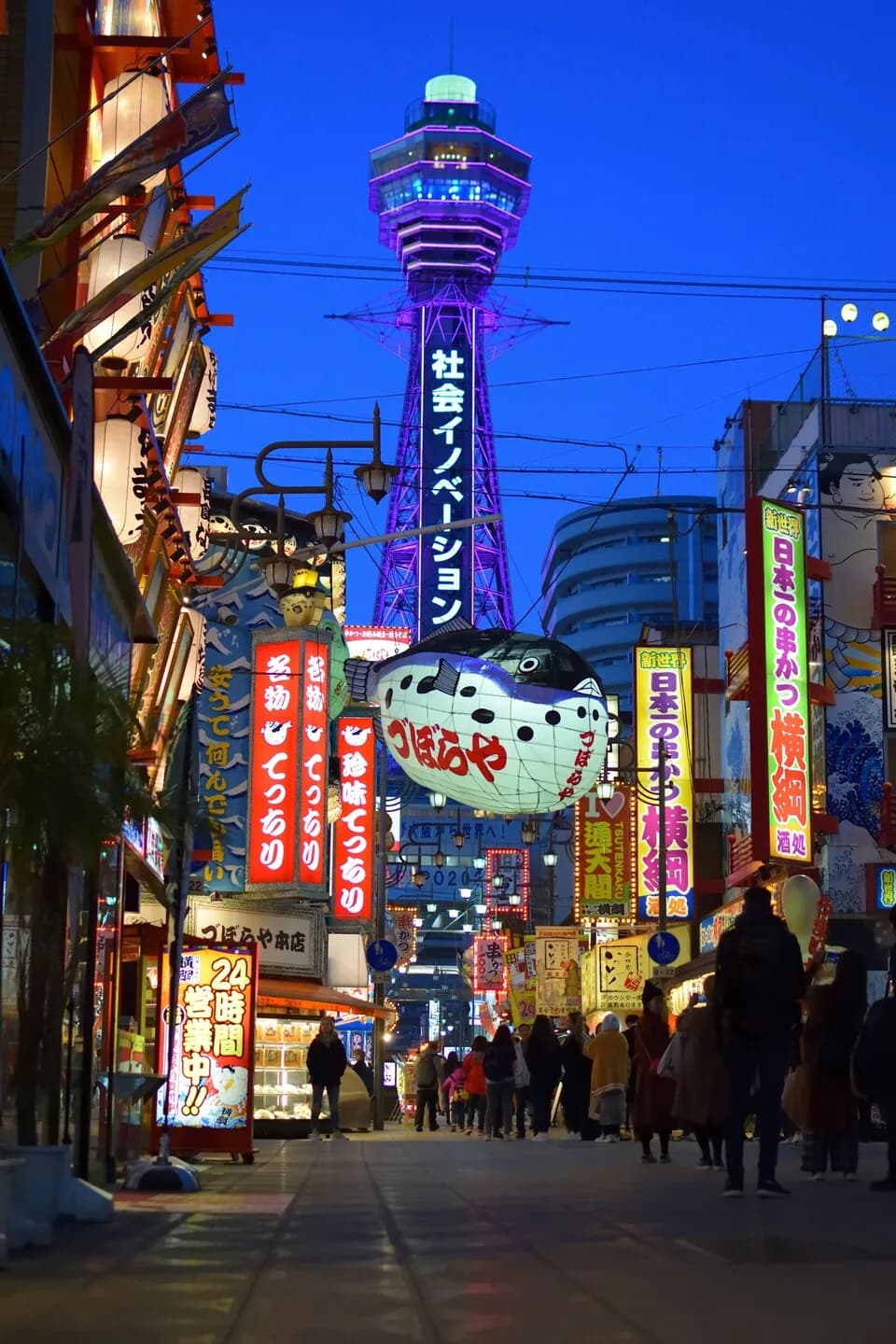
- Usage Benefit: Free general observatory entry upon presentation of the Osaka Amazing Pass.
- Hours: 10:00 – 20:00 (Last entry 19:30)
- Lighting: Brilliant LED lights turn on from sunset until midnight.
- Open year-round
Activities for 200% Enjoyment at Tsutenkaku
Recently, Tsutenkaku has transformed into a sanctuary for thrilling attractions beyond just being an observatory.
1) Tower Slider
Installed in 2022, this is a massive slide with a total length of 60m. There is a transparent section in the middle, giving you the feeling of flying through the sky.
- Amazing Pass Benefit: Free experience available regardless of weekdays or weekends.
- It was once only available on weekdays, but it can now be used on weekends as well. However, be aware that use may be restricted if reservations fill up early, and you should anticipate a wait of over an hour, especially on weekends.
2) Dive & Walk
A brand-new attraction opened in July 2024. It consists of the 'Dive,' where you jump 14m down from a height of 40m, and the 'Walk,' where you walk along the exterior wall at a height of 26m.
- Amazing Pass Benefit: Free experience available regardless of weekdays or weekends.
- Precautions:
- Operations may be suspended depending on weather conditions.
- All belongings except mobile phones are prohibited from being brought on.
- Usage may be restricted if wearing skirts, dresses, sandals, or high heels.
- For safety, you must complete the dive within 45 seconds for smooth video recording.
💡 TourCast Tip
There is a statue of the deity 'Billiken' in the Tsutenkaku observatory, which is said to bring good luck if you touch its feet. Before descending after your observatory tour, be sure to rub Billiken's feet and make a wish. Also, since 'Dive & Walk' has a fairly high individual usage fee, it is a must-visit course that more than pays for your Amazing Pass.
Harukas 300 ObservatoryEnjoying dusk and night views from Osaka's highest point
The highest observatory in Osaka, Harukas 300, allows you to look down on the city with a 360-degree panoramic view from the 60th floor, at a height of 300m. Although free entry is not possible with the Osaka Amazing Pass, it is ranked as the most preferred observatory by travelers due to its overwhelming height and facilities.
Since its opening in 2014, it has established itself as Osaka's representative night view spot. We most recommend entering about 30 minutes before sunset to watch the sky turn red during the twilight period until the city lights turn on.

- Usage Benefit:
- Kansai Joy Pass: Free entry possible (Pre-check mandatory).
- Osaka Amazing Pass: Provides a 10% discount on admission.
- Hours: 09:00 – 22:00 (Last entry 21:30)
- Open year-round
💡 TourCast Tip
The 58th floor features the 'Sky Garden,' an outdoor garden open to the sky, and a cafe where you can leisurely enjoy the night view with a beer or drink. Also, even the restrooms have floor-to-ceiling glass, earning fame as the 'restrooms with the best view in the world,' so don't forget to stop by.