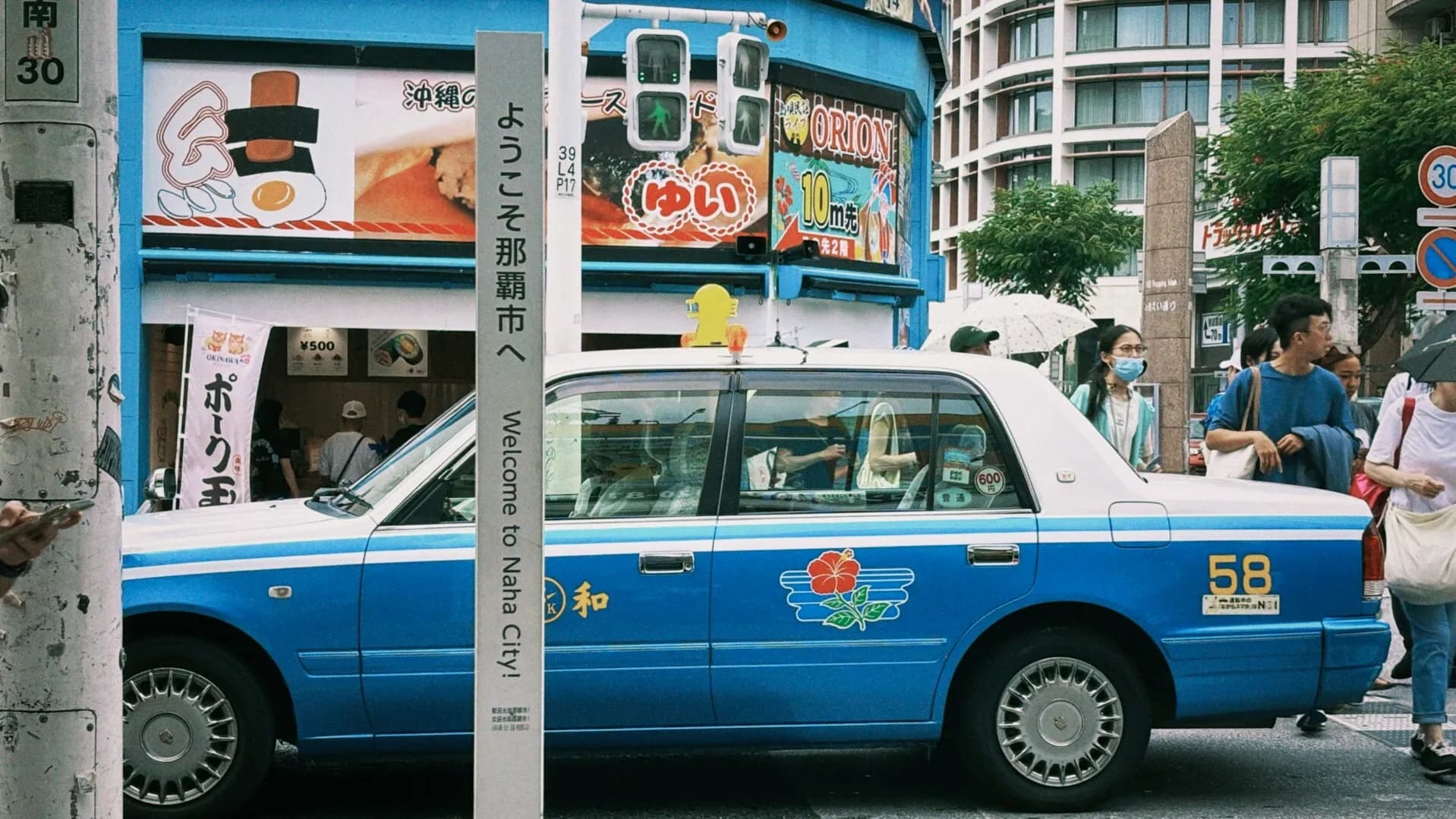
OKICA IC Card GuidePurchase, usage, and refunds
OKICA is Okinawa’s IC transit card that can be used on Yui Rail and local route buses. However, note that it cannot be used for scheduled sightseeing buses or limousine buses.
You can purchase it from ticket vending machines at Yui Rail stations.
Do you really need to buy OKICA?
It is best to decide based on your itinerary and how often you will use public transportation.
- If you plan to use Yui Rail or local route buses frequently, choosing a separate pass may be more cost-effective.
- If you will use Yui Rail only about 3–4 times, buying OKICA can be too much hassle because of the refund process, and you may also pay a refund fee if you have leftover balance.
- Some bus routes accept cash or OKICA only, so if you expect to ride buses often, OKICA is worth considering.
- If you plan to ride buses only a few times, paying in cash may be more efficient.
For broader IC-card guidance, refer to 'Common Part 2 - Japan Transportation System'.
Yui Rail GuideRoutes, fares, and passes
Yui Rail is Okinawa’s only rail line, running as a monorail. It connects the airport to key spots such as Kokusai-dori (International Street), Shuri Castle, and the Urasoe Castle ruins area.
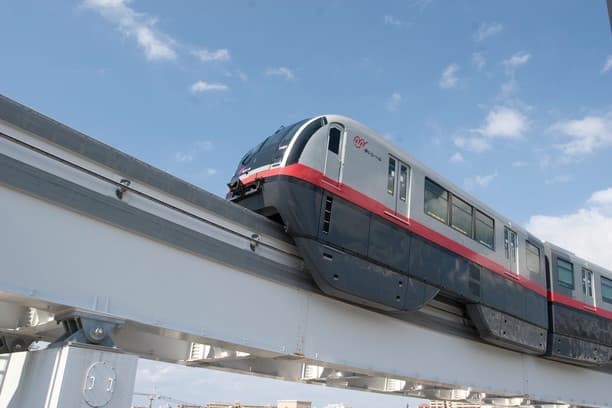
From the airport to Kencho-mae Station, the fare is 270 yen. If you ride 3+ times in one day, the Yui Rail Pass is usually cheaper: a 1-day pass (1,000 yen) or 2-day pass (1,400 yen).
These passes are valid for 24 hours or 48 hours from the time of purchase.
However, to reach Shuri Castle using only this pass, you need to walk about 15 minutes from Shuri Station, so there is some distance between the station and the destination.
In that case, the 'Bus & Monorail Pass (バスモノパス)', which covers both Yui Rail and Naha route buses, can be useful and is explained in the bus section below.
To ride Yui Rail, you can either tap an IC card on the reader or pass through gates using a QR code for single tickets or passes.
- In addition to OKICA, IC cards from other regions (Suica, ICOCA, etc.) can also be used.
Contactless card entry is available
- From March 28, 2025, you can also ride using a contactless card (with the Wi-Fi-like symbol) such as Visa, Mastercard, etc.
- There is a daily cap of 800 yen, and after reaching the cap you can ride unlimited times.
- Note: The 1-day pass is valid for 24 hours from purchase, but contactless rides are valid only until the end of that calendar day.
Okinawa Bus OverviewTypes, operations, and practical tips
In Okinawa, buses are broadly divided into local route buses and scheduled services to central/northern areas (highway buses).
However, because the operating system is not unified, some buses are pay-on-boarding while others are pay-on-exit, and even buses from the same company can differ.
Payment methods also vary. Some buses accept cash only, while others accept certain IC cards or credit cards. This can easily confuse first-time visitors.
Many travelers find bus usage in Okinawa difficult for this reason.
TourCast explains this complex system in a clear and practical way, and this section follows that approach.
You do not need to memorize everything. It is enough to understand what exists, then check details on-site when needed.
Because there are many different payment systems, if you are not using a transport pass (e.g., the All-route Bus Pass or Yanbaru North Pass), the safest option is to carry cash, especially multiple 1,000-yen bills.
Local Route Bus GuideOperators, fare systems, and how to ride
1) Local Route Bus 1
Typical local route buses
Okinawa’s main local route buses are operated by Ryukyu Bus Kotsu, Okinawa Bus, Toyo Bus, and Naha Bus, and some routes are jointly operated.
Within Naha City stops, there is a flat-fare system. The basic fare is 260 yen, and Route 105 is 190 yen.
Even on the same local bus network, both pay-before and pay-after systems exist, and boarding/alighting doors can differ (front vs back).
- IC-card payment is available only with OKICA (some routes are cash-only)
- Buses with only a front door: board at the front, take a numbered ticket, then pay when getting off after checking the fare display
- Routes under 20, including Route 105
- Exception: Routes 10 and 12 → board from the rear, exit from the front
- Buses with front & rear doors:
- Front-door boarding: pay when boarding, exit from the rear (often flat-fare)
- Rear-door boarding: take a numbered ticket, then pay when exiting from the front
Some buses show 『前払い (pay before)』 / 『後払い (pay after)』, which is helpful to check.
Currently, only a limited set of routes support contactless cards (roughly Routes 20, 28, 29, 95, 120, 228). If you do not have OKICA, it is best to carry several 1,000-yen bills to pay in cash.
2) Useful transport passes
Naha Bus 1-Day Unlimited Ride Ticket
- Unlimited rides for 1 day on Naha City flat-fare routes
- Adults 780 yen, children 390 yen
- Available on-site and via the My route app
- Note: Not a 24-hour pass → valid until 23:59 on the same day
- Eligible routes: Routes 1–19, Route 125, and some city-section routes
Bus & Monorail Pass (バスモノパス)
- Naha Bus 1-day pass + unlimited Yui Rail rides
- Adults 1,000 yen, children 500 yen
- Note: Not a 24-hour pass
Okinawa All-route Bus Pass
- Unlimited rides on all routes except Routes 111 and 117
- 1-day pass 2,900 yen / 3-day pass 5,800 yen
- Add Yui Rail Plus for +600 yen
- Note: Not a 24-hour pass
This pass cannot be used on Tokyo Bus (TK) or Nanjo City N-Bus, so you should distinguish them.
3) Local Route Bus 2
Tokyo Bus - TK
Except for Umikaji Terrace, most tourists do not use it often.
- OKICA and other IC cards are not accepted
- Contactless cards are accepted (limited support)
- Routes: TK01–TK04 (Route link)
- Payment system:
- TK01, TK02: take a numbered ticket, then pay in cash when getting off
- TK03: flat-fare system
- TK04: tell the driver your destination when boarding and pay upfront
Nanjo City N-Bus
- Key attractions: Okinawa World, Sefa Utaki, etc.
- Flat fare: Adults 300 yen, children 150 yen
- Single-ride tickets or 1-day tickets (available via the Japan Transit Planner app)
- OKICA is accepted, but check the fare on the device before tapping
- Pay when getting off (single door)
Exclusive TourCast Tips!
What about child fares on Kyubon (7/15), Sundays, and public holidays?
For Local Route Bus 1 operators (Ryukyu Bus Kotsu, Okinawa Bus, Toyo Bus, Naha Bus), on Kyubon, Sundays, public holidays, and 1/1–1/3, up to 3 children (elementary school age or younger) can ride free per paying adult (cash payment only).
Highway & Scheduled Bus GuideRoutes, fares, and service info
1) Routes 111 & 117
- These are highway buses using expressways. Route 111 goes to Nago Bus Terminal, and Route 117 goes to Orion Motobu Resort & Spa
- Take a numbered ticket when boarding, then pay on exit based on the fare display
- Contactless card payment is available
- Naha Airport stops: Domestic Terminal Stop 2, International Terminal Stop 2
- Route 111 timetable / Route 117 timetable
- Example fares:
- Naha Airport ↔ Kinenkoen-mae: one-way 2,880 yen / round-trip 3,500 yen
- Naha Terminal ↔ Kinenkoen-mae: one-way 2,770 yen / round-trip 3,300 yen
- Round-trip tickets
- The Okinawa All-route Bus Pass cannot be used
2) Yanbaru Express Bus - YKB

- Routes: YKB 888, YKB 4T, YKB HLT
- Pay-before is common, with some routes operating as pay-after
- Some sections allow flexible boarding/alighting without designated stops
- Among IC cards, OKICA and PiTaPa are not accepted
- Passes are available for northern sightseeing
- Various zone-based prices for 1–5 days (e.g., 1-day pass 1,000 yen, 5-day pass 3,000 yen)
- Yanbaru Pass info
3) Okinawa Airport Shuttle - OAS

- Two types: Regular (OAS/RSL) and Rapid (OAS/RSL-RP)
- Online reservation recommended (you can pay on-site, but you may not board if seats sell out)
- Payment: cash, credit card, Alipay, WeChatPay, some IC cards, etc. (but OKICA and PiTaPa are not accepted)
- Example fares:
- Naha Airport ↔ Churaumi Aquarium: one-way 2,400 yen / round-trip 3,800 yen
- Naha Airport ↔ Onna resort area: one-way 1,800 yen / round-trip 2,800 yen
- Round-trip/pass deals
4) Okinawa Airport Limousine Bus - LIM
- A reservation-based shuttle with direct service to major resorts
- No cash accepted, advance ticket purchase required
- OKICA and other IC cards are not accepted
- Route map: View PDF
- Official website
5) Karry Kanko Liner
- Route: Naha Airport ↔ Chatan American Village
- Frequency: 2 departures from the airport, 3 services toward the airport
- Payment: cash or OKICA only
- Other IC cards are not accepted
- Official website
How to Use Google Maps Route SearchSteps and how routes are displayed
If you understand the information above, the example below is easy to follow.
- Example: Route search results from Naha Airport to Churaumi Aquarium
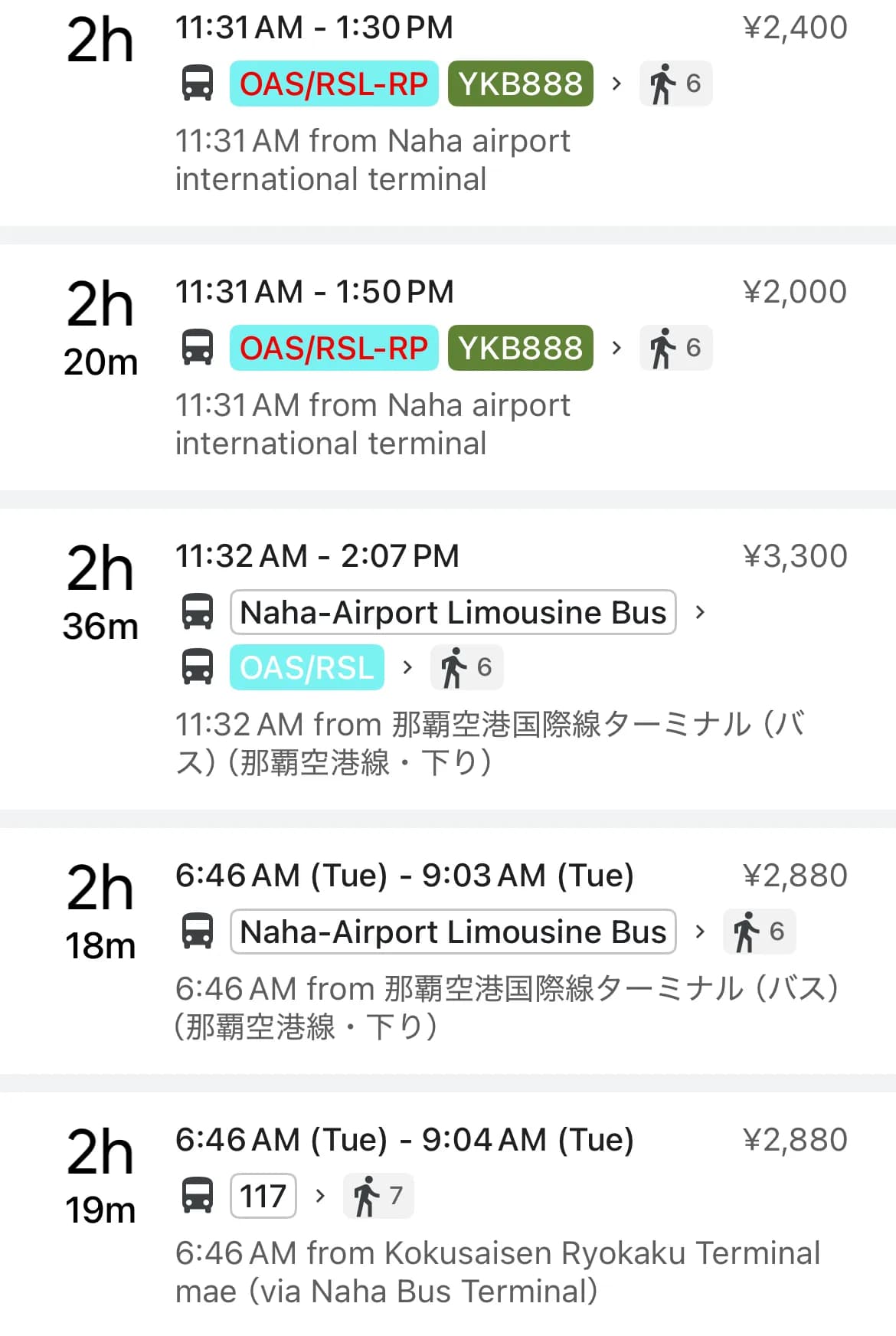
-
Okinawa Airport Shuttle - Rapid
-
Okinawa Airport Shuttle Bus
-
Yanbaru Airport Line Bus
-
111, 117: When departing from the International Terminal stop, only the route number is shown
-
Route 120 (Nago Nishi Airport Line)

-
Okinawa Limousine (LIM) Line A (Colors differ by line)

-
Other local route buses are shown by route number, and Tokyo Bus appears in formats such as TK02
Okinawa Ferry GuideRoutes, fares, and tips
As a unique option to travel by sea (instead of by bus) from Naha toward the Churaumi area, here is the Jinbe (ジンベエ) Marine high-speed ferry.
Exclusive TourCast Tips!
Tips for using the Jinbe Marine high-speed ferry
- Jinbe-zame (ジンベエザメ) means “whale shark” in Japanese, and the ferry is wrapped in a whale shark design, so it is called 'Jinbe Marine' 🐋

- The ferry operates from Naha Port → Motobu Port, and the one-way fare is 2,000 yen.
- From Motobu Port → Churaumi Aquarium, you can take Bus 117 in about 25 minutes for 350 yen.
- Service may change depending on weather, so you must confirm operation status in advance.
- If you have ridden similar high-speed ferries before, the experience is similar, but rough seas may cause motion sickness, so be careful.
- It is recommended to take motion sickness medicine at least 1 hour before departure.
- Check Okinawa wave height
- Complete boarding at least 15 minutes before departure
- Ticket counter locations
| No. | Departure (time) | Stopover (arrive/depart) | Arrival (time) |
|---|---|---|---|
| 1 | Naha Port (08:30) | Nago Port (09:45/10:05) | Motobu Port (10:30) |
| 2 | Motobu Port (10:50) | - | Naha Port (12:05) |
| 3 | Naha Port (14:25) | - | Motobu Port (15:40) |
| 4 | Motobu Port (16:00) | Nago Port (16:25/16:45) | Naha Port (18:00) |