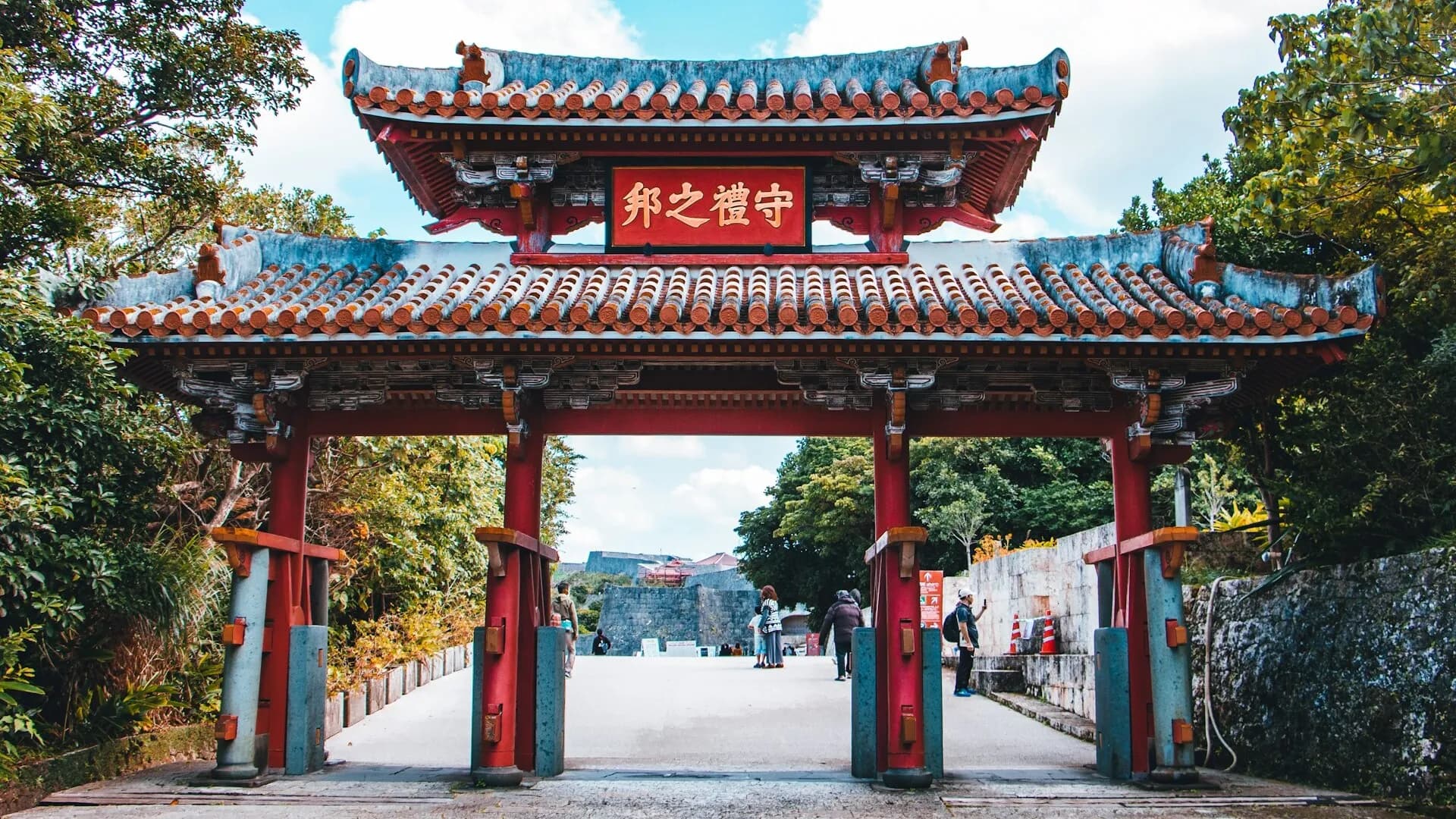
PrefaceOkinawa history: the more you know, the more you see
One element you should never leave out of travel is history. History creates cultural heritage, and that heritage becomes a tourism resource.
Okinawa’s old name, Ryukyu (琉球), is made of 'Ryū (琉)' and 'Kyū (球)', and it has the beautiful meaning of 'a glass bead'.
If you understand how the Ryukyu Kingdom fell and why it was absorbed into Japan before you visit Okinawa, your journey will feel deeper and richer. ✨
Okinawa’s history is usually divided into the following periods:
Prehistory → Gusuku (castle) period & Sanzan period → Early Ryukyu Kingdom → Late Ryukyu Kingdom (under Satsuma Domain) → Okinawa Prefecture (annexed by Japan) → U.S. administration period → Okinawa Prefecture after reversion to Japan
Gusuku (Castle) PeriodThe beginning of a kingdom built with stone walls
From the 13th century ~
Before the 13th century, Okinawa was a tribal society that relied on gathering and hunting, and this stage is classified as prehistory. Later, as castles began to be built across the islands, this era is called the Gusuku period.
In mainland Japan, a castle (城) is read as 'shiro (しろ)', but in Okinawa it is read as 'gusuku (ぐすく)'. Because of this difference, the period is named the 'Gusuku period'.
1) The Tenson (天孫氏) Period
According to Okinawan historical texts, Chūzan Seikan (中山世鑑) and Chūzan Seifu (中山世譜), the heavenly emperor Tentei (天帝) sent down a goddess Amamikyo (阿摩美久) and a god Shinerikyo (志仁禮久) as a couple, and they created the Ryukyu Islands.
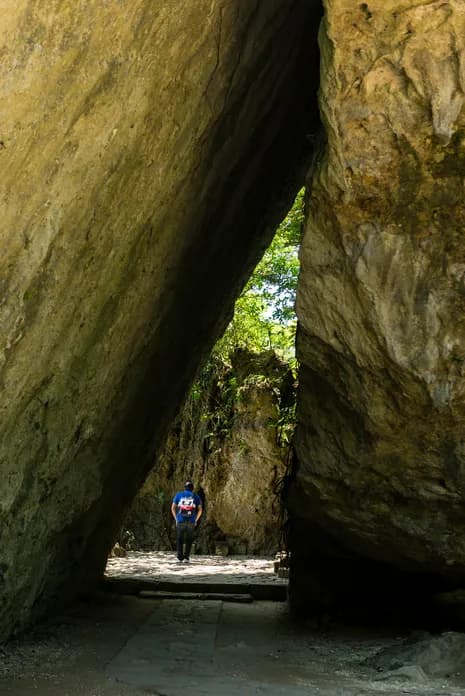
In this tradition, the first place Amamikyo descended to is 'Sefa-utaki (斎場御嶽)' in southern Okinawa.
Their eldest son is said to be the ancestor of the Tenson line (天孫氏), who reportedly ruled for 17,802 years across 25 generations.
This account is best understood as a mythological origin story rather than literal history. And because Chūzan Seikan and Chūzan Seifu are written from a 'Chūzan (中山)' perspective, it naturally brings to mind the idea that 'history is written by the winners'.
2) The Shunten (舜天) Period
The Tenson line is said to have fallen to a local power holder, Riyu (利勇). The person who defeated him was Shunten, an aji (按司, local lord) from the Urasoe (浦添) area.
Shunten took the throne as the king of Chūzan and started the Shunten dynasty, which lasted about 73 years.
However, politics at the time was closer to a coalition of multiple aji than a centralized state. Here, 'aji' refers to local ruling powers.
3) The Eiso (英祖) Period
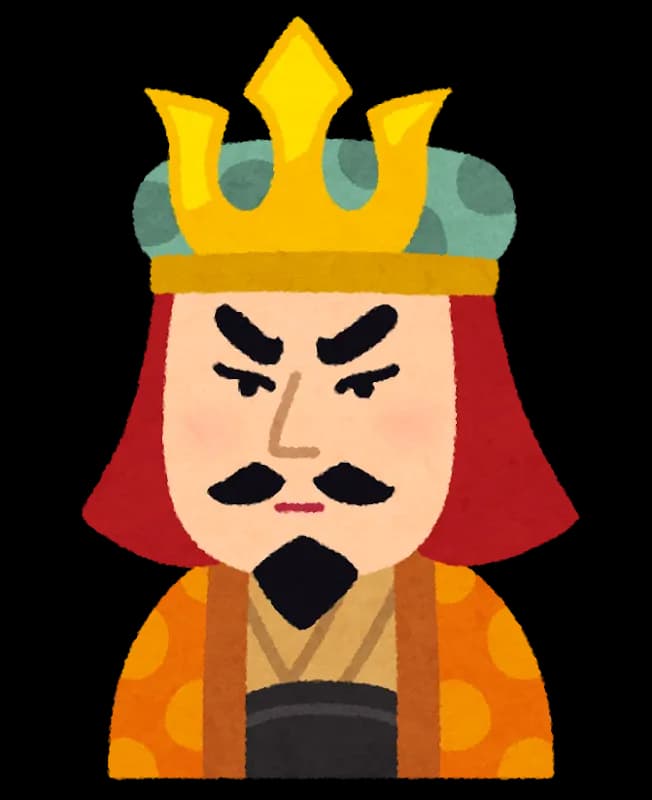
During the reign of Gihon (義本), the 3rd king of the Shunten dynasty, an epidemic broke out, and he handed the throne to Eiso (英祖).
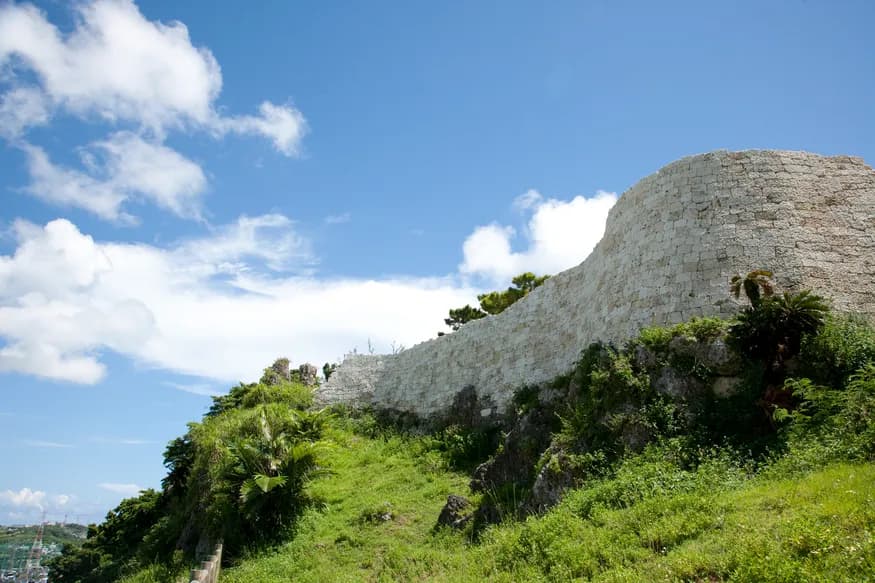
Eiso is said to be a descendant of the Tenson line. His tomb is known as 'Urasoe Yodore (浦添ようどれ)', located at Urasoe Gusuku (浦添城).
The 4th king under Eiso’s line, Tamagusuku (玉城), neglected state affairs and died at age 40. His son Seii (西威) became king at just 9 years old. But with a weak political base, Seii lost the dynasty in 1349, at age 21.
After that, the 14th century opened the Sanzan period (三山時代), when Okinawa was divided into Hokuzan, Chūzan, and Nanzan.
Sanzan (三山) PeriodA 100-year era of division: Hokuzan, Chūzan, and Nanzan
Until 1429
When central power weakens, local forces rise—this is true in any era.
In Okinawa as well, aji (按司, local elites) expanded their influence. Three kingdoms formed in the north, central region, and south: Hokuzan (北山), Chūzan (中山), and Nanzan (南山). This became known as the 'Sanzan (三山) period'.
This era lasted about 100 years and ended when it was unified by Chūzan in 1429.
1) Hokuzan
北山
Around 1322, Haniji (怕尼芝) overthrew his cousin, the existing Nakijin aji (今帰仁按司), and proclaimed himself king of Hokuzan.
Hokuzan continued until it was destroyed by Chūzan’s invasion in 1416.
2) Chūzan
中山
In 1372, the 4th year after the founding of the Ming dynasty, the Hongwu Emperor sent envoys to Chūzan and demanded tribute. In response, Chūzan sent Taiki (泰期) as a tribute envoy, and diplomacy with Ming China began.
Through this, the name 'Ryukyu Kingdom (琉球國)' and the existence of the King of Chūzan became known internationally.
Chūzan sent tribute to Ming China 42 times, far more than Nanzan (24 times) and Hokuzan (11 times). This suggests that Chūzan had the strongest national power among the three.
3) Nanzan
南山
Around 1314, Shōsatto (Shōsatto), the aji of Ōzato (大里), took control of the south and became king of Nanzan.
Some views suggest that 'Shōsatto' was not a single person’s name, but a hereditary title.
In 1388, when his uncle-like relative Ōeiji (汪英紫) seized the throne, Shōsatto sent his son to Joseon (Korea) for refuge.
The Chūzan king Satto (Satto) requested the son’s return from Joseon, but Joseon refused. Shōsatto then fled into exile to Jinju and died in October of the same year.
4) Unification of the Three Kingdoms
Shō Hashi (尚巴志), a powerful aji in Chūzan, took control of Chūzan in 1406, moved the capital from Urasoe to Shuri, and made Shuri Castle the royal palace.
In 1416, he allied with aji who opposed the Hokuzan king and attacked Nakijin, destroying Hokuzan.
In 1425, he was formally invested as King of Chūzan of the Ryukyu Kingdom by the Yongle Emperor of Ming China. In 1429, he conquered Nanzan, unified the three kingdoms, and founded the Ryukyu Kingdom. 🏯
Ryukyu KingdomA 450-year kingdom that ruled the seas
1429 ~ 1609
In 1429, Shō Hashi (尚巴志), the Chūzan king who unified Okinawa, received formal investiture from Ming China and officially used the state name 'Ryukyu Kingdom (琉球國)'. Based on this, the name “Ryukyu Kingdom” became established.
This state name remained in use for about 450 years, until the annexation by Japan in 1879.
However, in 1453, after the death of the 5th king Shō Kinpuku (尚金福), the 'Shirō–Furi Rebellion (志魯・布里の乱)' broke out, and Shuri Castle was burned down.
Late Ryukyu Kingdom and Rule by Satsuma DomainA kingdom turned into a tributary state
1609 ~ 1879
It is often grouped as one Ryukyu Kingdom period, but after 1609, the political and diplomatic situation changed completely. It is more accurate to understand this as a separate “late” period.
In 1609, the Ryukyu Kingdom became a tributary state of Satsuma Domain (薩摩藩), in what is now Kagoshima Prefecture. This event is linked to Toyotomi Hideyoshi’s plan to unify Japan and attack Joseon and Ming China—leading to the Imjin War.
About eight months before the Imjin War began, Toyotomi Hideyoshi ordered the Shimazu family, lords of Satsuma, to provide 15,000 troops. The Shimazu then requested supplies equal to half of that from King Shō Nei (尚寧) of Ryukyu.
King Shō Nei refused and instead took diplomatic action to warn Joseon and Ming China of Japan’s invasion. Later, under pressure from Satsuma, he provided some supplies.
Satsuma’s invasion and tributary control
After Toyotomi Hideyoshi died in 1598, the Imjin War ended, and Tokugawa Ieyasu seized power after winning the Battle of Sekigahara.
In 1602, when a Ryukyu ship drifted to Sendai Domain, Ieyasu requested its return and demanded a delegation of gratitude. King Shō Nei refused.
In March 1609, Ieyasu ordered Satsuma Domain to subjugate Ryukyu, and the Satsuma forces began a full-scale invasion.
Ryukyu had almost no experience of war, while Satsuma had fought through the Sengoku period and the Imjin War. The gap in military power was overwhelming, and King Shō Nei surrendered.
The cost of war and a strategy of control
After the war, all islands between Ryukyu and Satsuma, including Yoron Island (与論島), were placed under Satsuma. This is one reason these islands are part of Kagoshima Prefecture today.
Satsuma imposed heavy tribute on Ryukyu. Those who could not pay fell into the status of 'nago (名子)', a form of enslaved tenant farmer.
However, Satsuma maintained the appearance of an independent state and kept Ryukyu’s tribute diplomacy with China. This was a strategy to preserve international prestige, and in reality, the Qing dynasty did not recognize that Ryukyu was under Satsuma. ⚖️
At Shuri Castle (首里城), separate reception spaces were prepared for Chinese envoys and Japanese envoys, enabling a carefully managed “dual diplomacy.”
From then on, Ryukyu maintained a dual tribute system, paying tribute to both Qing China and Satsuma.
Sugar industry and exploitation by Satsuma
Sugar-making technology introduced from Qing China helped Ryukyu expand sugarcane cultivation, and sugar grew into a major industry.
But the profits were monopolized by Satsuma. This became one financial foundation for Satsuma’s role in the Satchō Alliance (薩長同盟) near the end of the shogunate.
Meanwhile, resentment toward Japan gradually deepened among Okinawans.
Western powers and pressure to open ports
In the 19th century, Western powers began to approach. France first demanded missionary work and trade, but Japan banned missionary activity and allowed only trade.
After Commodore Perry’s “Black Ships (黒船)” in 1854, Shimoda and Hakodate were opened, and the United States demanded the opening of Naha Port.
To avoid this, Japan used a false explanation: 'Ryukyu is an independent country different from Japan, so Japan has no authority to open its ports'.
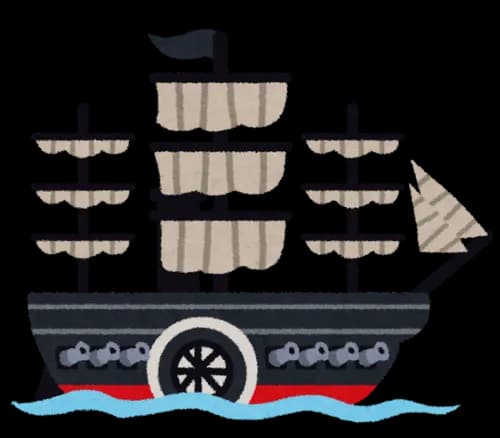
The United States then sent a fleet directly to Naha to demand opening, and this led to the Ryukyu–U.S. Treaty of Amity (琉米修好条約).
Ryukyu’s final request for Qing support
Realizing the danger, the Ryukyu Kingdom appealed to Qing China for help as a last hope. But Qing China was weakened by the Opium Wars and could not provide meaningful support.
After confirming this diplomatic vacuum, the Meiji government decided to annex Ryukyu.
Okinawa PrefectureFrom a kingdom to a prefecture
1879 ~ 1945
After the Meiji Restoration, the Meiji government pushed rapid modernization. In 1872, it downgraded the Ryukyu Kingdom to “Ryukyu Domain (琉球藩)” and lowered the status of the king Shō Tai (尚泰) to “Ryukyu Domain King”.
This is called the “First Ryukyu Disposition”.
Then in 1879, the Meiji government temporarily placed Ryukyu Domain under Kagoshima Prefecture, and then re-established it as an independent administrative unit: “Okinawa Prefecture (沖縄県)”.
At the same time, it forcibly moved Shō Tai to Tokyo and reduced him to a marquis (侯爵). With this, the Ryukyu Kingdom, which had lasted over 450 years, was fully dismantled.
This is known as the “Second Ryukyu Disposition”, and it marked the official end of the kingdom system that had existed since the 1429 unification.
Impact on East Asia
This event caused a major shock across East Asia, including Joseon, and became a turning point that increased wariness of Japanese imperialism.
In particular, the annexation of Ryukyu is often seen as a symbolic precedent for Japan’s later expansion, including the annexation of Korea.
Language suppression and the “dialect tag” system
At the time, a native language called Uchinaguchi (沖縄口, Ryukyuan language) was widely used in the former Ryukyu Kingdom.
However, the Meiji government suppressed Ryukyuan languages as part of a “assimilation policy (unification policy)” and forced people to use only Japanese.
In schools, students who spoke Uchinaguchi were punished by being made to wear a wooden tag around their neck labeled “dialect tag (方言札)”.
To get rid of the tag, a student had to report another student speaking Uchinaguchi. This encouraged surveillance and reporting among children.
This system was a form of psychological pressure designed to make people abandon their language and culture. In some areas, it reportedly continued unofficially into the 1960s.
Later, it gradually disappeared as mainland Japanese broadcasting and media spread.
U.S. Administration PeriodU.S. military rule, cultural clashes, and the reversion movement
1945 ~ 1972
After World War II began, Japan’s attack on Pearl Harbor in December 1941 marked the full start of the Pacific War.
In 1943, a summit of China, the United States, and the United Kingdom was held in Cairo, Egypt to discuss how to handle Japan after the war. This is known as the Cairo Conference.
Key agreements included:
- Demanding Japan’s unconditional surrender
- Returning territories taken from China
- Guaranteeing Korea’s independence
However, Okinawa was not clearly mentioned, leaving its future status unclear.
U.S. President Roosevelt suggested to Chiang Kai-shek (蔣介石) that Okinawa be placed under China, but Chiang refused, prioritizing the recovery of Manchuria and Taiwan and responding to the civil war.
On April 1, 1945, the Battle of Okinawa began.
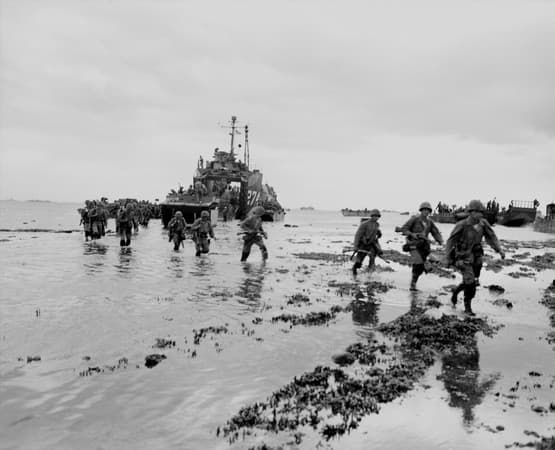
Okinawan civilians were forcibly mobilized by the Japanese military, and some were sacrificed as human shields. Meanwhile, the U.S. military provided food and supplies to cooperative civilians and offered a certain level of safety.
In response, the Japanese military spread rumors such as “If you become a prisoner, you will be killed horribly”, and ordered mass suicide, even distributing grenades to civilians. In reality, there were cases where families were forced to kill each other, or people were killed for disobeying orders.
After three months of fighting, the U.S. lost about 12,000 troops, while Japan recorded 80,000–100,000 deaths. The battle ended with a U.S. victory. But because U.S. losses were also severe, it became part of the background to the decision to use nuclear weapons.
- On August 6, 1945, the first atomic bomb was dropped on Hiroshima
- On August 9, the second atomic bomb was dropped on Nagasaki
Japan then surrendered, and Okinawa came under U.S. military rule. Residents were placed in camps, and Okinawa began to be used as a major U.S. military base.
Arrival of U.S. culture
From this period, Okinawa began to receive strong U.S. cultural influence, and foods like the following became popular:
- Pork tamago (Spam and egg)
- Taco rice 🌮
- A&W burgers 🍔, root beer 🥤
Debates over Okinawa’s future
As long-term U.S. rule continued, different political positions clashed inside Okinawa:
- Groups calling for independence and the revival of the Ryukyu Kingdom
- Groups calling for reversion to Japan
- Groups preferring the status quo (remaining under the U.S.)
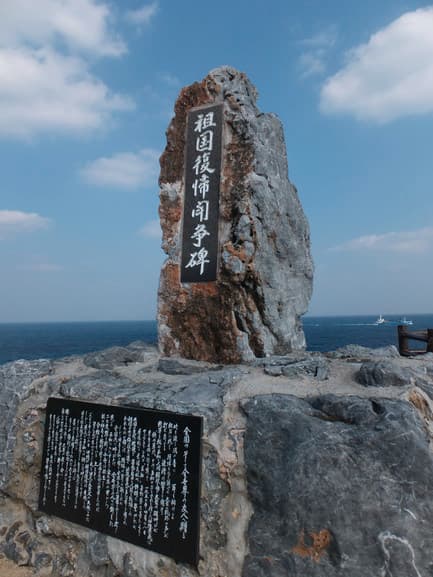
Over time, support for reversion to Japan grew, and in 1972, a reversion movement began at Cape Hedo (辺戸岬), the northernmost point of Okinawa.
Okinawa TodayOkinawa today: identity and culture that continue
1972 ~ Present
In 1972, as the reversion movement grew stronger, the U.S. returned administrative authority to the Japanese government while keeping the use and strategic function of U.S. bases.
As a result, Okinawa returned to Japan in name.
However, because of the forced annexation through the 'Ryukyu Disposition' and the tragic experience of the Battle of Okinawa during the Pacific War, deep distrust and resentment toward the Japanese government still exist among many Okinawan residents.
In this context, it is said that schools in Okinawa Prefecture do not teach Japan’s national anthem, 「Kimigayo (君が代)」, and there are also reports of Okinawan entertainers refusing to sing Kimigayo in official settings.
Because of these differences in identity and perception, many Okinawans clearly describe themselves not as 'Japanese' but as 'Okinawans (Uchinanchu, うちなんちゅ)'.
In addition, because of the deep scars of the 1945 Battle of Okinawa, Japan’s emperor has reportedly still not been able to make an official visit to Okinawa. In parts of mainland Japan, Okinawa is sometimes described as 'the southern islands (南国)', in a way that emphasizes it as “different.”
These are examples showing that a cultural and emotional distance still remains today.