
Mastering Fukuoka Transport: A Convenient Journey via Subway, Train, and IC CardThe first step to understanding Fukuoka's transport system
Fukuoka's subway route map is much simpler compared to Tokyo or Osaka.
However, just because it's simple doesn't mean you should take it lightly.
This is only true if you limit the scope to the subway map. In reality, it is complexly intertwined with JR trains, private railways (私鐵), and buses. If you don't understand these operational concepts, it will be difficult to make 100% use of the transport passes introduced later, and you may even face difficulties interpreting Google Maps route guides.
- This guide is structured based on the concepts in 'Essentials Part 2 - Japan Transport System.' For an efficient Fukuoka trip, we strongly recommend fully understanding the general concepts first before checking the content below.
Complete Guide to IC Transport CardsHow to use and purchase tips for nimoca, SUGOCA, and Hayakaken
There are three main transport cards essential for a Fukuoka trip: nimoca, SUGOCA, and Hayakaken. While they are mutually compatible throughout Japan, there are differences in purchase locations, refund policies, and especially child card issuance conditions, so please check the details below carefully.
1) nimoca
- Purchase/Refund: Available for purchase at International Terminal bus counters and Tenjin/Hakata Bus Terminals.
- Note: Refunds are not possible at the International Terminal bus counters or Hakata Port; additionally, Korean travelers cannot issue child cards.
2) SUGOCA
- Purchase/Refund: Available at vending machines or counters (Midori no Madoguchi) at each JR Kyushu station.
- Features: A major advantage is that child cards can be issued at the counter.
- Note: Hakata Station counters are always crowded, so visit with plenty of time to spare.
3) Hayakaken (はやかけん)
- Purchase/Refund: Available at Fukuoka Subway station vending machines and airport domestic terminal vending machines.
- Features: For anonymous issuance, select 'IC Card Purchase' (ICカード発売) → 'Anonymous IC Card' (無記名ICカード) at the vending machine.
- Note: Children must be issued a named card, which requires a verification process by station staff.

4) Transport Card Usage Range and Tips
"Can I go anywhere with just a transport card?" Unfortunately, no. There are stations where transport cards cannot be used, such as Yufuin, so you must purchase paper tickets in advance for long-distance travel.
- Available Areas: JR lines and city buses in major metropolitan areas like Karatsu, Kumamoto, Beppu, Oita, and Kitakyushu.
- Bus Usage: Most local city buses (excluding highway buses) can be used if they display the 'IC Card' mark.
- How to Check: Look for the mark at the front door or entrance of the bus.

💡 TourCast Tip
When refunding your card after the trip, you will receive the balance minus a 220 yen handling fee. If your remaining balance is less than the fee, you will only get the deposit back. Alternatively, using up the balance at a convenience store and keeping the card as a souvenir is also a great idea!
Exclusive TourCast Tips!
How to Save Up to 90 Yen on Bus Transfers
Fukuoka city buses do not fundamentally have a free transfer system, but if you use a nimoca transport card, you can receive a discount of up to 90 yen on transfers.This benefit is a fixed-amount discount, which is automatically deducted from the fare upon boarding the next bus.
- Discount Amount: Up to 90 yen per transfer (no limit on the number of transfers).
- Conditions: Re-boarding at a stop classified as the 'same group' (同一グループ) within 60 minutes of getting off.
- What is a group stop?: Stops that are geographically close are bundled into one zone.
You can check the specific list of stops on the official Nishitetsu website, but it is enough to remember that "if you got off at a major hub stop, a 60-minute transfer discount applies to other nearby stops."
Nishitetsu Bus Transfer Discount DetailsDistinguishing Between Trains and SubwaysDistinguishing operators and fare systems
In Japan, the distinction between subway and train (electric rail) is not just about whether it runs underground or above ground. It must be understood as entirely separate transport means with different operators and fare systems.
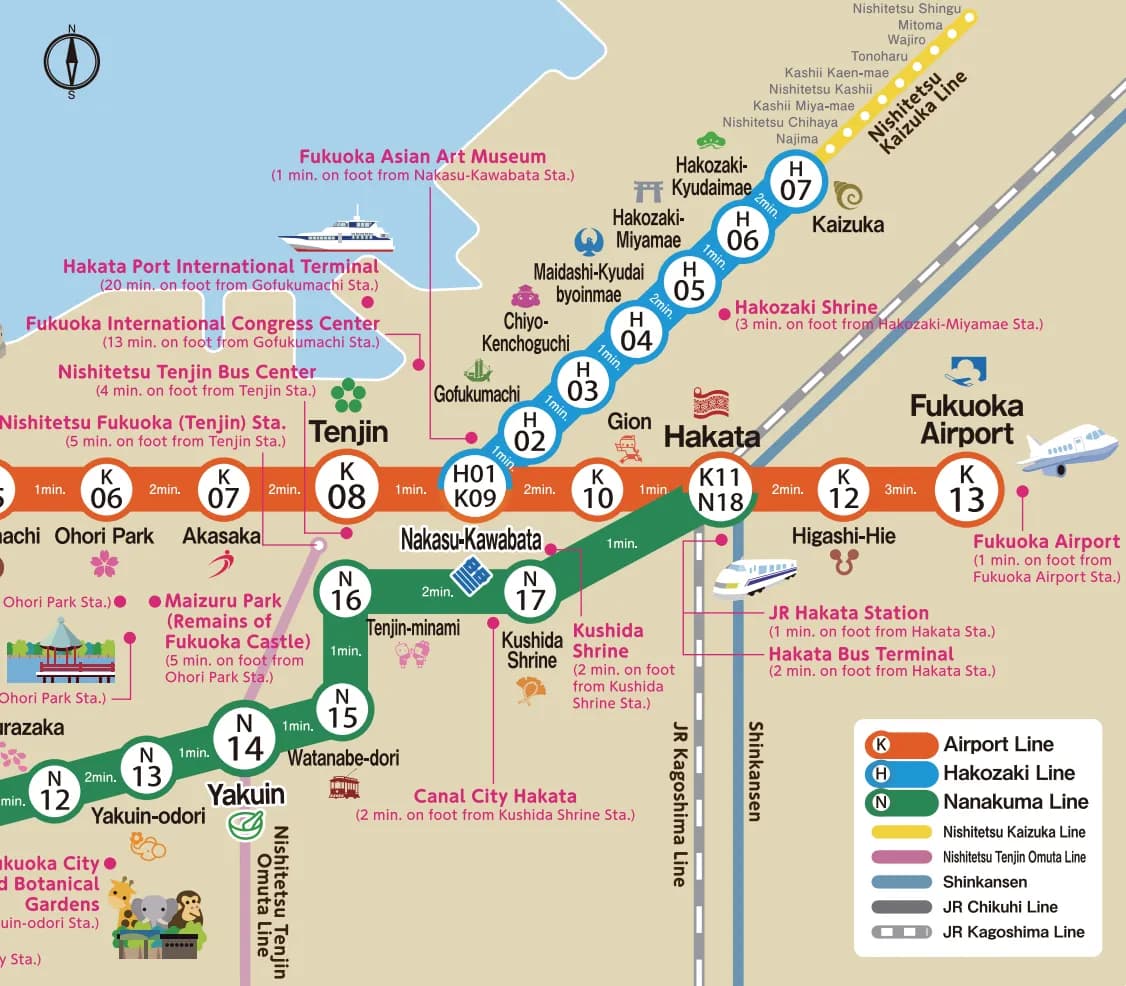
- JR Lines: Routes operated by a national state-run corporation.
- Private Railways (私鐵): Routes operated by private companies (Nishitetsu Line).
- Subway: Routes operated by municipal transportation bureaus (Airport Line, Hakozaki Line, Nanakuma Line).
Since their operators differ, when transferring to a different operator's line, you must exit the ticket gate and enter again, and fares are charged separately for each section.
- Transfer Example: When switching from the JR Kagoshima Main Line to the Subway Airport Line, you must exit the station completely and purchase a new ticket or tap your card again at the subway-specific ticket gate.
Exclusive TourCast Tips!
The Green Gate is Closed: How to Transfer Now
On March 27, 2023, the Nanakuma Line was successfully extended from Tenjin-Minami Station to Hakata Station, significantly changing the Fukuoka subway map.
Travel information from the past might suggest a free transfer through the 'green gate' that used to connect Tenjin Station and Tenjin-Minami Station, but that gate is now completely closed.
Currently, to move between Tenjin Station (Airport Line) and Tenjin-Minami Station (Nanakuma Line), you must exit the ticket gate and move on foot through the underground mall, and a new fare is charged during this process.
Therefore, if a transfer between the two lines is necessary, transferring at Hakata Station, where both lines connect, is the only way to save time and money.
Three Tenjin Stations on One Map?Accurately distinguishing the three Tenjin Station routes
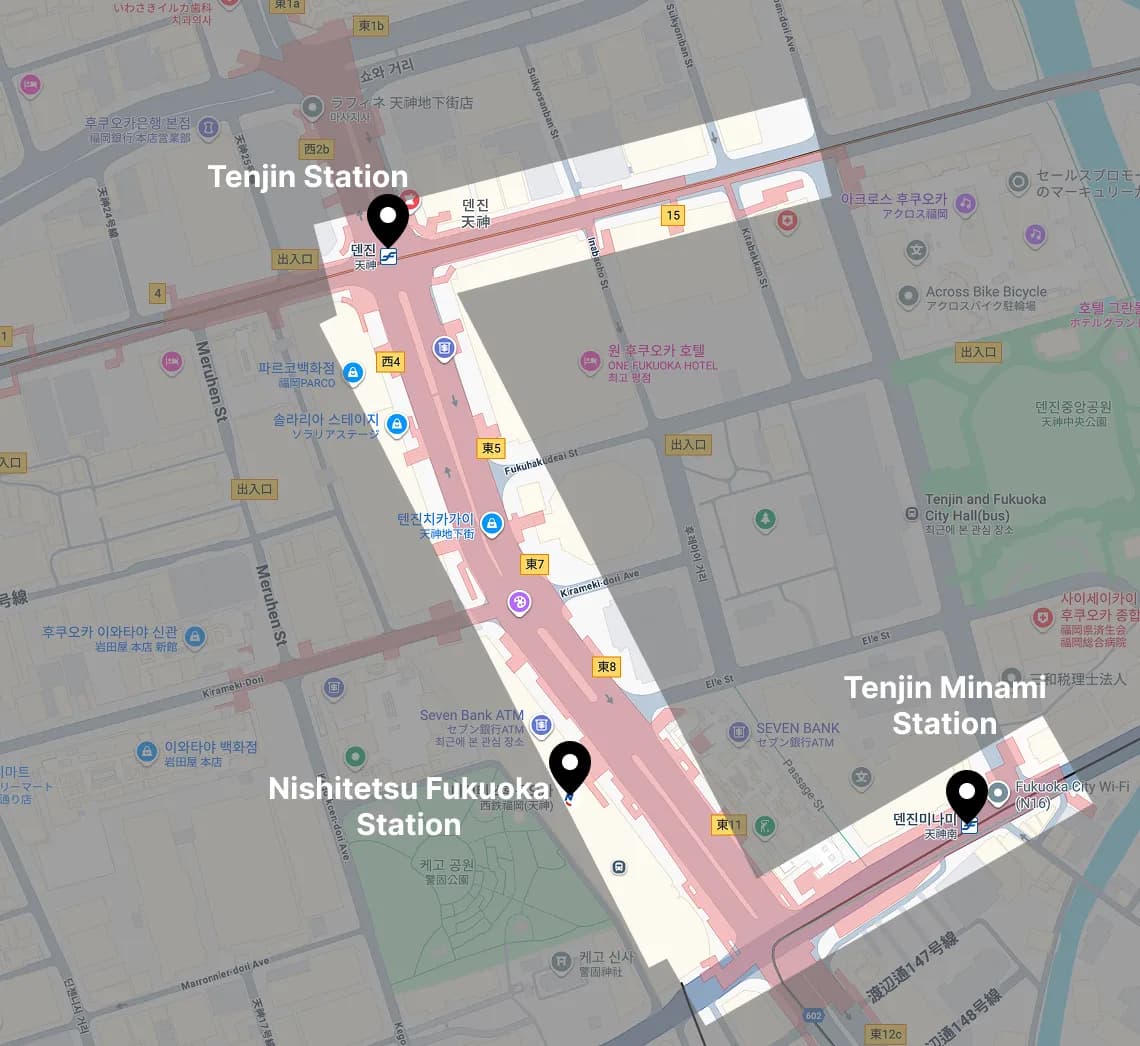
If you search for 'Tenjin Station' on Google Maps, it appears as one massive station, but in reality, it is a complex structure where three different operators are intertwined in a 'ㄷ' (C) shape. They are connected by an underground mall, making movement easy, but the systems are entirely separate, so you must accurately understand the identity of each station.
- Subway Airport Line (Top of the 'ㄷ'): Subway 'Tenjin Station'
- Nishitetsu Train (Vertical side of the 'ㄷ'): Private rail 'Nishitetsu Fukuoka (Tenjin) Station'
- Subway Nanakuma Line (Bottom of the 'ㄷ'): Subway 'Tenjin-Minami Station'
These are three separate stations where fares are settled anew every time you pass through their respective ticket gates.
- Transfer Example: To transfer from the Subway Airport Line Tenjin Station to the Nishitetsu train, you must exit the subway gate, move to the Nishitetsu station, and then buy a new ticket or tap in with your transport card again.
Navigation Warning!
Google Maps guides routes including walking time between transfers. Don't rely solely on "Transfer from Tenjin Station to Tenjin Station" and try to find an internal passage, or you will get lost. Always check the unique name of each station (Tenjin vs. Tenjin-Minami vs. Nishitetsu Fukuoka) and follow the signposts.
💡 TourCast Tip
The Tenjin underground mall is a massive hub and shopping center connecting all three stations. When moving, the fastest way is to follow the 'Exit Number' or 'Line Color' (Airport Line: Orange, Nanakuma Line: Green, Nishitetsu: Pink) marked in the underground mall. Especially note that the Nishitetsu station is inside a department store building (Solaria Stage)!