PrefaceHokkaido history that becomes 10 times more enjoyable in 10 minutes
One thing that can never be missing from travel is history.
Because history exists, cultural heritage is created, and that heritage becomes a travel destination.
On the other hand, without any historical context, a place is just an empty space with no meaning.
The name “Hokkaido” is not even 200 years old.
If you visit while knowing what happened on this land and how it was developed, you will start to notice things you did not see before.
If you spend just 10 minutes to understand Hokkaido’s history, the depth and fun of your trip will expand by more than 10 times.
Were the Ainu the original people of Hokkaido?The first meeting between the Ainu and Japan’s shogun
Around 10,000 BCE, rising sea levels formed the sea between the Korean Peninsula and the Japanese archipelago, and Japan became an island country. The period shaped by the people who settled at this time is called the Jomon period, known for a pottery-based culture. Because of Japan’s geographic isolation as an island, it developed a unique culture, called the Jomon culture.
Before sea levels rose, Japan and the continent were connected by land, so various groups came in from the Korean Peninsula and what is now Russia. In particular, some groups that came from the north settled in Japan’s Tohoku region and what is now Hokkaido.
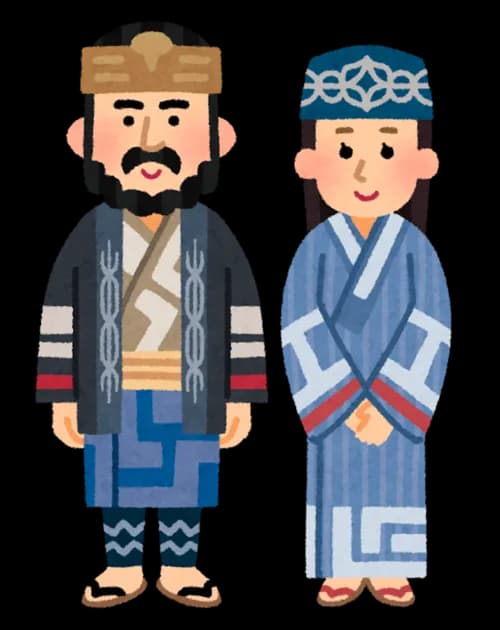
They had a distinctive culture: many had thick body hair, men grew sideburns and beards, and women tattooed black patterns around the mouth. Because of this, they were first called “毛人 (moin),” meaning “hairy people,” read as “Emishi (えみし).”
Later, they were called “Ezo (蝦夷, えぞ),” combining “shrimp” (蝦) and “barbarian” (夷), and the land where they lived was called “Ezochi (蝦夷地).”
However, through trade, they disliked being called “Ezo” by Japanese people. They wanted to be called “Ainu,” meaning “human,” and from then on they came to be known as the Ainu people.
Around the early 4th century, during the Three Kingdoms period, Japan interacted with the Korean Peninsula and adopted new knowledge and culture. This led to the formation of the Yamato (大和) state, the first unified state centered in the Kansai region.
However, the Ainu people living in Hokkaido, Tohoku, the Kuril Islands, and Sakhalin continued community life based on tribes, and did not develop into a state system.
The Yamato state later built its national system through the Taika Reform, the Nara period, and the Heian period. It also changed its name from Wa (倭) to Japan (日本) and moved toward a modern state. But the Ainu people continued to live in tribal society and kept their distance from the state system.
At that time, people in mainland Japan viewed the Ainu, who continued tribal life, as “barbarians,” and took various measures to protect themselves.
The relationship between Japan’s shogun and the Ainu people
At the end of the Heian period, Minamoto no Yoritomo, a warrior from the Kanto region, united forces across Japan and founded the Kamakura shogunate. In 1192, he took the office of Sei-i Taishogun (征夷大将軍), and the “shogun” system (将軍) began as we know it today.
In the title “Sei-i Taishogun,” the characters “to subdue” (征) and “barbarian” (夷) are used, carrying the meaning of “a general who subdues barbarians.”
Here, the “barbarians” referred to were the Ainu people living in the north. The office was created as a justification to contain and conquer them, and Yoritomo was the first person to receive it as a formal appointment.
Before that, Sei-i Taishogun was a temporary title given only in certain periods, but after Yoritomo it became a fixed position for the top ruler with real governing power. The Emperor (Tenno) remained only as a symbolic figure, and this power structure continued for about 700 years.
Later, there were other general titles, such as Sei-i Taishogun (征西大将軍) to contain groups in southern Kyushu. Over time, however, only Sei-i Taishogun remained, and the shogun monopolized power.
The spark of the Koshamain WarA revolt that began with the death of an Ainu boy
Because the Ainu people did not have the technology to produce iron, they obtained daily necessities through trade with Japanese people who had ironworking skills.
Then, in southern Ezochi, in today’s Hakodate area, an Ainu boy ordered a small knife from a Japanese blacksmith. A conflict arose because the quality was poor and the price was unreasonably high.
After an argument, the Japanese blacksmith stabbed and killed the Ainu boy with a knife.
This incident led the Ainu people to unite in anger and organize an alliance, leading to armed clashes with Japanese people. The war was named after the Ainu leader at the time and is known as the Koshamain War (1457).
In the early stage, the Ainu people took control of most Japanese strongholds, but the war ended after Takeda Nobuhiro killed Koshamain and his son.
After this, Takeda Nobuhiro was rewarded and changed his family name to “Kakizaki (蠣崎)”, becoming a key gateway linking mainland Japan and Ezochi (Hokkaido).
Matsumae, a castle of power and tradeThe shadow of power behind Matsumae Castle
After the Onin War (1464), which triggered the start of the Sengoku period (Warring States period), intense battles spread across Japan for about 100 years. Many Japanese people moved to Ezochi, and the Ainu people gradually lost their territory.
After changing his family name to Kakizaki, the 5th head of the family, Yoshihiro, acted as a mediator between Japanese and the Ainu people. He later submitted to Toyotomi Hideyoshi, who unified Japan, and changed the family name again to Matsumae (松前).
After Hideyoshi died in 1598, Yoshihiro presented a map of Ezochi to the next leader, Tokugawa Ieyasu, and received recognition of his control over the area.
After Tokugawa won the Battle of Sekigahara in 1600, the Edo shogunate was established in 1603. The following year, in 1604, Matsumae Yoshihiro gained the exclusive right to trade with the Ainu people, becoming Hokkaido’s first daimyo.
In general, to become a daimyo, a domain needed an annual rice yield of 10,000 koku (石) or more. One koku was the amount of rice one adult man consumed in a year, and it had to be harvested from farmland.
- At that time, Ezochi was a region where rice farming was difficult due to the climate and environment.
Even so, Yoshihiro was recognized as a daimyo because he could secure enough income through trade with the Ainu people. For him, trade profits were the foundation of power.
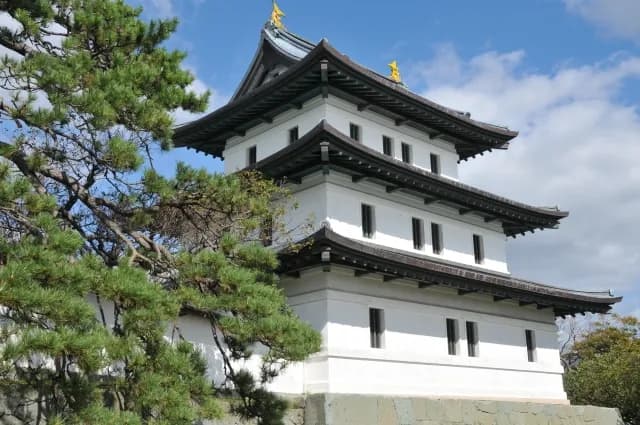
After this, Japanese and Ainu living areas were strictly separated, and trade was allowed only under Matsumae Castle. This was part of a strict control policy.
In trade, Japanese people provided iron goods, rice, and ceramics, and the Ainu people exchanged seafood, seaweed, animal skins, and more.
However, prices were always set in favor of the Matsumae Domain, and as a result the lives of the Ainu people became increasingly difficult.
Shakushain’s RevoltThe largest resistance, turning division into unity
As life for the Ainu people in Ezochi became more difficult, power struggles also grew within their society.
The Ainu people still lived in tribal units. While Shakushain, a sub-leader in the Hidaka area, and Onibishi, a leader in the Hae area, were in conflict over fishing and hunting rights, Shakushain killed Onibishi’s subordinate in 1648, and the conflict intensified.
In 1653, the Ainu people of Hae killed Kamokutain, the leader of the Hidaka group, and Shakushain became the chief of the Hidaka group.
Matsumae Castle invited both sides to mediate the conflict, but Shakushain killed Onibishi again on the spot, after Onibishi had killed their chief.
Onibishi’s brother-in-law, Utahu, went to the Matsumae domain office to request weapons support, but was refused. He died on the way back.
The cause of death is said to have been smallpox, but as rumors spread that he was poisoned by the Japanese side, distrust and unrest grew within Ainu society.
After this, Shakushain called on the Ainu people to stop inter-tribal division and unite, representing the whole Ainu community.
In 1669, Shakushain gathered about 2,000 fighters and launched a large-scale uprising, killing 273 Japanese people.
Feeling threatened, the Matsumae Domain requested military support from the Edo shogunate and reinforced its forces.
At the time, the Japanese army used matchlock guns (firearms) passed down from the Sengoku period, while the Ainu people had only bows and arrows, so the gap in military power was significant.
Even so, the Ainu people fought to the end, but as the war dragged on and Matsumae’s trade profits were threatened, the Japanese side proposed a peace settlement.
Worried about a long war, Shakushain accepted the offer and was invited to Matsumae Castle to attend a banquet.
However, it was a trap by the Matsumae Domain. Shakushain was assassinated by Japanese soldiers in hiding, and other tribal leaders met the same fate.
After losing their leaders, the Ainu people gradually lost strength and weakened, and this revolt was recorded as the largest resistance in Ainu history.
The Kunashir–Menashi BattleAn uprising against harsh labor and discrimination
As Japanese people advanced further into Ezochi, the Ainu people were pushed into becoming laborers even in their own traditional fishing grounds, and they had to endure hard work in harsh conditions.
Angered by this situation, the Ainu people rose up again in 1789 in what is now the Kuril Islands and the Menashi area.
However, because the Ainu people lacked organized combat experience, they were easily suppressed by the Japanese forces, and the uprising ended quickly.
Afterward, a tragedy occurred: 71 people involved were executed at Matsumae Castle, and the incident came to be known as the Kunashir–Menashi Battle.
After this, the Edo shogunate implemented a policy to relocate Japanese residents to Ezochi in earnest and accelerate assimilation.
Hakodate, Japan’s first open portOpening the country with the arrival of the Black Ships
In 1853, a U.S. fleet entered Edo Bay (today’s Tokyo Bay) and demanded that Japan open its ports. This is known as the Black Ships (Kurofune, 黒船) incident. Commodore Perry of the U.S. Navy led four warships and pressured the Edo shogunate to open the country.
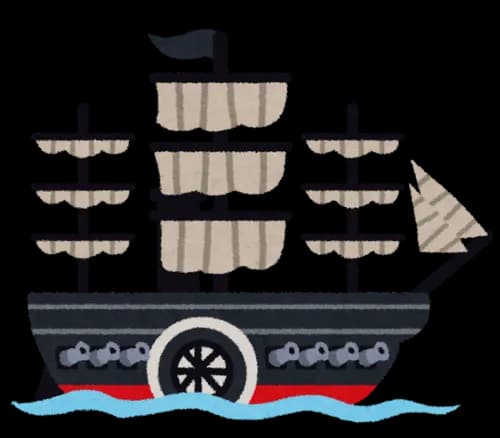
The shogunate, due to its military disadvantage, had no choice but to accept the U.S. demands. In 1854, it signed the Treaty of Peace and Amity between the U.S. and Japan.
Through this treaty, Hakodate and Shimoda were opened. This was Japan’s first official opening of ports in its history. However, it was an unequal treaty, and many terms were unfavorable to Japan.
After that, ports such as Nagasaki, Kobe, Niigata, and Yokohama were opened one by one, and foreign influence began to spread across Japan.
The Edo shogunate’s weak response to U.S. pressure disappointed domains across the country. Among them, the Satsuma Domain and the Choshu Domain promoted the Sonno Joi (Revere the Emperor, Expel the Barbarians) movement and called for overthrowing the shogunate.
In 1867, the shogunate returned political power to the Emperor through Taisei Hokan, but the shogunate system that had lasted for about 700 years did not collapse easily.
Although the Emperor regained authority in name, Tokugawa Yoshinobu and the Tokugawa family still held much real power.
The shogunate’s final war: the Boshin WarA civil war from Edo to Hakodate
Dissatisfied with the weakening of the Edo shogunate and the signing of unequal treaties, four New Government forces, including the Satsuma and Choshu domains, staged a coup, occupied Kyoto, and began pressuring the Emperor.
As a result, in January 1868, Emperor Meiji declared the Imperial Restoration Edict to Tokugawa Yoshinobu and demanded that he return governing authority.
Yoshinobu refused and delayed for time, relying on U.S. support, hoping the New Government forces would split internally. However, the New Government forces sent ronin to Edo and encouraged arson and killings to create public disorder. The Tokugawa side could no longer avoid armed conflict, and the Boshin War, the shogunate’s final war, began.
1) The battle in Kyoto and flight
Tokugawa Yoshinobu advanced toward Kyoto with 15,000 troops, but was defeated by 5,000 New Government troops armed with modern weapons.
He then fled, leaving troops behind at Osaka Castle, and returned to Edo. The New Government forces, who labeled Yoshinobu a traitor, secured support across the country.
2) The bloodless surrender of Edo Castle
After Yoshinobu’s retreat, Katsu Kaishu, Commander-in-Chief of the shogunate navy, and Saigo Takamori of the Satsuma Domain negotiated and achieved the bloodless surrender of Edo Castle.
However, some shogunate forces opposed this and resisted in Ueno and Utsunomiya, but they were suppressed by the New Government forces.
Shogunate-supporting domains in the Tohoku region formed the Ouetsu Reppan Alliance and continued resistance.

3) The founding of the Republic of Ezo
Enomoto Takeaki, Vice Commander of the shogunate navy, did not join the Ouetsu Reppan Alliance. After Yoshinobu’s safety was secured, he planned to establish an independent government in Ezochi (today’s Hokkaido).
After securing an additional 3,000 troops in Sendai, he landed in Hakodate and declared the “Republic of Ezo”.
However, due to bad weather, the main fleet ran aground. Then, as the ironclad “Kotetsu” was handed over from the U.S. to the New Government forces, Enomoto’s side became weaker at sea.
They tried a preemptive attack but failed, and the New Government forces advanced on Hakodate in earnest in the spring of 1869.
4) The end of the Boshin War
New Government strategist Kuroda Kiyotaka urged Enomoto to surrender.
Enomoto then gave Kuroda Bankoku Kairitsu Zensho, a book on international law that he had translated, and asked him to preserve the book. Moved by this, Kuroda sent sake and tuna in return.
Enomoto requested a ceasefire until the next morning, and finally accepted surrender. With this, the Boshin War, Japan’s last civil war, came to an end.
Why there are two “Date” cities in JapanA shared name created by migration and settlement
After losing the Boshin War, Date Kunishige (伊達邦成), a warrior of the Sendai Domain, had his territory of 240,000 koku confiscated and was granted only 58 koku of land. To survive, he asked the New Government for permission to migrate to Hokkaido.
The New Government approved it on the condition that he would keep only his samurai status with no compensation. Kunishige, his retainers, and about 2,800 family members then migrated to Hokkaido over 12 years.
They developed land once known as Monbetsu (紋別), introduced Western-style farming for the first time in Japan, and imported agricultural machinery from the U.S., laying the foundation for agricultural modernization. For these achievements, the Meiji government granted Kunishige the title of baron, and the village name was changed to Date-mura (伊達村).
Later, Date-mura was promoted to Date City (伊達市) in Hokkaido in 1972.
Meanwhile, in 2006, a Date City with the same name was created in Fukushima Prefecture. It was formed when several towns (町) where descendants of the Sendai Domain had settled were merged. With permission from Date City in Hokkaido, it even adopted the same kanji city name.
1) Connection to the Date Masamune family
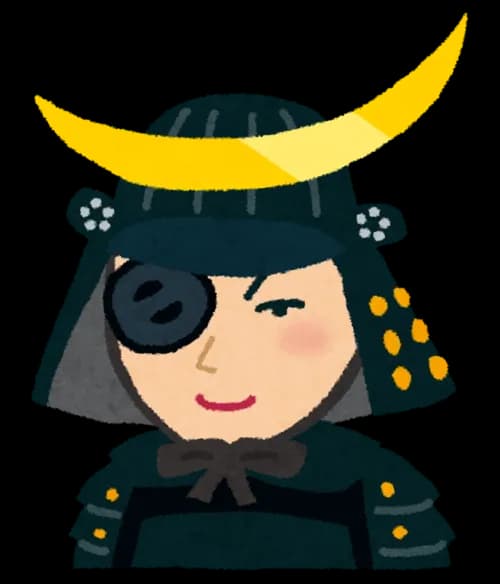
- Date Kunishige was the 14th head of the Watari Date (亘理伊達) branch, one line of the family of the Sengoku-era famous commander Date Masamune.
- Date Masamune is well known as a warlord with a crescent moon helmet. After the Battle of Sekigahara, Tokugawa Ieyasu allowed him to relocate his main castle, and he built Sendai Castle.
- Because of this, the Sendai Domain is often called the domain of the Date family (伊達家), and Masamune also participated in the Japanese invasions of Korea (Imjin War).
2) Other cases of cities with the same name
In Japan, there are other cities with the same name besides Date City. A well-known example is Fuchu City (府中市) in Tokyo and Hiroshima Prefecture.
Also note that Date City in Hokkaido and Date City in Fukushima are not sister cities.
The Hokkaido Development CommissionHow it connects to Principal Clark and “Boys, be ambitious!”
The Meiji government feared Japan could split into two countries. In 1869, it changed the name of Ezochi to Hokkaido and began full-scale settlement and development policies. This was a strategic response to counter Russia’s southward expansion.
In particular, it established the Development Commission in the Ishikari Plain, Hokkaido’s largest flat area, and appointed Kuroda Kiyotaka, who would later become Japan’s second Prime Minister, as Vice Director of the Commission.
- 1869 is considered the starting point of Hokkaido’s development.

Kuroda asked the U.S. for cooperation and invited the head of the U.S. Department of Agriculture and geologists to Hokkaido. They led Sapporo’s city planning for about three years.
As a result, Sapporo gained a neat, grid-style city layout. They also advised that, rather than rice farming, Western-style farming focused on field crops and livestock was more suitable.
Kuroda accepted this advice and invited American instructors by field to teach livestock farming to settlers. One of them was William Smith Clark, the first principal of Sapporo Agricultural College (today’s Hokkaido University).
After serving for eight months, he returned home and left the following message:
Principal Clark’s message
“Boys, be ambitious!
Be ambitious not for money or for selfish aggrandizement, not for that evanescent thing which men call fame.
Be ambitious for the attainment of all that a man ought to be.”Boys, be ambitious!
Not for fleeting things like money or fame,
but be ambitious for what a person should truly achieve.
Later, in 1876, the Development Commission established the Development Commission Beer Brewery and invested in the beer industry by developing its own varieties and collecting beer yeast from around the world.
In 1877, it released Sapporo Lager, Japan’s first beer, which later became today’s Sapporo Beer.
- The star in the Sapporo Beer logo also comes from the Development Commission’s flag.
Thanks to development centered on livestock and field crops that began during the Development Commission era, Hokkaido is now called Japan’s food basket. In particular, it is known for the following shares of national production:
- Beef: about 20% of Japan’s total
- Milk: 50%
- Potatoes: 80%
- Soybeans: 90%
The Ainu people todayFrom a history of discrimination to cultural preservation
Along with the establishment of the Development Commission, the Meiji government promoted migration policies, and in 1899 it enacted the Former Aborigines Protection Act. It was officially a protection law, but in reality it was a discriminatory policy under the name of assimilation.
Under this law, the Ainu people lost their land, were banned from using their language, and were forced to adopt Japanese-style names. Even their traditional customs were restricted.
The Ainu people had lived by hunting for centuries, but even hunting was prohibited. The land given by the government was also useless for people with no farming experience. As a result, many sold their land to Japanese people at very low prices.
In this situation, the Ainu people gradually declined and were mobilized for forced conscription, forced labor, and human experimentation, and women also faced discriminatory treatment.
The term Former Aborigines (舊土人) originally meant people who originally lived on this land, but it was used to distinguish them from mainland Japanese and encouraged normalized discrimination.
Some Japanese anthropologists at the time considered the Ainu people as “an under-evolved form of humans”, and at one point Japanese textbooks even included statements like In Hokkaido, there were only bears and Ainu, not people.
The Ainu people experienced discrimination from childhood, and even as adults they faced disadvantages across society, including marriage and employment.
In 1994, change began when Kayano Shigeru, the first Ainu member of the National Diet, appeared. He compiled an Ainu language dictionary and worked to protect Ainu identity.
As a result, in 1997, the Former Aborigines Protection Act was abolished, and the Ainu Culture Promotion Act was enacted.
However, even through this process, the Japanese government made no official apology even once, and only in 2019 did it recognize the Ainu people as Indigenous.
Because this happened soon after Russia’s President Putin visited the Kuril Islands and declared the Ainu people as Indigenous people of Russia, some critics argue that Japan recognized them quickly due to concerns about territorial disputes.
Today, the number of Ainu people in Japan is estimated at about 13,000, and only two people are said to be able to speak the Ainu language.
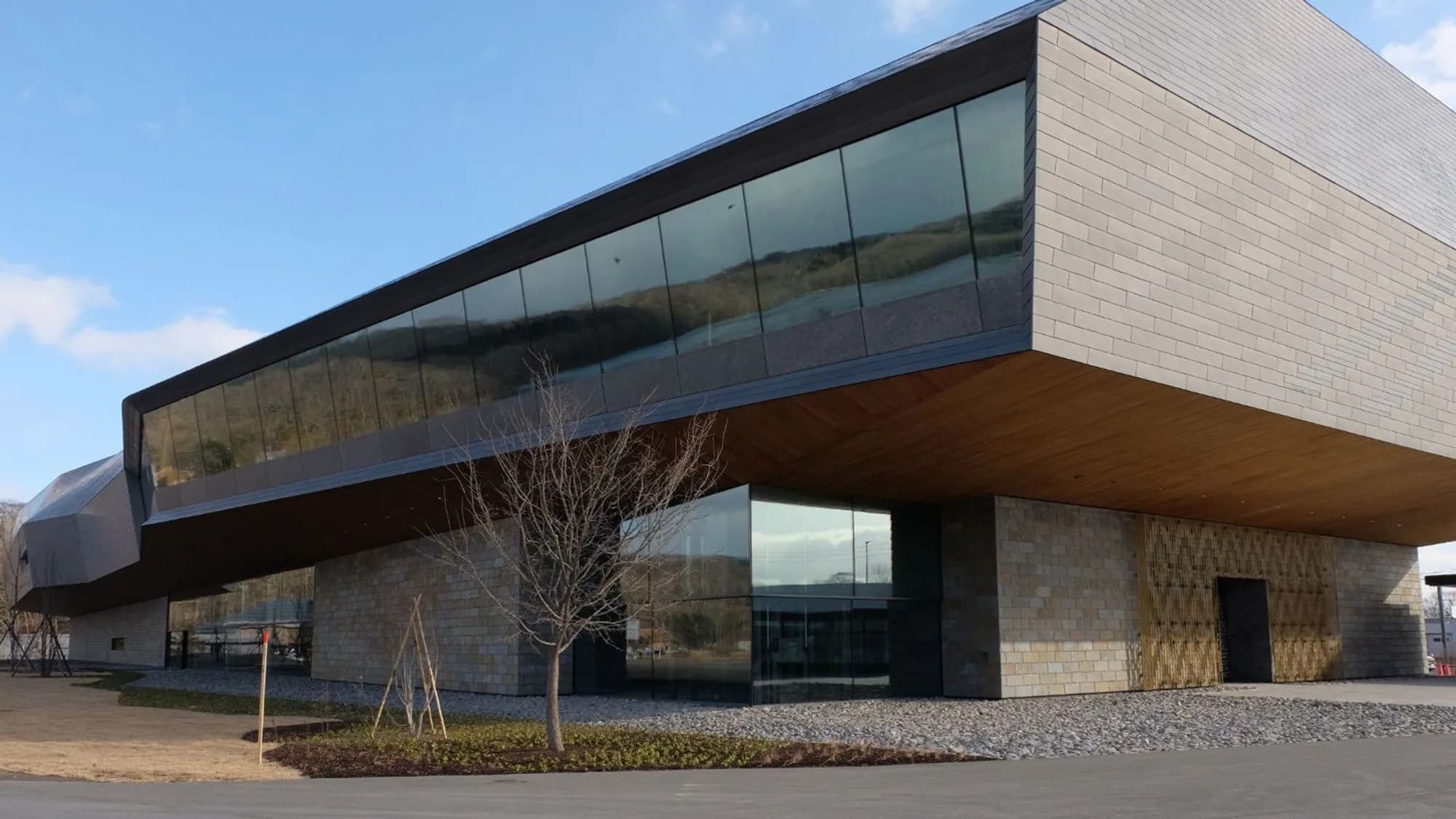
Recently, efforts to preserve Ainu culture have continued, including the establishment of the National Ainu Museum. Descendants are also working to protect their culture with pride.